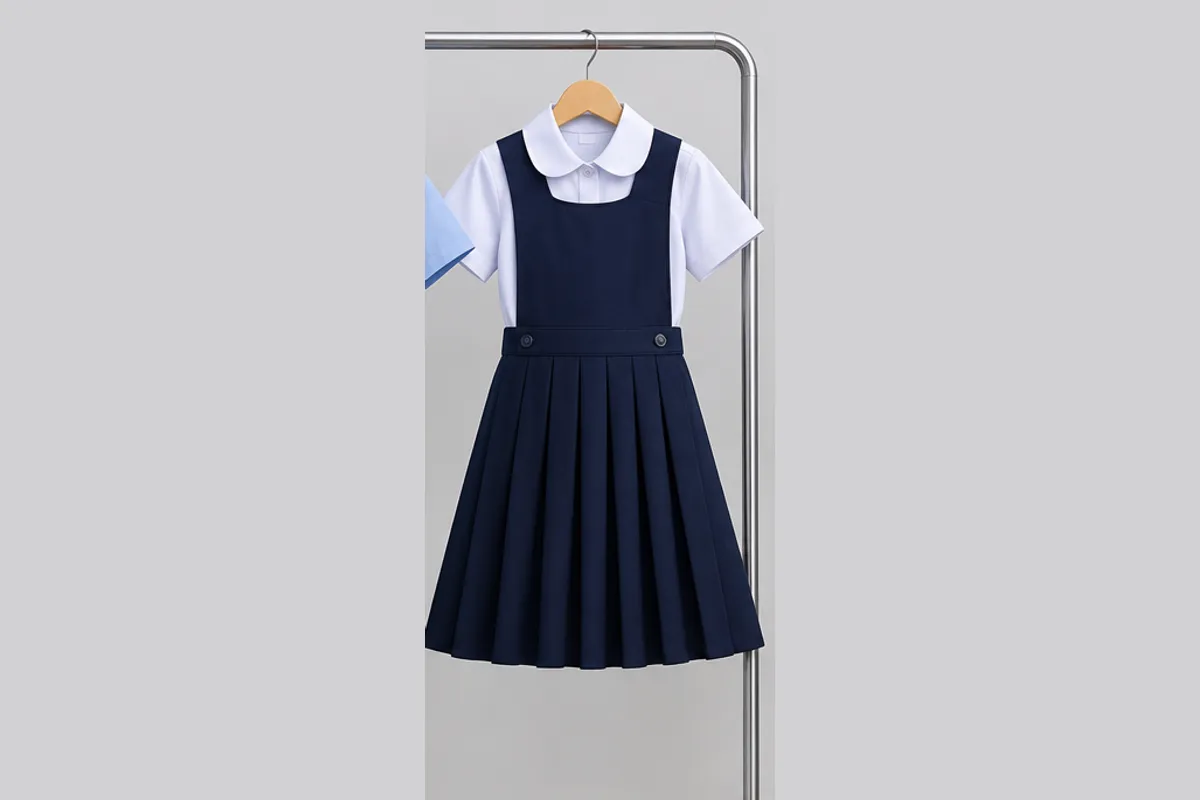
Pinafore fabric weight is how heavy the woven cloth is for its area, and it shapes how warm the pinafore feels, how the pleats hang, how firm the bib or bodice is and how long it takes to dry. Most schools use a single medium weight for pinafores all year, with layers added in winter and a summer dress replacing the pinafore in warm terms. Judge the weight by handling a swatch and the sample beside your existing garments, rather than by a number alone.
What weight changes on a pinafore
| Feature | Lighter cloth | Heavier cloth |
|---|---|---|
| Warmth | Cooler, comfortable in mild weather | Warmer, better in cold classrooms |
| Pleats | Fall softly; can open out | Hang straighter and heavier |
| Bib and bodice | Need facings or lining for shape | Hold shape on their own |
| Movement | Lighter, more swing | Steadier, less flapping in wind |
| Drying | Faster | Slower |
| Small children | Easier to move in | Can feel stiff on the youngest |
Neither end is right for every order. A very light cloth looks flimsy on a pleated pinafore, and a very heavy one is stiff and slow to dry.
One weight or two?
Some buyers ask whether to carry a winter pinafore and a summer pinafore. In practice, few schools do. The common pattern is:
- Autumn and winter terms: pinafore over a long-sleeve blouse, with a cardigan or jumper and tights.
- Summer term: a gingham or striped summer dress instead of the pinafore, or the same pinafore over a short-sleeve blouse.
Because the pinafore’s warmth comes mostly from the layers worn with it, one medium weight usually works across the year. If your school is in a hot climate and keeps the pinafore all year, a lighter cloth may suit better; tell us and we suggest options at quotation.
Weight and the two fabrics we use
Both poly-viscose and polyester twill come in a range of weights. Twill weaves are often a little denser for their weight, giving a firm feel. Poly-viscose of a similar weight usually feels softer and drapes more.
We do not quote weights as a performance promise. Instead, the swatch we send for colour approval also lets you feel the cloth, and the sample shows how it behaves as a finished garment.
How to judge weight without a lab
You do not need equipment to compare cloths. With the swatch and sample in hand:
- Hold the swatch against your current pinafore or skirt. Is it noticeably thinner, thicker or about the same?
- Fold it. A heavier cloth resists folding and springs back; a lighter one creases flat.
- Hold it up to the light. A light cloth shows more light through the weave.
- Look at the sample pleats. Do they hang straight, or flare out?
- Feel the bodice. Does it sit flat without wrinkling?
If you want the new pinafore to match one you already sell, send that garment. We match the fabric type and suggest a cloth of similar weight. Our fabrics and colour matching page explains how existing garments are matched.
Specifying weight on your enquiry
Write something simple, such as “same weight as our current pinafore”, “medium weight, all-year” or “lighter for a warm climate”. We manufacture in India and confirm the fabric in the quotation, then show it to you on the swatch and sample. The styles are on our school pinafores and tunics page, from 50 pieces per style, and each quotation is per style, by fabric, quantity and branding.
Questions buyers ask
Does a heavier pinafore last longer?
Not automatically. Wear depends on the weave, the fibre and the construction as much as on weight. A well-made medium cloth with good seams can outlast a heavier one that is poorly sewn.
Should tunics be heavier than pinafores?
They are often cut from the same cloth so they match. A tunic is longer, so it already feels a little heavier as a garment; there is rarely a need for a heavier fabric as well.
Can the pinafore weight match the school skirt exactly?
We match the fabric type and look for a cloth of similar weight. Send the skirt, and when the swatch arrives compare the two in your hands before approving.