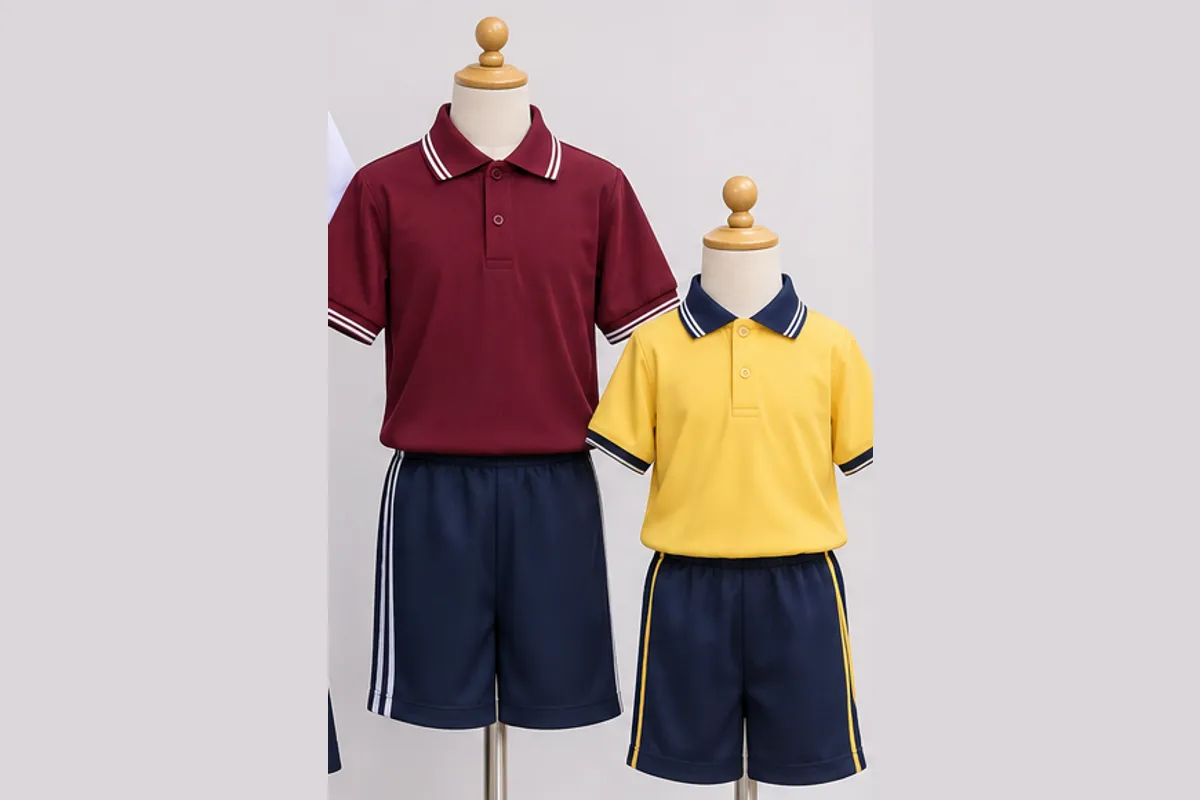
The PE shorts leg opening is the hem at the bottom of each leg, and its shape decides how freely students can run and how the shorts look. The usual choices are a straight hem, a straight hem with small side splits, or a curved hem cut higher at the sides. Along with the leg width and the length, the opening is set on the sample and repeated in every size.
Getting it right matters most for older students, where a tight or awkward hem is noticed at once.
Three common leg opening shapes
Straight hem
The leg ends in a level, turned-up hem. It looks neat, suits all ages and is the simplest to make. On a fairly fitted leg, a straight hem can restrict long strides slightly.
Straight hem with side splits
A short split, or vent, at the outside of each leg lets the hem open when the student moves. The top of each split is usually bar-tacked or reinforced so it does not tear further. This is a practical choice for running and field games.
Curved hem
The hem rises at the side seam in a gentle curve, like athletic running shorts. It gives the most freedom and a sporty look. It shortens the side length, so the front and back need enough length for the school’s expectations.
| Shape | Freedom of movement | Look | Suits |
|---|---|---|---|
| Straight hem | Good on a loose leg | Plain, neat | All ages, daily PE |
| Straight with side splits | Better | Sporty but modest | Juniors to seniors |
| Curved hem | Most freedom | Athletic | Older students, running |
How long should the leg be?
Length depends on the school, the climate and the age group, so there is no single answer. A few general principles help:
- For young children, a leg that ends mid-thigh keeps the shorts practical without being too short.
- For older students, many schools prefer a longer leg, especially where modest dress is expected.
- Length should grow in proportion with the size, not by a fixed amount, so each size looks right.
Your size chart is the reference. If you are matching shorts you already sell, send a pair in two or three sizes, and we measure the side length and inseam from them.
Hem finishes
A leg opening also needs a finish:
- Twin-needle hem. Two parallel rows of stitching. Common on knitted shorts and flexible enough to stretch.
- Coverstitch hem. A stitch designed for knits that looks like twin needle outside and covers the raw edge inside.
- Contrast hem band. A separate band of fabric, often in a contrast colour, sewn to the opening.
The hem must stretch with the knit. A stitch that cannot stretch will crack when the leg is pulled.
What to give us for the leg
- Opening shape: straight, split or curved
- Side split depth, if chosen
- Target side length or inseam per size, or a reference pair
- Leg width at the hem, if you have a preference
- Hem finish and any contrast band colour
- Whether all sizes share one shape
We make PE shorts in polyester knit with an elastic waist, and the leg is agreed on the sample before bulk production. The rest of our range, from T-shirts to sports polos, is on our PE kit and sports uniforms page.
Distributors supplying several schools with different expectations can keep one leg shape per school as separate styles. Our page for schoolwear suppliers and distributors explains how that works. Send us the leg details or a reference pair, and we will quote by fabric, quantity and branding.
Questions buyers ask
Do side splits weaken PE shorts?
Not if the top of each split is reinforced with a bar tack or a few rows of stitching. That small detail stops the split from opening further. Check it on the sample by gently pulling the hem apart.
Can junior and senior shorts have different leg shapes?
Yes, though they become separate styles, each needing its own quantity. Many schools keep one shape for all sizes and adjust only the length, which is simpler to stock and reorder.
What leg width suits PE shorts?
A leg loose enough for running but not flapping is the general aim. If you have shorts your customers like, send them; matching a known width is more reliable than describing one.