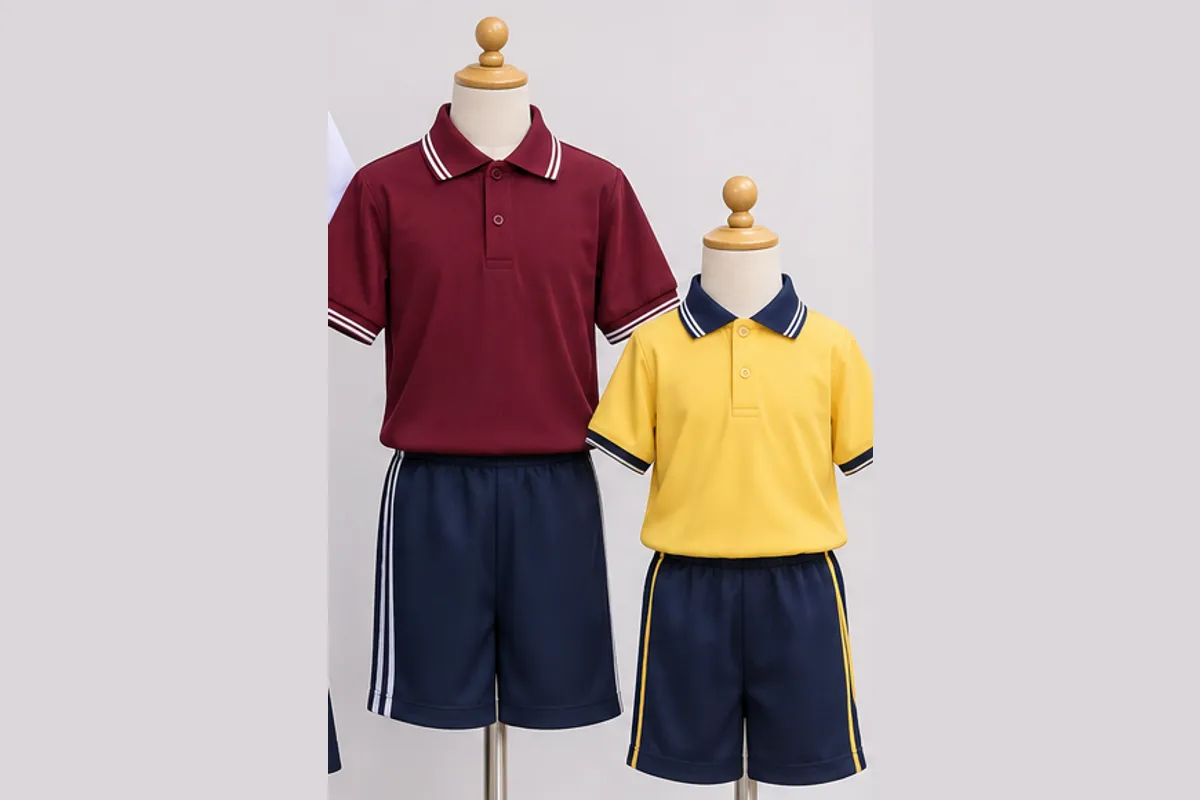
PE shorts with a liner have an extra inner layer, either a brief-style lining or a short inner pair of shorts, sewn in at the waistband. Most school PE shorts do not need one: a plain pair of polyester knit shorts worn over normal underwear does the job. A liner is worth discussing when the shorts are short and loose, when students change at school, or when parents have raised modesty concerns.
A liner is a specification choice, raised at quotation and judged on the sample. It changes the garment enough that it should be decided early.
What counts as a liner?
Two kinds are common in sportswear:
- Brief liner. A light inner lining shaped like a brief, attached at the waistband. It sits close to the body under loose outer shorts.
- Inner short. A short, closer-fitting pair of shorts attached at the waist, ending a little above the hem of the outer shorts. This is the same idea as the inner short in a skort.
A third approach avoids a liner altogether: making the outer shorts a little longer or less loose, so cover is not an issue.
Arguments for and against
| Consideration | Without a liner | With a liner |
|---|---|---|
| Making | One layer, simple | Two layers joined at the waist |
| Washing and drying | Dries quickly | More fabric, slower to dry |
| Cover during games | Depends on length and cut | Extra cover under loose shorts |
| Fit across ages | Easy to grade | Inner layer must fit each size |
| Families’ expectations | Familiar | Expected by some for older students |
| Quotation | Simpler | Adds fabric and making |
For junior classes, the case for a liner is weak. Children grow quickly, kit is replaced often, and a simple pair of shorts is easier to dress in.
For older students, especially where shorts are cut short for running, some schools find a liner or inner short answers families’ concerns without changing the outer look.
Alternatives to a liner
Before adding a second layer, consider whether a change to the outer shorts gives the same result:
- A slightly longer leg. A few centimetres more length changes cover more than most people expect.
- A less flared leg opening. A straighter cut sits closer to the leg during movement.
- A separate garment. Some schools let students wear their own close-fitting shorts underneath. Those are sourced by families, not part of our order.
These options keep the shorts as one layer, which keeps the price and drying time down.
If you decide on a liner
Settle these points at quotation:
- Liner type: brief style or inner short
- Liner fabric and colour, usually matching or darker than the outer
- Inner short length, if chosen, relative to the outer hem
- Which sizes take the liner, and which do not
- How the liner is joined at the waistband
- Care label wording that covers both layers
If only senior sizes have a liner, that becomes a separate style. Our minimum for PE kit is 100 pieces per style, with sizes mixed inside it.
Checking the sample
Try the sample on students of different sizes if you can, or measure it carefully against your size chart. Check that the liner does not pull the outer shorts out of shape, that the waist joins lie flat, and that both layers recover after a wash. The PE shorts, T-shirts and polos we make are listed on our PE kit and sports uniforms page.
If you are a school deciding kit policy, our page for schools and school groups explains how we work with schools directly. We manufacture in India, and every quotation is per style, by fabric, quantity and branding. Send your shorts specification, with or without a liner, and we will prepare one.
Questions buyers ask
Do lined PE shorts need a different size chart?
The outer measurements stay as your size chart sets them. The liner is cut to fit inside each size, and its own measurements are recorded on the approved sample so reorders match.
Can a liner be added to shorts we already sell?
Yes, if you send the current shorts, we can make a sample with a liner added. You can then compare both versions side by side before deciding whether to change the specification.
Does a liner make PE shorts harder to wash?
Not harder, but slower to dry because there is more fabric. Families should turn the shorts inside out on the line so the liner dries properly. Include that tip in any care note.