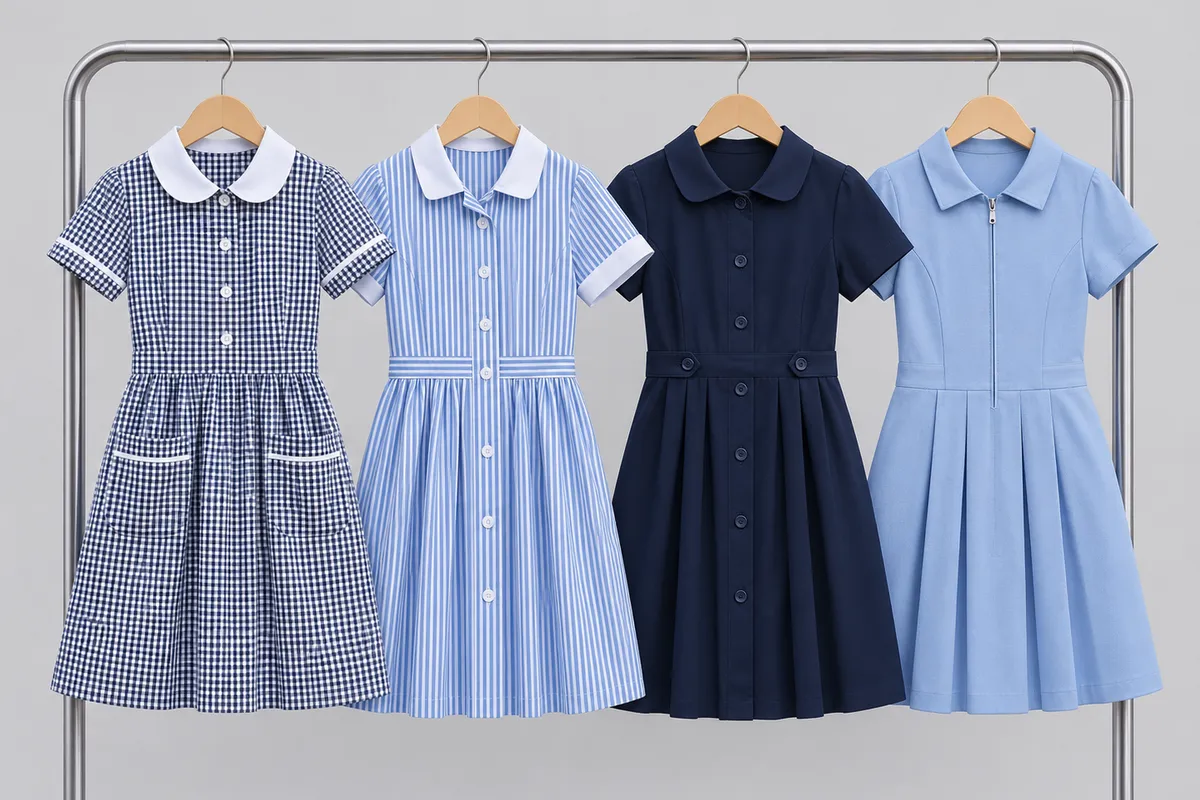
When a school gives every student a uniform choice of skirt or trousers, the order can no longer be split by the number of girls and boys. The school has to estimate how many students will pick each garment, size those quantities separately, and hold a margin on both until the real pattern of choice is known. A first order based on a careful estimate, followed by an early reorder, handles the uncertainty well.
This guide is about the planning side of an open-choice list. It assumes the school has already decided to describe garments by name, such as “trousers” or “pleated skirt”, rather than by who wears them.
Why does an open choice change the order?
On a list split by gender, each garment’s quantity follows the roll. On an open-choice list it follows preference, which is harder to predict and can shift between year groups. A few things tend to happen:
- Trousers are often chosen by a wider spread of students than a skirt.
- Choice can change with the season, with some students wearing trousers in winter and a skirt or summer dress in warmer months.
- Older students may choose differently from younger ones.
- A new style, such as a skort, can draw students from both garments.
None of this is a problem once the school knows its own pattern. The first year is the one that needs care.
Estimating the first split
Start from what you know, then build in room to adjust.
| Source of information | How to use it |
|---|---|
| Last year’s uniform shop or office sales | The real number of skirts and trousers bought by each year group |
| A short question on the admissions form | Ask families which garments they expect to buy, in which size |
| Comparison with a similar school | A rough guide only, because every school differs |
| A sample display at a parents’ evening | Ask families to note their choice next to each garment |
Use the most reliable figure you have. If nothing is available, an even starting split with a modest margin on each garment is a reasonable place to begin, adjusted as soon as early sales come in.
Sizes within each garment
Trousers and skirts in an open-choice list may need a wider size range than before. A trouser that previously served mainly one group now needs sizes and fits for everyone who chooses it. Many schools list a regular-fit trouser and a girls’ cut trouser as separate styles, and let students choose either. A skirt may need longer lengths for taller students.
We make school trousers and shorts in regular and slim fit, girls’ trousers and an elastic-back waist, and school skirts and skorts in pleated, A-line, check and skort styles. Each style is ordered separately. Our minimum for woven garments is 50 pieces per style, and sizes can be mixed within a style.
Planning the first reorder
The first term of an open-choice list tells you more than any estimate. Plan for it:
- Record sales of each garment by size and year group from the first week.
- Note which sizes run out first in each garment.
- Place a reorder once the pattern is clear, rather than waiting for the next school year.
- Keep the reorder on the same approved sample so the garments match.
- Adjust next year’s opening split using this year’s real figures.
Lead time is confirmed in the quotation. Since the first reorder may be needed mid-year, ask about timing when you place the opening order. Our how to order page sets out each step from enquiry to dispatch.
Writing the list so the choice is clear
Families need to see the choice in plain words. List each garment once, with its options:
- Trousers: regular fit or girls’ cut
- Skirt: pleated, in the school grey
- Skort: optional alternative to the skirt
Avoid listing garments under “girls” and “boys” headings if the choice is open. It makes ordering and stock records simpler too, because each item is recorded once.
If you are moving to an open-choice list and want a quotation, send us the garments, your estimate of the split and your size range, and we will quote each style.
Questions buyers ask
Should a school still offer a girls’ cut trouser?
Many do, because a trouser cut with a different waist-to-hip shape fits some students better. It can sit on the list as one of two trouser fits, open to anyone, rather than as a garment for one group.
How large should the margin be on a first open-choice order?
There is no fixed figure. A school with good sales data needs a small margin. A school starting without data may hold a little extra in middle sizes of both garments and reorder once the first weeks of sales show the true pattern.
Does an open choice increase the number of styles?
Not always. Many schools already list trousers and a skirt. The change is in how quantities are split and how the list is worded. Adding a second trouser fit or a skort does add a style, each with its own minimum.