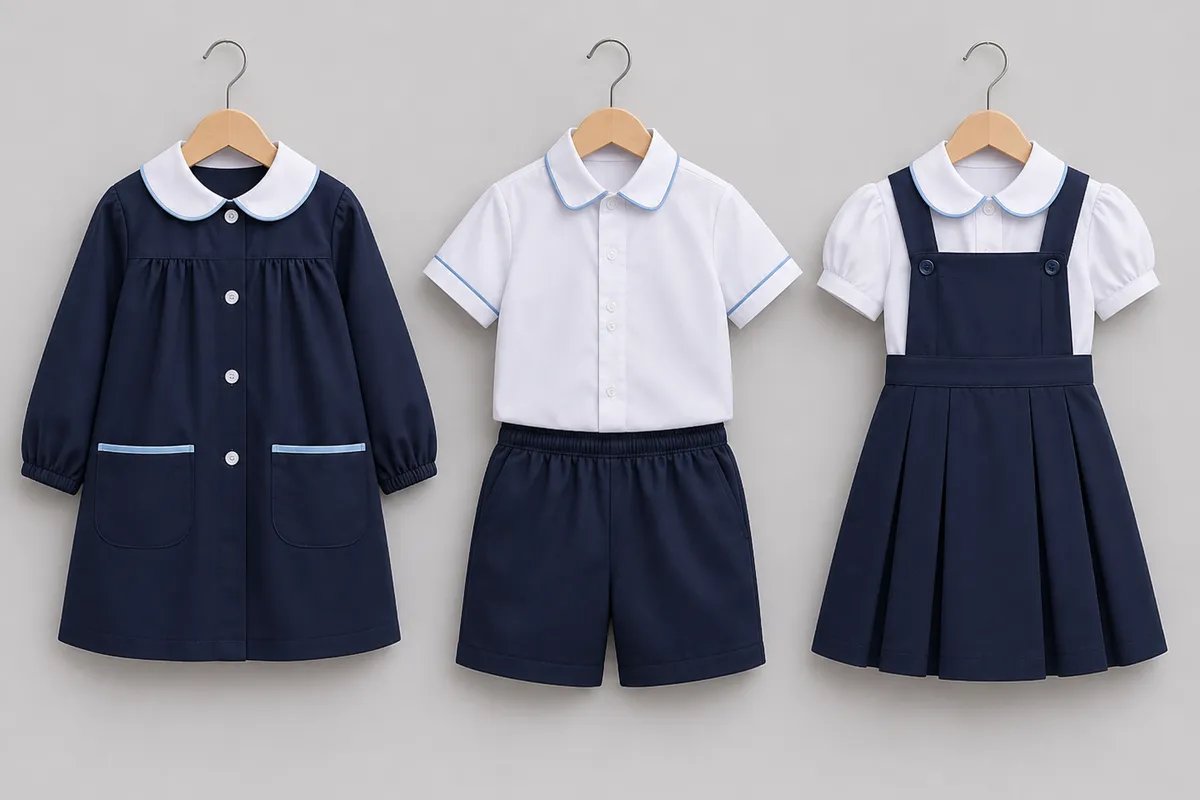
Nursery children outgrowing uniform partway through the year is expected, not a sign that the first order was wrong. Between two and six, many children move up a size within twelve months, so a nursery or shop should plan a growth top-up in the next size up rather than hope the first issue lasts. The aim is to have the larger sizes on hand before families start asking for them.
How do you know a child has outgrown their nursery uniform?
Staff usually notice before parents do, because they see children reaching, climbing and sitting on the floor all day. The signs differ by garment.
| Garment | Signs it is too small | Usually the first thing to go |
|---|---|---|
| Smock | Pulls across the back when arms lift; fastening strains | Width over winter layers |
| Shirt | Untucks or rides up at the back; cuffs above the wrist | Body length |
| Elastic-waist shorts | Waist marks on the tummy; legs ride up when sitting | Rise and seat room |
| Pinafore | Hem well above the knee; armholes tight | Length from shoulder |
| Blouse | Buttons gape at the chest; sleeves short | Sleeve length |
Length nearly always goes before width at this age. That is why a garment can look fine at the chest while clearly being too short.
When in the year does outgrowing happen?
If uniform is issued at the start of the school year, the first wave of children needing the next size usually comes in the second half of the year. In a September-start setting that tends to be from early spring; in a January-start setting, from around mid-year. A second, smaller wave follows just before the year ends, when some families decide to buy rather than wait.
Two groups move up sooner:
- The youngest children in each room, because growth is fastest at two and three.
- Children who were issued their exact age size rather than one band up.
Planning a growth top-up order
A growth top-up is a second order placed mainly in the upper sizes, so children who have outgrown their first set can move up. It is different from a top-up for new starters, which is mostly in the smaller sizes. Plan it like this:
- Record the size issued to each child at the start of the year.
- Shift everyone up one band on paper and count how many would now need each size.
- Estimate the share who will actually buy a new set this year rather than next. Use your own sales history once you have it.
- Check the minimum. Nursery styles start at 50 pieces per style, with sizes mixed. A growth top-up for one room may be small, so combining it with new-starter sizes or another style keeps it workable.
- Count back from when you need the stock. Lead time is confirmed in the quotation, so place the order early enough to arrive before the spring wave.
Repeat orders follow the approved sample and the agreed size chart, so a larger size bought mid-year matches the garments already in the room. Our size charts page explains how those measurements are fixed.
Ways to reduce mid-year size changes
Outgrowing cannot be avoided, but it can be smoothed.
- Issue one band up at the start of the year. A slightly roomy smock or set at the start lasts much longer.
- Keep the elastic waist generous. Full elastic-waist shorts adapt to a growing child better than a fixed waist.
- Run a swap shelf. Many nurseries collect outgrown, clean uniform and pass it to younger children, which cuts demand for the smallest sizes.
- Talk to families early. A note at the start of spring term reminding parents to check sizes spreads demand over several weeks instead of one rush.
You can see the styles that make up most nursery uniforms on our nursery and kindergarten uniforms page. Send us your issue record and the sizes you expect children to move into, and we will quote the top-up per style, by fabric, quantity and branding.
Questions buyers ask
Should a nursery replace the whole set when a child outgrows one piece?
Not always. Shirts and pinafores often go before shorts or smocks. If you stock pieces separately, families can replace only what no longer fits, which also lets you order the outgrown garment in the larger size without buying matching bottoms.
How much extra stock should a shop hold in the next size up?
Start with a small buffer in the two upper sizes, judged against how many children the shop supplies in each room. Adjust after one year, using actual mid-year sales rather than a fixed rule.
Does a growth top-up have to match the first order exactly?
Yes, if it is made to the same approved sample and size chart. Quote the sample reference and order date when you reorder, and the larger sizes will match the colour, fabric and logo already in use.