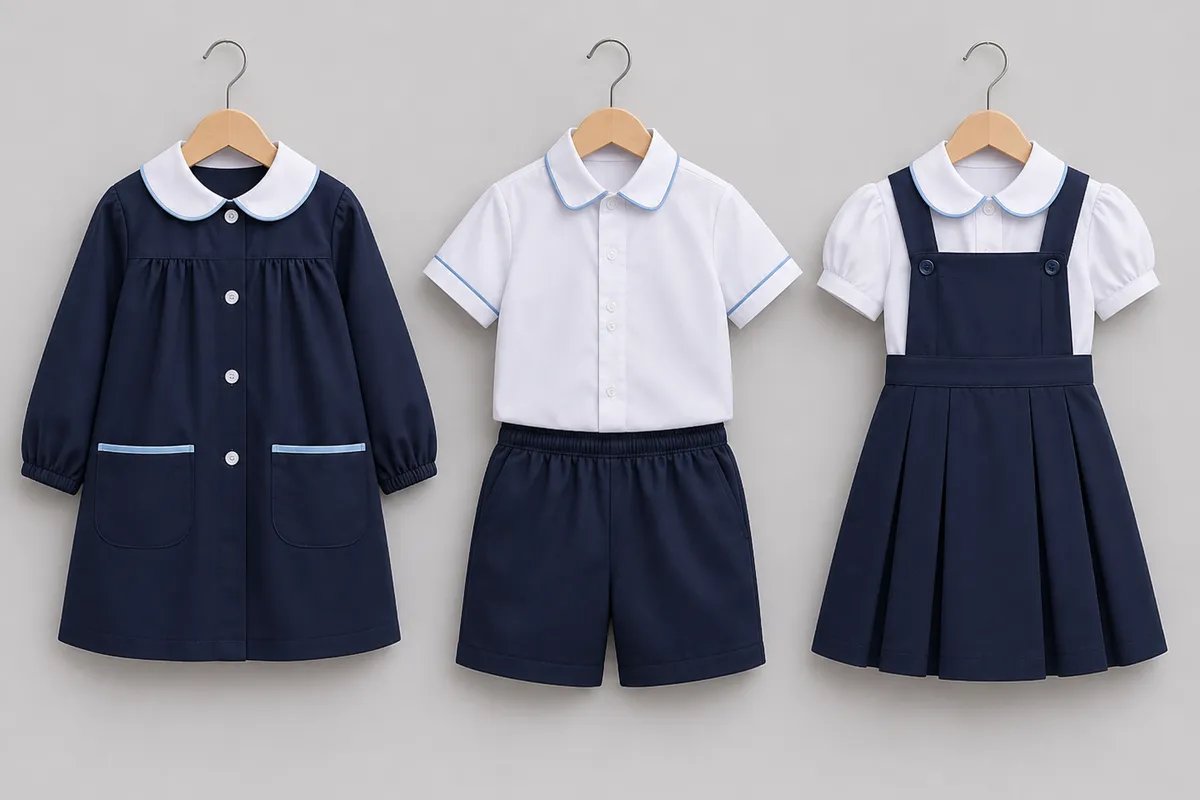
Nursery uniform fabric weight describes how heavy and dense the woven cloth is for its area. Lighter fabrics feel airy and drape softly, which suits shirts, blouses and summer smocks; heavier fabrics feel more substantial and hold their shape, which suits pinafores, shorts and smocks that see rough play. Weight is not a quality score on its own: the right weight depends on the garment, the climate and how the uniform is used, and it is judged on the sample.
How fabric weight is described
Woven fabric weight is often given as grams per square metre (GSM). A higher number means more fibre in each square metre. Buyers do not need to quote a figure; describing the weight by comparison works just as well:
- “Like our current smock, but a little lighter.”
- “Shirt-weight for the top, heavier for the shorts.”
- “Light enough for a hot classroom.”
Where a figure is given in a quotation, treat it as a description of the fabric chosen, not a promise about how the garment will perform.
Typical weight choices by garment
| Garment | Usual direction | Reason |
|---|---|---|
| Shirt or blouse | Lighter | Sits next to the skin; collar and front lie softly |
| Shorts | Medium to heavier | Takes knees, floor sitting and climbing |
| Pinafore | Medium to heavier | Holds its shape and hangs well over a blouse |
| Smock, everyday | Light to medium | Worn over clothes, so does not need much body |
| Smock, art cover | Medium | More coverage and body for messy play |
A set often combines weights: a lighter top with a heavier bottom. That is normal, and each piece is matched to its colour separately.
What weight changes in the garment
Drape. Lighter cloth falls close to the body; heavier cloth stands away a little. A smock in a heavier cloth looks fuller.
Coverage. A light-coloured fabric in a light weight can show what is underneath. That matters for white blouses and pale smocks, so hold the sample up to the light.
Comfort in heat. Lighter fabrics generally feel cooler in warm classrooms.
Construction. Heavier fabrics make thicker seams and hems. On small garments, that can make collars and plackets feel bulky, so the pattern sometimes needs adjusting.
Ironing. Heavier cloth often hangs out more creases on its own; very light cloth can crease easily.
Weight and fibre together
Weight and fibre interact. A poly-cotton and a cotton of similar weight can feel quite different: the blend often smoother, the cotton softer and more matt. When comparing options, compare like with like, and judge both on the sample.
For nursery styles we offer poly-cotton and cotton; the fabrics and colour matching page sets out every garment’s options.
Choosing weight for your order
- Note the climate: hot all year, mixed or cool
- Decide whether the top and bottom should differ in weight
- Check light colours for show-through on the sample
- Feel collars and plackets for bulk
- If you have a garment with the right feel, send it as the reference
If you already have a smock or set whose weight is right, send it; we match the fabric type, weight and colour as closely as we can and show you the result on the sample. The garments are on our nursery and kindergarten uniforms page.
We manufacture nursery uniforms in India and choose fabric weights with each buyer. Describe how the garments will be worn, or send one you like, and we will quote and sample in that weight.
Questions buyers ask
Is a heavier fabric always more hard-wearing?
Not necessarily. Weight is one factor; weave, fibre, construction and care all matter too. A medium-weight fabric well sewn can outlast a heavier one poorly made, so judge the whole garment on the sample.
Can the summer and winter versions use different weights?
Yes. A lighter version for warm months and a heavier one for cooler months is a common approach. Each weight is treated as a separate style for the minimum order and quotation.
Should we specify GSM in our enquiry?
You can if you know the figure you want, but it is not required. A description or a reference garment is enough for us to suggest a fabric, which you then judge on the sample.