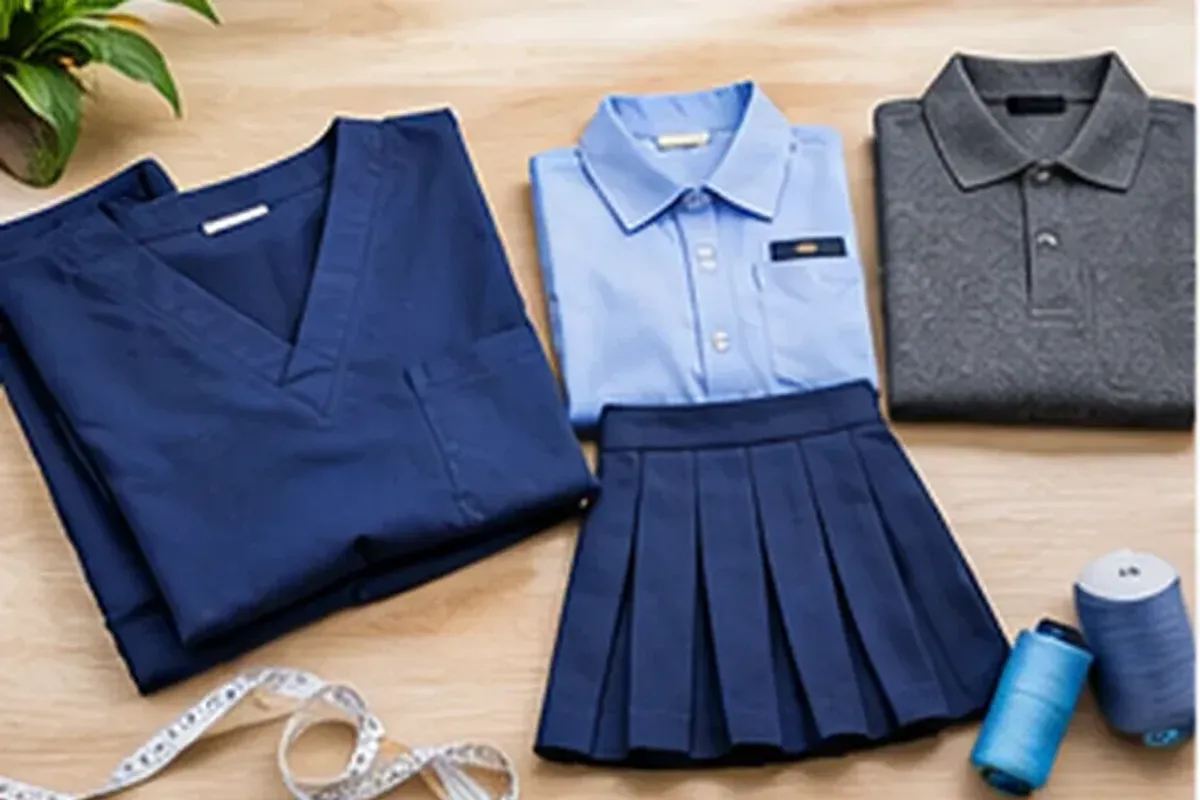
When labelling uniforms for several schools in one order, the aim is that every garment, polybag and carton can be traced to its school without anyone opening a box. That means a school code on the polybag sticker, a school name on the carton label, and a clear order sheet that lists each school’s styles, badges and sizes separately. The garment’s own neck label can stay the same across schools; the badge on the outside and the sticker on the bag do the sorting.
Why multi-school orders go wrong
A uniform shop or supplier often combines several schools into one order to make the minimums work and to receive one shipment. Most problems come from items that look alike:
- grey sweatshirts for three schools with badges that differ only in colour
- white polos for two schools with similar crests
- plain trousers that belong to no school and every school
- cartons that hold several schools’ stock mixed together
Without clear labelling, staff spend days sorting stock when it arrives, and mistakes reach families.
A labelling scheme that works
Set up a simple scheme before the order is placed, and use it on every layer.
| Layer | What it shows | Example |
|---|---|---|
| Garment badge | The school’s logo | Embroidered or printed per school |
| Neck or waistband label | Your brand and size | Same for every school |
| Polybag sticker | School code, style, colour, size | PPS / POLO / NAVY / 9–10 |
| Carton label | School name, style, sizes and quantities inside | Placeholder Park School, navy polo, mixed sizes |
| Order sheet | Each school’s lines listed separately | One section per school |
A short school code, two to four letters, saves space on stickers. Write the full list of codes on your order sheet so everyone uses the same ones.
Plain items in a multi-school order
Plain garments, such as grey trousers or white shirts, are often shared across schools. Decide how to label them:
- As shared stock. Sticker shows style, colour and size only, with no school code. Cartons are packed by style and size.
- Allocated by school. Sticker carries a school code even though the garment is plain, because the shop has already allocated quantities to each school’s sales.
The first suits a shop that sells plain items over the counter. The second suits a supplier delivering directly to each school.
Steps to plan the labelling
- List the schools in the order, with a code for each.
- List each school’s styles, noting which carry that school’s badge and which are plain.
- Confirm each badge with artwork, size and position. Logo embroidery or printing is available, and each school’s badge is confirmed on its own sample.
- Choose one neck label for your brand, or decide whether any school needs its own label.
- Set the sticker format, including the school code.
- Set the carton rule: one school per carton, or mixed cartons with a contents list.
- Check quantities: 50 pieces per woven style and 100 per knitwear or sportswear style, with sizes mixed within a style.
The carton rule is the decision that saves most time on arrival. One school per carton is easier to receive; mixed cartons may be needed when one school’s quantity of a style is small.
A pre-order checklist
- School codes agreed and listed
- Each school’s badged styles and plain styles separated
- Artwork and badge details sent for every school
- Neck label artwork sent, if you use your own label
- Polybag sticker layout agreed
- Carton packing rule chosen
- Order sheet laid out school by school
Our page for schoolwear suppliers and distributors explains how we quote orders that cover several schools. Polo shirts are the garment most often ordered for many schools at once; see our school polo shirts page. Label and packing options are summarised on our logos, embroidery and labels page.
We manufacture in India and pack each order to the buyer’s labelling scheme. Send your school list, codes and styles, and we will prepare a quotation for the whole order.
Questions buyers ask
Can different schools share one neck label in the same order?
Yes, and most shops do. The neck label carries your brand and the size, while the badge on the outside identifies the school. Using one label across schools keeps label stock simple and makes your range look consistent.
Should each school’s stock be packed in separate cartons?
Separate cartons per school make receiving faster and reduce sorting mistakes. Where a school’s quantity of a style is too small to fill a carton, a mixed carton with a clear contents list on the outside is a workable alternative.
What if two schools have almost identical badges?
Make the difference visible on the packaging. A distinct school code on every polybag sticker, and separate cartons for each school, stop similar garments being mixed. Check both badges side by side on the samples as well.