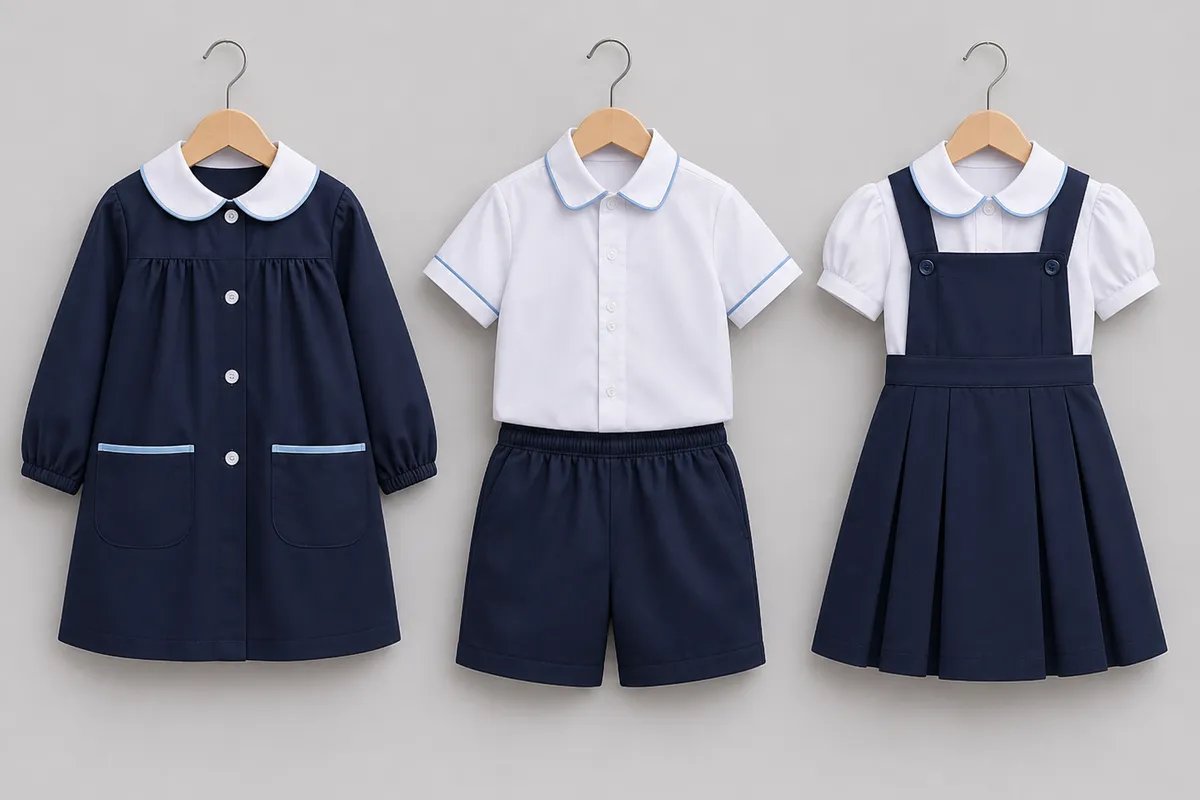
A kindergarten uniform size chart lists the finished garment measurements for each age band in your range, garment by garment, so every reorder comes back the same. For small children the chart needs fewer points than a senior uniform, but each one matters more: chest width, body length, sleeve length and, for shorts, the waist measured both relaxed and stretched.
This guide sets out what to put on the chart, how to agree it with your manufacturer, and the mistakes that make a chart hard to use later.
What should a kindergarten uniform size chart include?
Each garment in a kindergarten set has its own chart. A smock chart and a shirt chart may share a column for chest, but they are cut differently and should not be merged. The points below are the ones buyers most often agree for early years garments.
| Garment | Measurement points to agree | Why it matters for small children |
|---|---|---|
| Smock | Half chest, back length, sleeve length, neck opening | The smock goes over clothes, so width and length decide whether it covers them |
| Shirt (set) | Half chest, body length, sleeve length, collar or neck width | A shirt that rides up at the back is the usual complaint |
| Elastic-waist shorts | Waist relaxed, waist stretched, hip, outside leg, leg opening | Small children pull shorts on alone, so the stretched waist must pass over the hips |
| Pinafore | Half chest, length from shoulder, hem width | A narrow hem restricts climbing and sitting on the floor |
| Blouse (pinafore set) | Half chest, body length, sleeve length | It must sit under the pinafore without bunching |
Garment measurements are taken flat on the finished piece, not on the child. That is what makes the chart useful for checking delivered stock: anyone with a tape measure and a table can confirm a sample against it.
Body measurements or garment measurements?
A kindergarten chart can carry two kinds of figures, and it helps to keep them apart.
- Body measurements describe the child: height, chest and waist. They help a nursery or shop decide which size to give a family.
- Garment measurements describe the finished piece. They are what production follows and what quality checks measure.
Many buyers publish a short body guide for families and keep the full garment chart for ordering. If you only have one of the two, send what you have and say which it is. We work from your existing chart where there is one, or from a garment you already stock, and the agreed chart is confirmed on the sample.
How do you agree the chart before bulk production?
A size chart for early years garments is usually settled in four steps.
- Send your current reference. That is your own chart, a garment you already sell, or the age bands you want. Your size range is yours to set; age bands such as 2–3, 3–4, 4–5 and 5–6 are common planning examples, not a fixed range.
- Receive a sample in one size. Most buyers ask for the middle size of the range first, since it is the one they sell most of.
- Measure the sample against the chart. Check every point, not only chest. Try the shorts waist stretched over a hand to see how much it gives.
- Confirm the chart in writing. The approved sample and the signed chart become the reference for the bulk order and for repeat orders.
Agree a tolerance for each point as well. A small allowance either side of each figure is normal in garment making, and writing it down avoids disputes when stock arrives. Our size charts page explains how charts are agreed for each order.
Common problems on early years charts
Kindergarten charts often go wrong in small ways that only show once garments are worn.
- Grading steps copied from older sizes. Children between two and six grow more in length than in width, so the step between sizes should usually be larger for length.
- No stretched waist on shorts. A relaxed waist alone does not tell you whether a four-year-old can pull the shorts up without help.
- Smock length left vague. A smock is meant to cover what is underneath; if length is not fixed, it may stop at the waist.
- One chart for two fabrics. Poly-cotton and cotton can behave differently after washing, so confirm the chart on a sample in the fabric you are ordering.
Keep a copy of the agreed chart with your order records. When you reorder, quote the chart reference and the sample date, and the next batch is made to the same figures.
You can see the smocks, shirt-and-shorts sets and pinafore sets we make on our nursery and kindergarten uniforms page. If you would like a quotation, send your current chart or a reference garment along with the quantity you have in mind, and we will price each style by fabric, quantity and branding.
Questions buyers ask
Can you make our kindergarten uniform to a chart we already use?
Yes. Send the chart and, if possible, one garment made to it. We sample against your figures, you check the measurements, and the bulk order follows the approved sample and the chart you signed off.
Should a kindergarten chart show heights?
Height is a helpful body guide for families and staff choosing a size, but production follows garment measurements. Many buyers print height ranges on the family guide and keep the flat garment chart for ordering and checking stock.
How many sizes does a kindergarten chart usually need?
It depends on the ages your setting takes. A kindergarten for three- to six-year-olds might use four age bands, while a nursery that starts at two may need one more. Set the range from your own roll.