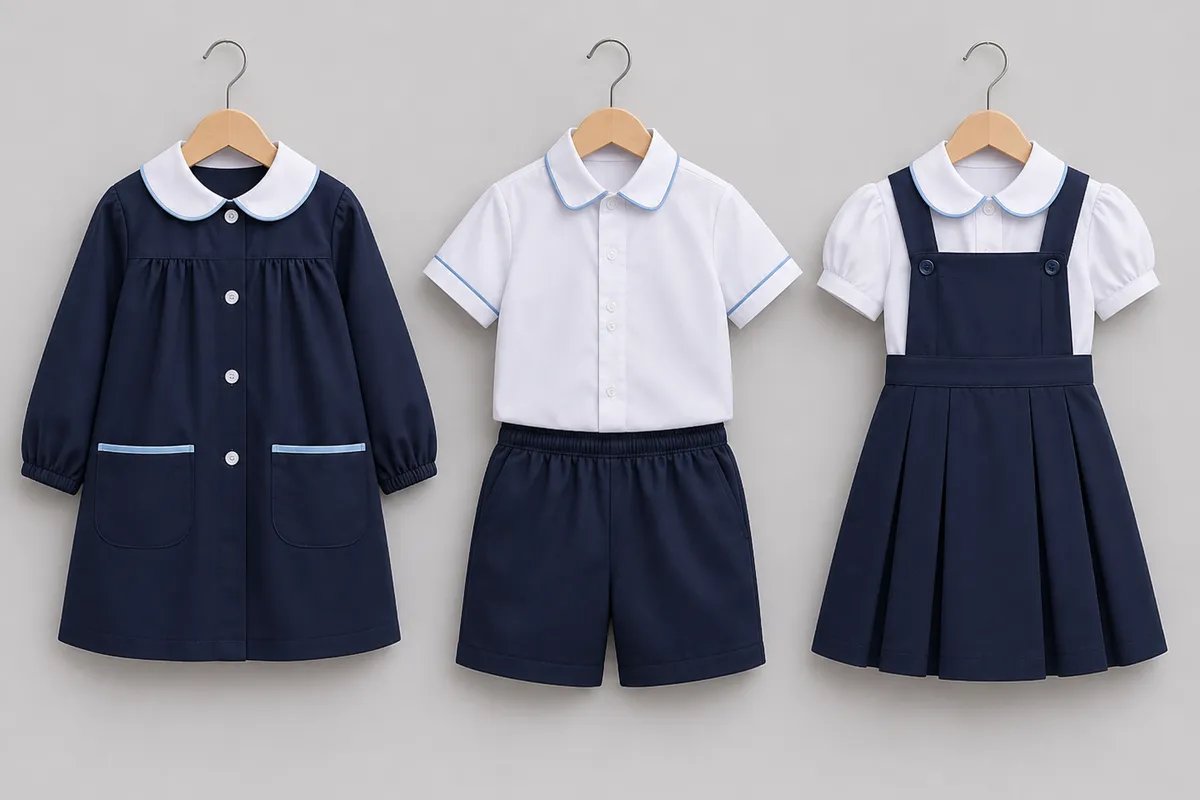
Kindergarten school uniform designs work in bulk when they are built from one base garment, one or two colours and a small number of fixed details, all written down so the same set can be made again next year. A design that looks charming in a sketch but depends on fussy trims, unusual prints or loose instructions tends to drift from one order to the next. The aim is a design that a factory can repeat exactly and a nursery can explain in one line to parents.
What makes a kindergarten uniform design repeatable?
A design is repeatable when every choice in it can be named, measured or matched. “Sky blue with a white collar” is a start; “sky blue matched to our swatch, white flat collar, logo on the left chest, press studs at the front” is a design a manufacturer can quote and a buyer can check against.
Three things usually decide whether a design survives several reorders:
- The base garment. We make three: a smock, a shirt-and-shorts set and a pinafore set. Building on one of these keeps patterns, sizes and costs stable.
- The colour plan. One main colour, plus at most one contrast, is easy to match again. Each extra colour is another reference to keep and another shade to approve.
- The fixed details. Collar type, pocket or no pocket, fastening, logo position and label. These are small decisions, but each one written down saves a question later.
Design elements to choose, one by one
The table sets out the main design levers for each base garment and the plainer option many buyers fall back on when they want an easy reorder.
| Design element | Smock | Shirt-and-shorts set | Pinafore set |
|---|---|---|---|
| Main colour | One solid colour | Shirt colour and shorts colour | Pinafore colour and blouse colour |
| Contrast | Collar, cuff or pocket trim | Collar or shorts in the second colour | Blouse in white or a light shade |
| Fastening | Buttons or press studs, as specified | Buttons on the shirt; elastic-waist shorts | Straps or buttons on the pinafore; buttons on the blouse |
| Logo position | Chest or pocket | Shirt chest or pocket | Pinafore bib |
| Plain fallback | Solid colour, no trim | Same colour family top and bottom | Navy or grey pinafore, white blouse |
A school that wants a “designed” look without complexity usually gets it from proportion and colour rather than decoration: a well-chosen contrast collar does more than three kinds of braid.
Turning a sketch into a specification
Many kindergarten designs arrive as a drawing, a photograph from a catalogue or a description from a head teacher. Before asking for a quotation, convert it into a short written specification. A single page is enough:
- Base garment and style name
- Main colour reference (swatch, garment or colour-standard number)
- Contrast colour reference, and where the contrast goes
- Collar type, or no collar
- Pockets: number and position
- Fastening type for each piece
- Logo artwork, position and approximate size
- Fabric: poly-cotton or cotton
- Neck label: your own woven or printed label, or plain
- Size range by age band
Logo embroidery or printing is available, and the final method, size and position are confirmed on the sample. Our logos, embroidery and labels page explains the options.
Where designs drift between orders
Drift happens when something important was never written down. Common examples in kindergarten sets:
- The contrast collar comes back in a slightly different white because only “white” was specified.
- The pocket moves because its position was shown in a photo, not measured.
- The logo grows or shrinks because nobody recorded its width on each size.
The cure is simple. Keep the approved sample, keep the specification sheet with it, and refer to both when you reorder. We work from the approved sample on repeat orders, so a sealed sample in your office is the single most useful reference you can hold.
Keeping designs consistent across a group of schools
A school group or supplier dressing several kindergartens can use one design with a different colour or logo for each setting. The pattern, collar, pocket and fastening stay the same; only the colour references and artwork change. This keeps sampling quick and lets the buyer compare quotations easily. Our page for schools and school groups sets out how such orders are usually arranged.
We manufacture kindergarten smocks and sets in India to the buyer’s design, and the minimum is 50 pieces per style with sizes mixed. Browse the base styles on our nursery and kindergarten uniforms page, then send your sketch or current garment and we will quote the design as written.
Questions buyers ask
Can you work from a hand-drawn sketch of our design?
Yes, a sketch is a fine starting point. We will ask for colour references, logo artwork and any measurements you have, then make a sample so you can see the design as a real garment before anything is cut in bulk.
How many colours should a kindergarten design use?
One main colour and one contrast is the most practical for repeat orders. Every additional colour needs its own reference and approval, and adds a point where shades can differ between batches of fabric.
Can a design be changed after the first order?
It can, but treat a change as a new sample. Even a small alteration, such as moving a pocket, should be approved on a garment so that the new version becomes the reference for later orders.