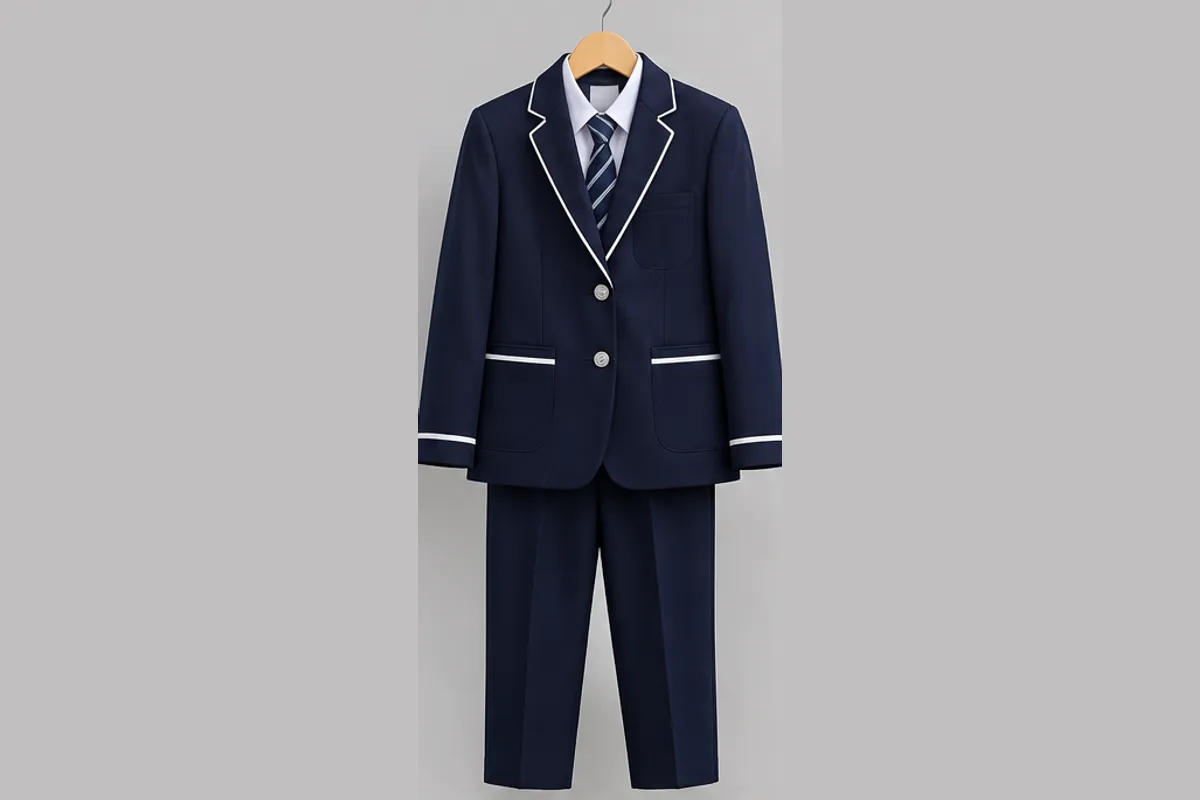
Junior school blazer sizes usually run in age bands from 5–6 to 10–11, one band per year, with the fit set a little easier than senior sizes so young children can do up buttons and move freely. Junior blazers are outgrown faster than they wear out, so the size range needs every band covered but in modest quantities. Planning them separately from the secondary sizes keeps stock lean.
Prep schools, primary schools with a formal uniform, and shops serving them face a different sizing problem from secondary buyers. This post looks at what makes junior blazer sizing different and how to plan an order for it.
How junior blazers differ from senior sizes
The same blazer style can run from age 5–6 upward, but the small sizes need a few adjustments to work for young children. These are agreed on the chart rather than built into a separate style.
| Point | Junior sizes | Why |
|---|---|---|
| Chest ease | Slightly generous | Young children wear the blazer over a jumper or cardigan and need to move |
| Button size and spacing | Buttons easy to grip | Children dress themselves after PE |
| Cuff opening | Wide enough for a hand to pass easily | Sleeves go on and off many times a day |
| Back length | Covers the seat without reaching mid-thigh | Long backs get sat on and creased |
| Sleeve length | Not too long | Young children push long sleeves up and stretch the cuff |
| Name tape space | Room inside for a sewn-in name | Junior blazers get lost and swapped often |
Pocket depth is worth a thought too. Deep lower pockets on small blazers fill with everything a young child picks up, and the front pulls out of shape. Your sample shows the pocket proportions for the smallest size; check them on a child, not only on a hanger.
Which age bands to include
Not every junior school starts blazers at age 5–6. Some begin in the later junior years, and some only for special occasions. Map your size range to the years that actually wear blazers.
- Blazers from reception or Year 1 equivalent: start at age 5–6, or the youngest band your chart allows.
- Blazers from the middle junior years: start at age 7–8 and drop the smallest sizes.
- Blazers for the top junior year only: a narrow range around ages 9–10 and 10–11, with a few larger sizes for tall children.
If the school runs both a junior and senior section, decide whether juniors and seniors share one style in one colour or have different blazers. Sharing one style means one minimum covers both sections, which suits smaller schools.
Planning quantities in junior sizes
Junior children grow steadily, so demand spreads fairly evenly across the bands, with a bump at the year blazers begin. They also lose blazers often. A shop or school should plan for replacements through the year, not only the start-of-term sale.
A simple starting approach, to adjust against your own sales or roll data:
- Count children in each year group that wears blazers.
- Expect most to need a new blazer every year or so while they grow, with larger children moving up faster.
- Give the entry-year size the largest share.
- Add a small buffer in every band for lost blazers and mid-year joiners.
- Keep at least a few of the largest junior size for tall children in younger classes.
Junior and senior sizes can be mixed within one style, so a combined order can reach the 50-piece minimum more easily than either section alone.
Getting the junior sample right
Ask for the sample in a junior size if juniors make up much of your order. A blazer that looks right at age 13–14 can look stiff and heavy on a six-year-old if the proportions of pocket, lapel and badge are not scaled down. The badge in particular may need a smaller version for junior sizes; that is agreed with the sample. Our size charts page explains how junior bands sit on the agreed chart.
Our school blazers start from age 5–6. Send us the years that wear blazers and your rough numbers, and we will prepare a quotation with a junior size breakdown.
Questions buyers ask
Should the school badge be smaller on junior blazers?
Often it should. A badge sized for a senior blazer can cover most of a small pocket. Many buyers use a smaller badge on the youngest sizes. The badge size for each size group is agreed on the sample before production.
Are press studs an option instead of buttons for little children?
Blazer fronts are normally buttoned. If you want a different fastening for the youngest sizes, raise it with your enquiry and we will confirm what is possible with the sample. Larger buttons with clear spacing are the usual answer.
Do juniors need half-lined or lined blazers?
Blazers are made lined or half-lined, as specified. Some buyers choose half-lined for juniors because it is lighter for active children. Discuss it at quotation, since it applies to the whole style rather than to selected sizes.