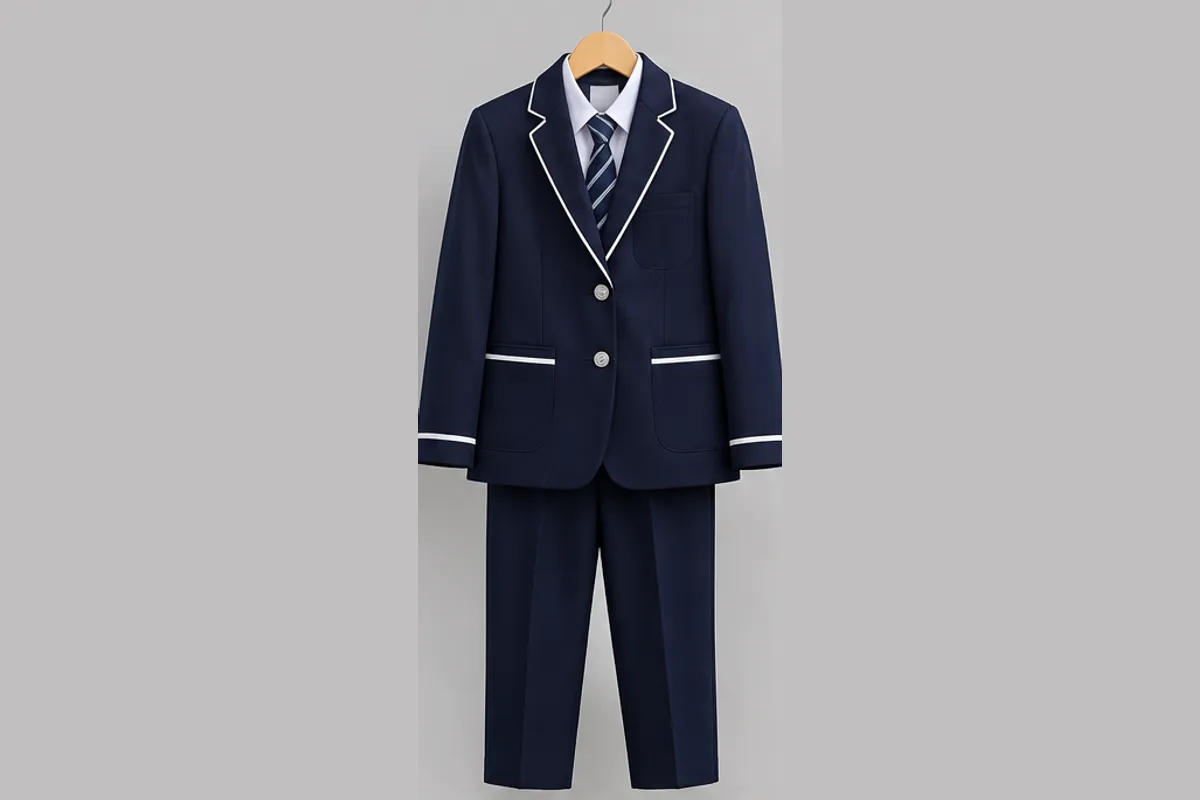
Nearly all school blazers use a notch lapel, where the collar meets the lapel at a small V-shaped gap; a peak lapel, with points rising towards the shoulder, is occasionally used for a more formal or ceremonial look. The other lapel decisions are width and roll, which set how the blazer reads from a distance. All of these are part of the pattern, so they are fixed when you approve the sample.
A lapel is the folded-back front edge of the blazer that runs from the top button up to the collar. On a school blazer it frames the shirt and tie, often carries braid, and sits right next to the badge. That makes it one of the most noticed details on the garment, even though few buyers write it down.
Notch, peak and shawl lapels defined
Notch lapel. The lapel and collar are separate pieces, joined at a seam called the gorge, with a notch where they meet. It is the standard for school and business jackets and works with every button count.
Peak lapel. The lapel’s lower edge rises to a point beyond the collar. It looks more formal and is seen on some senior or ceremonial blazers. Braid on a peak lapel needs care at the point, so ask to see it on the sample.
Shawl lapel. The collar and lapel form one continuous curve with no notch. It is rare on school blazers and closer to evening wear.
How wide should a school blazer lapel be?
Width is measured across the lapel at its widest point, just below the notch. The useful comparison is proportion rather than a number, because the right width changes with the size.
| Lapel width | How it looks | Works well with |
|---|---|---|
| Narrow | Slim, current, a little casual | Single-button girls’ blazers, plain blazers without braid |
| Medium | Balanced and timeless | Most school blazers, braided or plain |
| Wide | Traditional, strong outline | Three-button blazers, schools keeping an older pattern |
Medium is the safe default for a uniform that must still look right in ten years. Narrow lapels date faster, and very wide ones can overwhelm small junior sizes. Lapel width is graded across the size chart, so it widens slightly as the blazer grows.
How do the lapels work with braid and badge?
Braid is most often run along the lapel and collar edge, and the lapel shape decides how it turns corners. A notch gives two corners for the braid to mitre neatly; a peak gives a sharp point where thicker braid can bunch. If your braid is wide, a medium notch lapel is the easier match.
The lapel also sets how close the badge sits to the edge. A wide lapel that rolls down to the breast pocket can partly cover a large badge when the blazer is fastened. When you send artwork, include the badge width, and we check its position against the lapel on the sample.
Other lapel details to state if they matter to you:
- a buttonhole on the left lapel, worked or left blank
- top-stitching along the lapel edge, if there is no braid
- how soft or firm the roll should be, as described in words or by a current blazer
Matching an existing lapel
When a school is replacing its supplier, the lapel is often the detail that gives the new blazer away. Send a current blazer if you can. We match the notch position, the width and the gorge height as closely as we can, and you compare the sample against the old garment before approving. A school that wants to update the lapel at the same time should say so, so we do not copy a shape you intend to change. Schools and school groups writing a full specification can find more on our page for schools and school groups.
Tell us the lapel style, width and any braid when you send your enquiry, together with your size list. We quote school blazers per style, by fabric, quantity and branding, and the lapel is confirmed on the sample before cutting begins.
Questions buyers ask
Is a peak lapel harder to make in junior sizes?
The point gets small on young sizes and can look sharp or fussy. Some schools keep a notch lapel for junior blazers and use a peak only on a senior or ceremonial style, which is ordered as a separate style.
Does a lapel buttonhole need to be cut open?
It can be worked as a real buttonhole or stitched as a decorative one that stays closed. Most school blazers use a closed, decorative buttonhole, or leave the lapel plain. Say which you prefer on the specification.
Can the lapel be faced in a contrast colour?
A contrast facing on the underside of the lapel is possible, though it shows mainly when the blazer is open. Braid along the edge is a more visible way to add a school colour to the front.