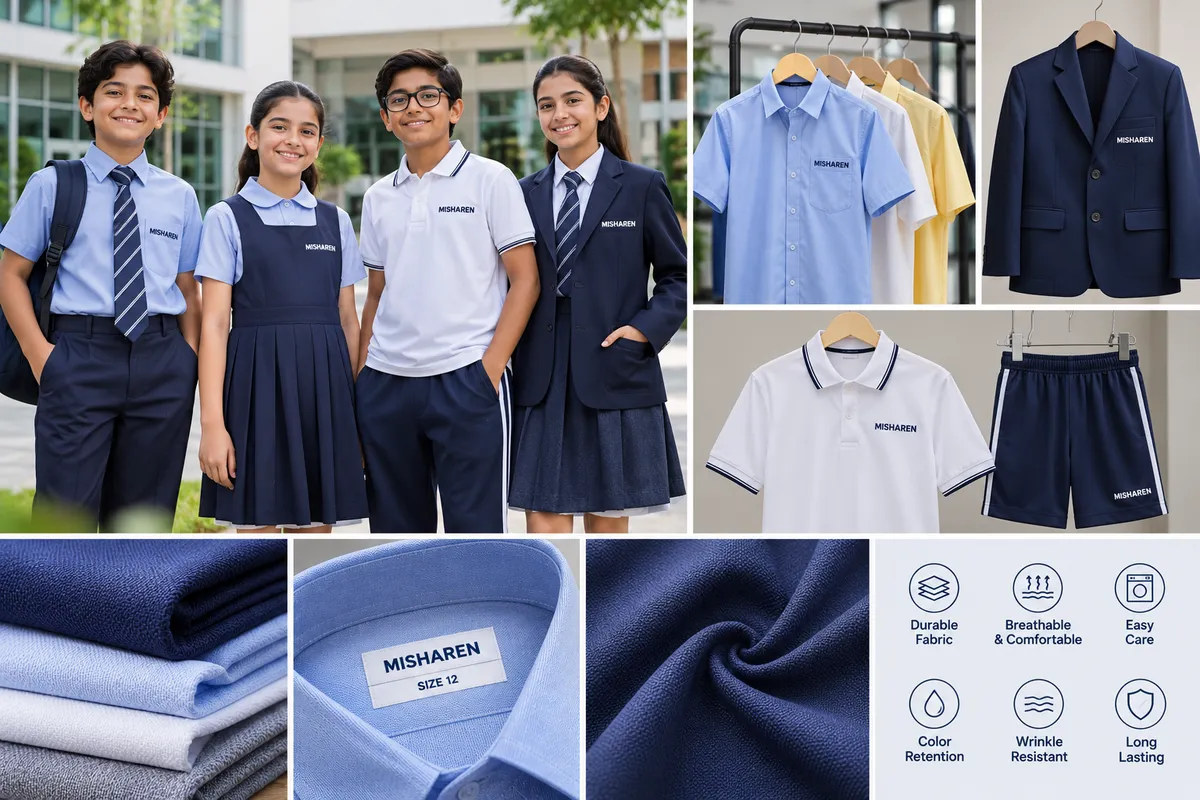
A sixth form uniform is a distinct version of the school uniform for the oldest students, usually aged sixteen to eighteen, that marks them out from younger years while keeping them recognisably part of the school. Most schools do this by changing two or three garments, such as the blazer colour or the shirt style, rather than designing a whole new uniform.
The same thinking applies to senior or higher secondary years elsewhere, whatever they are called. The planning questions are the same: what changes, what stays, how to size it, and how to order for what is often a small group of students.
Which garments should change for senior students?
Changing a few visible garments is usually enough. Changing everything increases styles, cost and the risk of small quantities falling below minimums.
| Approach | What changes | What stays | Effect on the order |
|---|---|---|---|
| Different blazer | Blazer colour, or same colour with different braid | Shirts, trousers, skirts | One or two new blazer styles |
| Different shirt | Oxford shirt or a different colour instead of the standard shirt | Blazer, trousers, skirts | One or two new shirt styles |
| Different knitwear | V-neck jumper in a contrasting colour, or none | Everything else | One new knitwear style |
| Business-style dress | Dark suit or plain smart wear, chosen by families within rules | Logo items reduced to one or none | Fewer school-made styles |
| Badge only | Standard uniform with a senior badge or tie | Everything | Small change, often to a separately sourced item |
Schools often combine two approaches, such as a different blazer and an Oxford shirt. Whatever you choose, write it as a clear list in the uniform policy so senior students and families know exactly what is required.
Sizing for older students
Senior students wear adult sizes. Age-band sizing stops making sense, and sizes move to chest measurements for tops and waist and leg for trousers. The spread is also wider than in younger years: some students are still slight, while others are fully grown.
Blazers. Plan chest sizes for senior students, and consider whether you need long fittings for taller students.
Shirts. Collar size or chest size, depending on the shirt style. If seniors move to an Oxford shirt, set its senior sizes separately from the junior range.
Trousers and skirts. Waist sizes with more than one leg length or skirt length.
Ask for the sample in a middle senior size and, if possible, one at each end of the range, and have a few students of different builds try them. Senior students notice fit more than younger ones, and a uniform that looks wrong on them is unlikely to be worn well.
Ordering for a small year group
Sixth forms are often smaller than the main school, sometimes much smaller. That makes minimum order quantities the main planning issue.
Our minimum is 50 pieces per style for woven garments, which covers blazers and shirts, and 100 for knitwear, with sizes mixed within a style. A sixth form of sixty students choosing between two blazer colours may struggle to reach the minimum for each. Ways to manage this:
- Choose one senior style per garment rather than options
- Order for two intakes at once, if storage allows
- Keep senior garments in colours that also suit staff or leavers’ items, sourced as you see fit
- Change only the blazer, not the blazer and the shirt
- Use a plain garment with a senior badge sewn on, so one style serves several needs
Timing the introduction
A senior uniform is usually introduced for a new intake, starting with students entering the sixth form in one year, while current students keep their existing uniform until they leave. This avoids asking families to buy twice.
Agree the design and approve samples well before the end of the school year, so the uniform can be fitted and bought over the summer. Lead time for the order is confirmed in the quotation; work back from the date students need it.
We manufacture in India and make senior uniform alongside a school’s main range, in adult chest and waist sizes as specified, with your badge or logo. You approve a sample of each style before bulk production.
Our page for schools and school groups explains how we quote for a school’s whole range. Senior uniforms most often change the school blazer and the shirt or blouse. Send us your senior uniform list and expected numbers, and we will quote each style.
Questions buyers ask
Should a sixth form uniform be optional or compulsory?
That is a decision for the school. A compulsory senior uniform gives a clear standard and predictable quantities. An optional one, or a business-style dress code, gives students more choice but makes ordering harder, because take-up is uncertain. Either way, state the rules plainly in the policy.
Can senior students wear the same blazer as younger students?
Yes, and many schools keep one blazer for all years, changing only a badge or tie for seniors. This keeps one blazer style, makes minimums easier and lets students keep a blazer they already own. Larger chest sizes are then added to the existing style.
How many spare senior sizes should a school order?
Order enough to cover new students joining the sixth form from other schools and students who grow during the year. Senior sizes sell slowly but are hard to replace quickly, so keep a few of each size rather than none, and review against your own records each year.