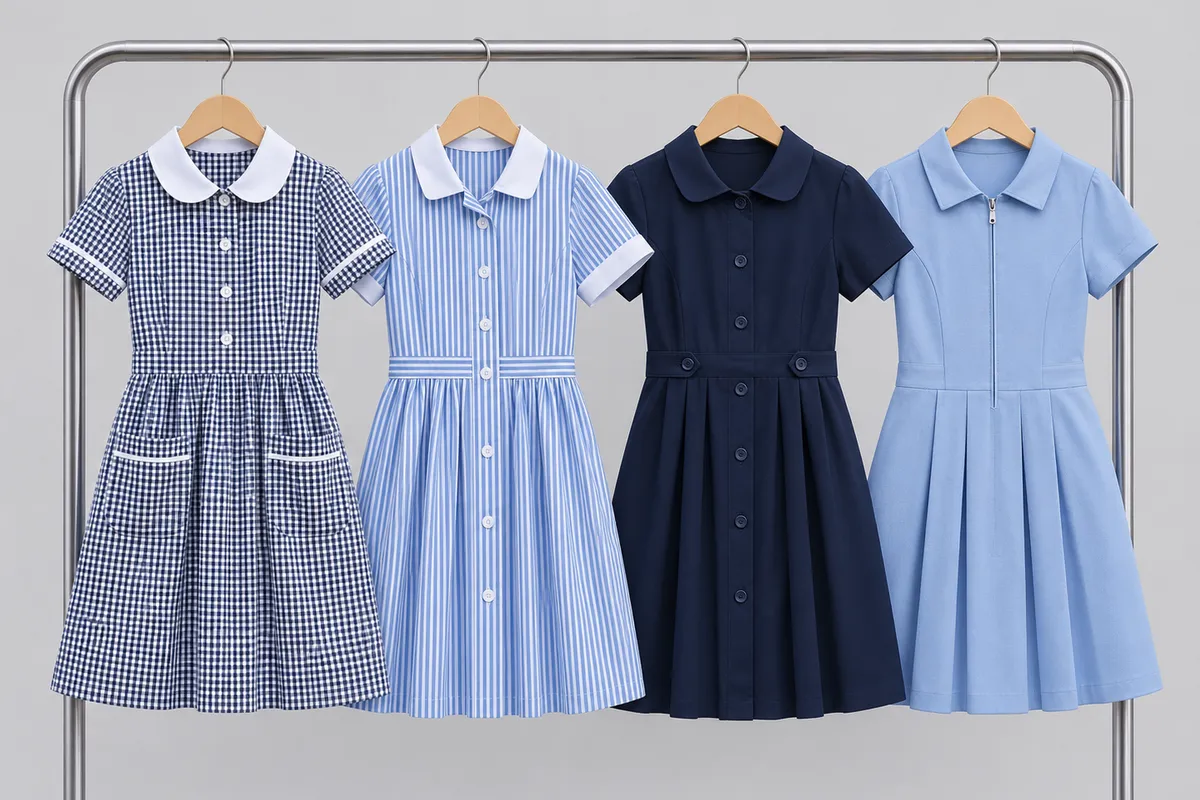
To measure a student for a school summer dress, take four readings: chest at the fullest point, natural waist, height, and the back length from the neck bone to the point where the hem should fall. Compare those body figures with the size chart, which lists garment measurements, and choose the size that clears the chest comfortably.
This post is written for staff who size students at a school fitting day or behind a uniform shop counter. It sets out the method step by step, the tools needed and the mistakes that send the wrong size home.
What you need before you start
A soft tape measure in centimetres, a wall where height can be read, a printed copy of the dress size chart and a simple record sheet are enough. Ask students to wear a thin top or their summer blouse, not a jumper, so the readings are close to the body.
If possible, have one sample dress in each size on a rail. A try-on settles most questions faster than any measurement.
The four measurements, step by step
- Chest. Pass the tape under the arms and around the fullest part of the chest, keeping it level across the back. It should be snug, not tight. Read it with the student’s arms relaxed at the sides.
- Waist. Find the natural waist, the narrowest point between the ribs and the hips. Younger children have little waist definition, so take it level with the navel instead.
- Height. Stand the student against a wall without shoes, heels together. Height is a good cross-check for dress length in the younger bands.
- Back length to hem. Measure from the bone at the base of the neck down the spine to where the school wants the hem, often around the knee. This tells you whether the student needs a longer size than the chest suggests.
Write each figure down at once. Memory is unreliable after the tenth student.
How do body measurements turn into a dress size?
A size chart for a dress lists the garment itself, measured flat or around, so it is always larger than the body. The difference is ease, the room that lets the student move. A student with a given chest needs a dress whose chest is larger by that ease allowance.
| Body reading | Compare with on the chart | Rule of thumb |
|---|---|---|
| Chest | Garment chest | Choose the size whose chest clears the body with room to move |
| Waist | Garment waist (sewn-waist dresses only) | If chest and waist point to different sizes, follow the chest |
| Back length to hem | Garment length | If the length is short, move up one size or use a longer option |
| Height | Age band guidance | Use as a cross-check, not as the deciding figure |
When chest and length point to different sizes, the chest usually wins for a dress, because a dress that will not close cannot be worn at all. A slightly long dress can still be worn, and some schools allow a hem to be taken up at home.
The chart for each order is agreed with us before the sample, and our size charts page explains what goes into it.
Common mistakes when measuring for a dress
- Measuring over a jumper or blazer. It adds several centimetres and pushes the student up a size.
- A tape that tilts at the back. The reading looks larger than the real chest. Check the tape is level.
- Pulling the tape tight. The student then gets a dress that fits on the day and is too small within weeks.
- Choosing by age alone. The age band is a guide; the chest decides.
- Forgetting growth. A dress bought before the warm term must last until the end of it, so leave the student some room.
Recording sizes for an order
A short form keeps sizing consistent across staff. Record the student’s name or number, year group, chest, waist, height, back length and the size issued. Add a column for “tried on” so you can see later which sizes were confirmed by a fitting and which were estimated.
Totals by size from that form are the strongest starting point for a bulk order. We manufacture summer dresses in India in your size range, and our school summer dresses page shows the styles we make. Send your measurement totals with your enquiry, and we will quote per style and confirm the size chart with the sample.
Questions buyers ask
Can parents measure their own children for a summer dress?
Yes, if the school gives clear written steps and a diagram. Home measurements vary more than staff readings, so ask parents to record chest and height at least, and allow an exchange if the size proves wrong when the dress arrives.
Should a school measure in centimetres or inches?
Use whichever unit your size chart uses, so staff are not converting figures at the counter. Centimetres are finer and avoid fractions, which helps on younger children where a small difference can change the size.
How often should students be measured for summer dresses?
Once a year is usually enough, shortly before the warm term begins. Children grow unevenly, so a fresh reading each year catches students who have jumped a band since the last summer.