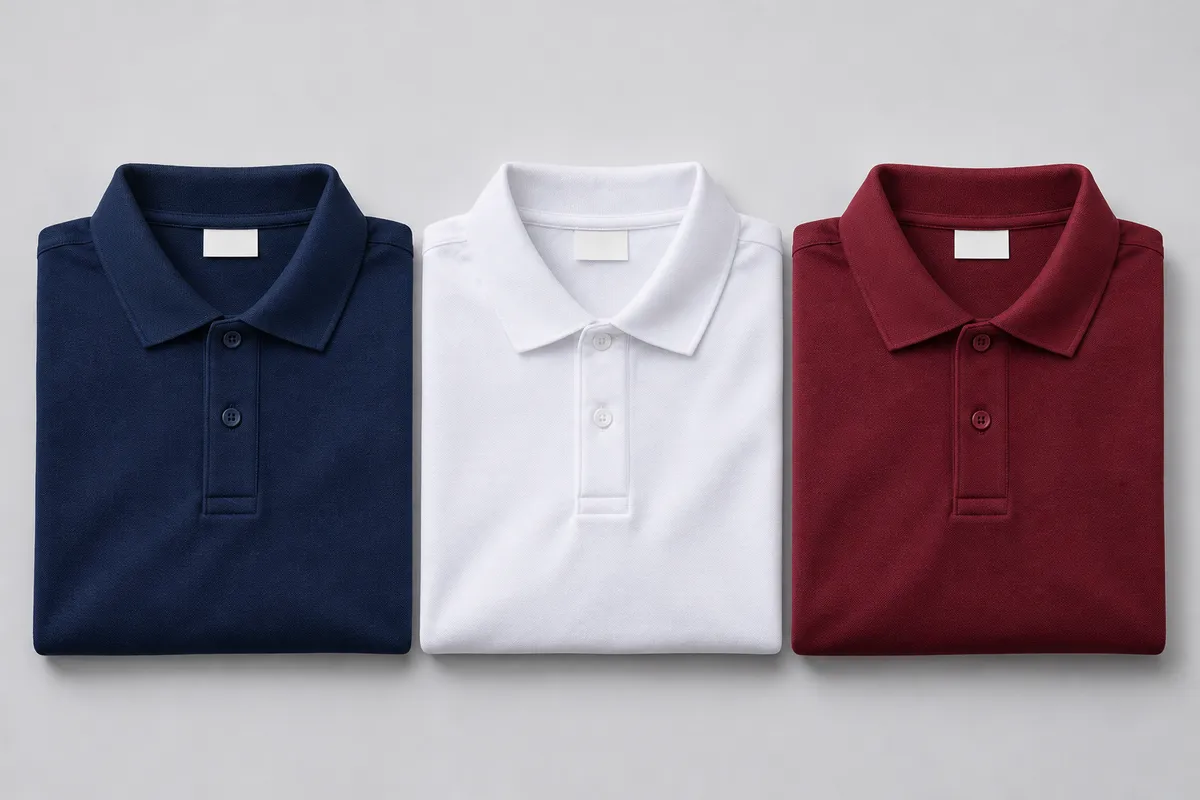
To iron a polo shirt, turn it inside out, set the iron to the cool or warm setting on the care label, and press lightly rather than pushing hard, so the piqué texture is not flattened or made shiny. Iron around the logo, never over it, and finish the collar on the underside. Many school polos need little or no ironing if they are shaped while damp and dried on a hanger.
Shops can share these steps with families who ask whether a polo should be ironed at all.
Does a school polo need ironing?
Often it does not. Piqué’s textured surface hides small creases, and poly-cotton and polyester piqué both relax as they dry. Hanging a polo straight from the wash, with the collar smoothed and the placket buttoned, usually gives a neat finish.
Ironing helps when:
- A polo has been left crumpled in the machine or a bag
- The collar points have started to curl
- The placket has a crease or ripple
- A school expects a crisp look for an event or photo day
Step by step: ironing a polo shirt
- Check the care label. It gives the iron setting for that polo.
- Turn the polo inside out. This protects the textured face and the logo.
- Start with the collar. Lay it flat, underside up, and press from the points towards the centre back.
- Press the placket. Iron down each side of the placket, not across the buttons.
- Do the shoulders and back. Slip the polo over the narrow end of the board.
- Do the front panels. Work around the logo area without touching it.
- Finish the sleeves. Press flat, avoiding a sharp crease along the top of the sleeve.
- Hang straight away. Let it cool on a hanger so creases do not return.
What should families avoid?
| Mistake | Result | Instead |
|---|---|---|
| Iron too hot | Shiny patches, melted polyester | Cool or warm setting, as labelled |
| Pressing hard on the face | Flattened texture | Light pressure, inside out |
| Ironing over the logo | Damaged embroidery or print | Iron around it |
| Pressing the collar edge hard | Rippled, wavy rib | Press from the underside |
| Ironing over buttons | Cracked or marked buttons | Iron beside the placket |
| Steam on a print | Lifted or softened print | Dry heat or a pressing cloth |
How does fabric choice affect ironing?
Both piqué fabrics we use are low-maintenance, but they behave slightly differently. Polyester piqué is more sensitive to high heat, so it needs a cooler iron. Poly-cotton piqué tolerates a little more warmth but still benefits from a moderate setting. If in doubt, a pressing cloth between the iron and the polo protects either fabric.
Our page on fabrics and colour matching describes the two piqué fabrics and how they are confirmed for an order.
Setting families up for easy care
Shops that sell polos can reduce ironing questions with a few simple notes at the point of sale:
- Shape the collar and placket while damp
- Dry polos on hangers
- Iron inside out on a cool or warm setting only
- Never iron directly over the logo
- Follow the care label, which the buyer sets
These points work with the care label you specify when you order. If you would like ironing guidance in the label wording, include it in your specification and it appears on the sample.
The polo styles we make are on our school polo shirts page. Ask for a quotation with your fabric, colour and logo details, and mention any care wording you want sewn in.
Questions buyers ask
Can a polo collar be ironed flat if it curls?
Usually, yes. Lay the collar underside up, dampen it slightly and press gently on a cool setting from the points inward. Avoid pressing the outer edge hard, as heavy pressure can ripple the rib rather than flatten it.
Is steam safe on a polo shirt?
A little steam is fine on the body, but avoid steaming a printed logo, as heat and moisture can soften it. On embroidered logos, steam is less risky, though pressing around the logo is still the safer approach.
Why does ironing make some polos shiny?
Shine comes from heat and pressure flattening the fibres, which is more likely with polyester or when ironing the right side. Turning the polo inside out and using a cooler setting avoids it in most cases.