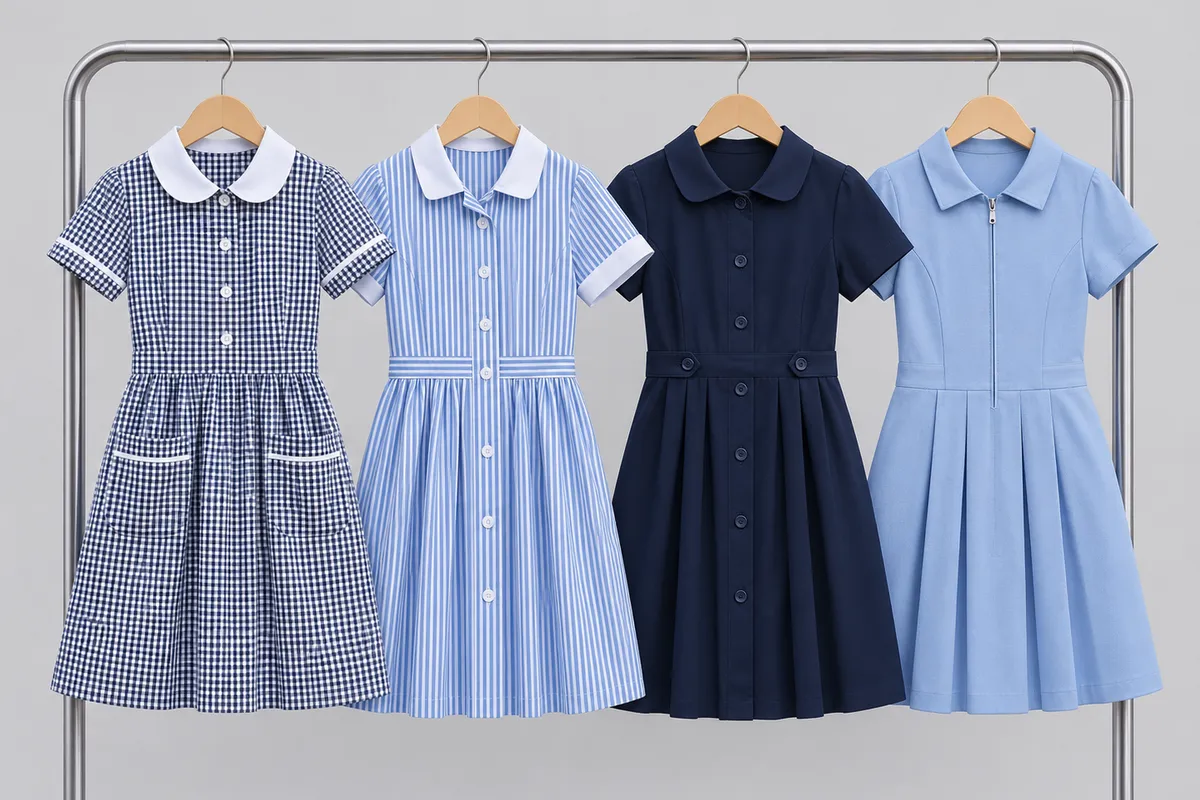
A school uniform for boys and girls usually differs in three ways: the garments offered (girls’ lists add skirts, pinafores, tunics and summer dresses), the cut of shared garments (trousers, blazers and blouses are shaped differently), and small details such as collar style and button side. Many garments, including polos, sweatshirts, knitwear and PE kit, are the same for both. Knowing exactly where the differences lie helps a buyer avoid ordering two styles where one would do.
The sections below walk through those three kinds of difference and end with a quick way to count the styles a mixed school needs.
Difference one: the garments on the list
Boys’ and girls’ lists overlap heavily. The differences are mostly on the girls’ side, where more options exist for the lower half of the body.
| Garment group | Boys’ lists usually include | Girls’ lists usually include |
|---|---|---|
| Lower garment | Trousers, tailored shorts | Skirt, skort, trousers, sometimes shorts |
| One-piece garment | None | Pinafore or tunic; summer dress |
| Top | Shirt or polo | Shirt, blouse or polo |
| Warm layer | Jumper, sweatshirt, blazer | Jumper, cardigan, sweatshirt, blazer |
| PE kit | T-shirt, shorts, tracksuit | Same, sometimes a skort for games |
A girls’ list may also add a cardigan where a boys’ list has only a jumper, though many schools offer both to everyone.
Difference two: the cut of shared garments
Where both boys and girls wear the “same” garment, it may still be made in two styles.
Trousers. Girls’ trousers usually have a shaped waist, more room at the hip and a different rise. Regular and slim fit trousers are cut straighter.
Blazers. A girls’ blazer has a shaped body and different shoulder and chest proportions. It is often shorter in the body.
Shirts and blouses. A boys’ shirt has a stand-and-fall collar that takes a tie. A girls’ blouse often has a revere collar that lies open over a jumper, and may be slightly shaped at the side seams.
Knitwear and sweatshirts. These are usually one style for everyone. Some schools prefer a girls’ cardigan with a slightly shorter body, but it is not standard.
Difference three: the details
Small details can make a garment boys’ or girls’ without changing its shape much:
- Button side. By convention, men’s and boys’ garments button left over right, and women’s and girls’ garments right over left. This applies to shirts, blouses, blazers and cardigans.
- Collar. Shirt collar for a tie, or revere collar worn open.
- Pockets. Girls’ trousers and skirts sometimes have fewer or smaller pockets.
- Length. Girls’ jumpers and blazers are sometimes cut a little shorter.
If a school is happy for one garment to serve everyone, ask for a unisex button side and cut, which reduces the number of styles.
Counting the styles a mixed school needs
For a co-educational school, list each garment and mark it as shared or split:
- Polo shirt: shared
- Sweatshirt and knitwear: shared, unless a girls’ cardigan is wanted
- PE kit and tracksuit: shared
- Shirt and blouse: split, or one shirt for all
- Trousers: split into regular and girls’ fits
- Blazer: split, or one cut for all
- Skirt, pinafore, summer dress: girls’ list only, or open to all
Every split adds a style, and each style carries its own minimum: 50 pieces for woven garments and 100 for knitted ones, with sizes mixed within a style. For a small school, keeping more garments shared helps reach those quantities.
We manufacture in India and make both the shared and the split garments. The shirt and blouse styles are on our school shirts and blouses page. Suppliers working out style counts for several schools can see how we quote on our page for schoolwear suppliers and distributors.
Send us the boys’ and girls’ lists for your school, and we will mark which styles can be shared before we quote.
Questions buyers ask
Do boys and girls need different polo shirts?
Usually not. A school polo is commonly cut as one unisex style, so a single style covers every student. That keeps the size range on the shelf simpler and makes it easier to reach the order minimum for knitted garments.
Why do girls’ blouses button on the other side?
It is a long-standing clothing convention rather than a practical need: women’s garments traditionally button right over left. Schools can keep the convention or choose one button side for all students. Tell us which, and we follow it on the sample.
Can a boy wear a girls’ uniform item?
That is a decision for each school’s uniform policy. Some schools now word their lists by garment rather than by gender, so any student may choose any item. For a buyer, it changes the split of quantities rather than the garments themselves.