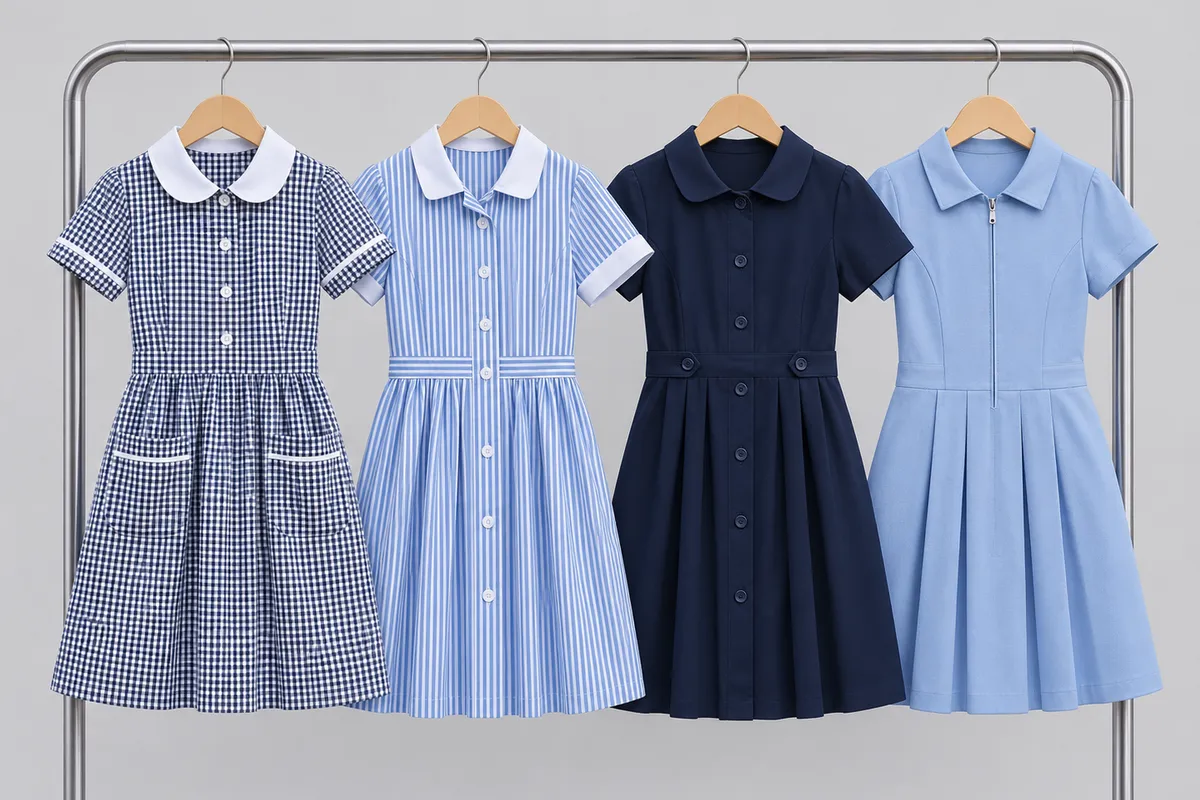
Schools commonly suggest two or three summer dresses per student for the warm term, so that one can be worn while another is washed and dried. The right number for your planning depends on how many days a week the dress is worn, whether there is an alternative such as a skirt or shorts, and how many families reuse last year’s dresses.
This post helps shops, schools and suppliers turn that per-student figure into a realistic bulk order quantity for summer dresses.
Why two or three dresses is the usual answer
A summer dress is worn in warm weather, often on consecutive days, and children are active. A dress worn on Monday is washed that evening and may not be dry and ironed by Tuesday morning. With two dresses, a family can alternate. With three, they have a spare for spills, wet days and the day the washing is delayed.
Families with a long summer term, or a school where the dress is the only warm-weather option, tend toward three. Where students can also wear a skirt and blouse or shorts and a polo, two dresses often cover it.
Factors that change the number
| Factor | Pushes the number up | Pushes the number down |
|---|---|---|
| Length of the warm term | A long term with several warm months | A short summer term |
| Other summer options on the list | Dress is the only choice | Skirt, skort or shorts allowed too |
| Washing and drying | Slow drying, humid climate | Quick-drying weather, easy-care fabric |
| Second-hand supply | Little reuse | An active second-hand rail |
| Growth | Young children outgrowing mid-season | Older students with stable sizes |
| Family budgets | Families buying the minimum the school asks |
Poly-cotton dresses are easy to wash and dry quickly, which helps families manage with fewer.
How do you turn dresses per student into an order?
Per-student figures are a ceiling. Real demand is lower, because not every student wears the dress and not every family buys new. A working method:
- Count students who will wear the dress. If the list allows other options, estimate how many choose the dress.
- Multiply by the dresses per student your school suggests.
- Subtract reuse. Returning students may still fit last year’s dresses, and some families buy second-hand.
- Separate new starters. They usually buy the full set, while returning students buy one or two to replace.
- Spread the total across sizes using your size data, and hold part of it back for a top-up.
The difference between new and returning students matters most. A new intake year often buys the full recommended number, while older year groups top up.
A worked example to adapt
For a school of 200 girls who may wear the dress, where most choose it and the school suggests two each, a shop might reason as follows. Of those choosing the dress, the new intake buys two each; returning students mostly buy one new dress, since one of last year’s still fits; some families buy second-hand. The resulting order is well under the simple “students times two”. Adjust every step against your own figures; this example is not a forecast.
Our minimum is 50 pieces per style, with sizes mixed, so even a small school can reach it with one style. Schools with more than one dress style need to reach the minimum in each.
Sharing the number with families
If you run the shop or the school, the per-student figure should appear on the uniform list as a suggestion, not a requirement. Families appreciate knowing how many they will need before the warm term, and a clear figure reduces last-minute rushes on the busiest sizes.
We manufacture school summer dresses in India for shops, suppliers and schools. See the styles on our school summer dresses page and the order steps on how to order. Send your student numbers and the dresses-per-student figure you plan to use, and we will help shape a first order.
Questions buyers ask
Should a school make a set number of summer dresses compulsory?
Most schools only suggest a number, since families’ washing routines and budgets differ. A requirement can feel heavy for families with several children, and it does not help the shop forecast, because some families will still reuse older dresses.
Do boarding schools need more summer dresses per student?
Boarding students often need more, as laundry runs on a set schedule and dresses may be away for several days. Ask the boarding house for its laundry cycle and plan the number of dresses around it.
How does a hand-me-down culture affect dress orders?
Where families pass dresses to siblings or friends, new sales fall in the returning year groups. Shops in such areas should keep the new-starter quantity firm and plan returning students’ demand more cautiously.