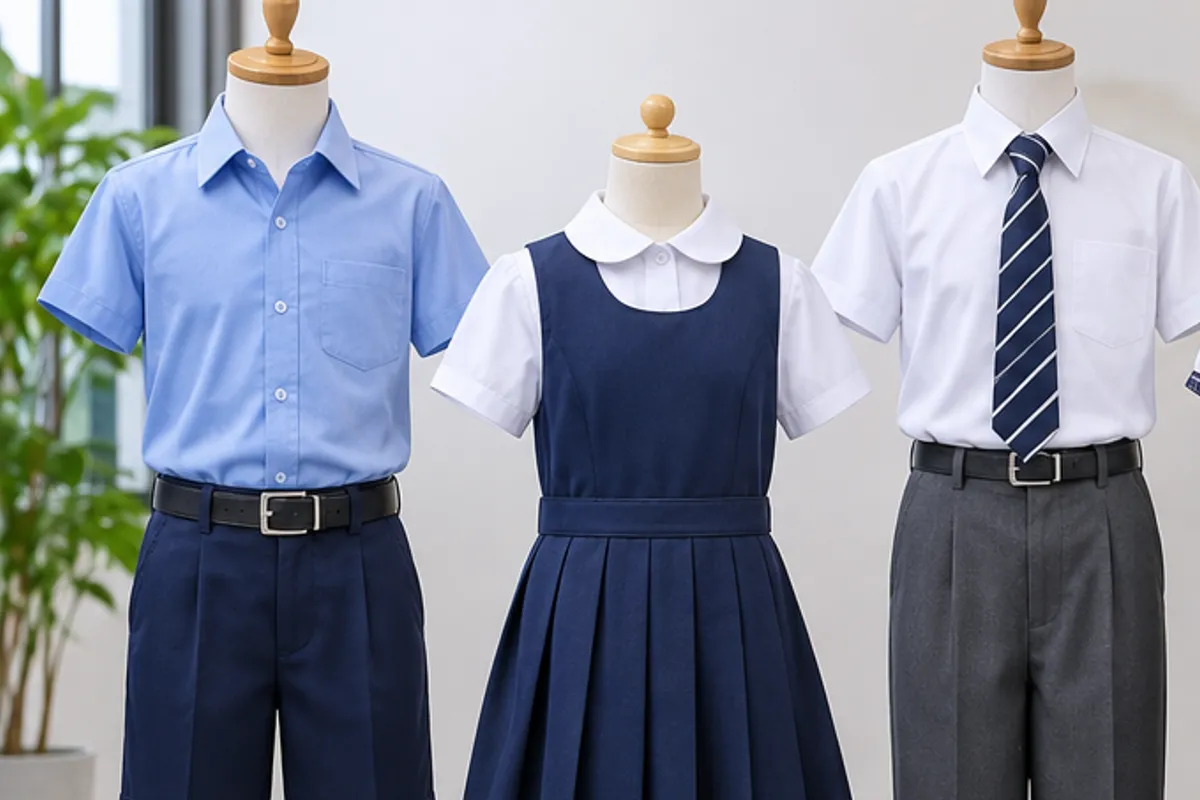
To measure for school trousers, take three body measurements: the natural waist, the seat at its fullest point, and the inside leg from crotch to floor without shoes. Record each in centimetres, compare them with the size chart agreed for your order, and choose the size by waist and seat first, then check the leg.
That order matters. A trouser that is tight at the seat cannot be fixed by a family at home, but a leg that is a little long can be hemmed. So the body measurements that cannot be adjusted decide the size, and the one that can be adjusted is checked last.
What to measure, and where
Each measurement has a fixed landmark. Staff who use the same landmarks every time produce numbers that can be compared across students, across fitting days and across years.
| Measurement | Where the tape goes | Common mistake |
|---|---|---|
| Waist | Around the body where the trouser waistband will sit, usually just above the hip bones | Measuring over a jumper or a bunched shirt |
| Seat | Around the fullest part of the bottom, feet together | Letting the tape slip down at the back |
| Inside leg | From the top of the inner thigh straight down to the floor, no shoes | Measuring with shoes on, which adds height |
| Outside leg (optional) | From the waistband position down the side to the floor | Starting from the natural waist when the trouser sits lower |
| Rise (garment only) | On a pair that fits, from the crotch seam to the top of the waistband | Trying to take it on the body |
The tape should sit flat and level, snug but not pulled in. Ask the student to stand normally and breathe out. A student who holds their breath or stands very straight will give a smaller waist than they wear day to day.
How do you measure a pair of trousers rather than a student?
Shops often have a pair that fits a student well and want to match it. Garment measurements work for this, but they are not the same numbers as body measurements, and the two should never be mixed on one chart.
Lay the trousers flat, front up, with the waistband fastened. Then:
- Waist: measure straight across the top of the waistband from edge to edge and double it.
- Seat: measure across the trousers at the widest point of the seat, a short way below the base of the fly, and double it.
- Inside leg: measure along the inner leg seam from the crotch point to the hem.
- Leg opening: measure across the hem and double it.
- Front rise: measure from the crotch seam up to the top of the waistband at the front.
A garment waist is always larger than the body waist it fits, because the trouser needs room to sit and move. When you send us a pair to copy, we take our own garment measurements from it and confirm them with the sample.
Measuring young children and senior students
The method changes a little across the age range.
Younger students
For the age bands where elastic-back waists are common, the waist is less critical because the back stretches. Seat and inside leg matter more. Young children rarely stand still, so measure the inside leg against a wall with a ruler at the top of the thigh rather than chasing them with a tape.
Senior students
For older students, sizes usually move to waist and inside leg. Here the waist reading decides the size, and the inside leg chooses between short, regular or long lengths if your range carries them. Measure the waist where the student actually wears trousers. Many older students wear them lower than the natural waist, and a reading taken higher will suggest a size that feels too big.
A routine for fitting days and shop counters
A short, written routine keeps the numbers consistent when several people are measuring.
- Use a soft tape marked in centimetres, checked against a ruler at the start of the day
- Measure over light clothing only, never over a jumper or coat
- Take each measurement twice and record the larger if they differ
- Remove shoes before the inside leg
- Write waist, seat and inside leg on the form, not just a size
- Note “between sizes” where a student sits on a boundary
- Keep a fitting pair in each core size so students can try one on
Recording the raw numbers, rather than only the size chosen, gives you something to compare with the chart at the next order. If many students sit between two sizes, the chart or the size range may need adjusting.
Our size chart is agreed with you for each order, so the measurements you collect become the starting point. The size charts page explains how the chart is set up. You can see the trouser and shorts styles we make on our school trousers and shorts page. We manufacture in India and make every repeat from the same approved pattern.
If you have a set of measurements or a pair you already sell, send them with your enquiry and we will prepare a quotation for each style.
Questions buyers ask
Should the waist be measured at the natural waist or where trousers sit?
Measure where the trouser waistband will sit on that student. For juniors this is usually close to the natural waist; for many seniors it is lower, near the hip bones. Note on your form which position you used so the next person measures the same way.
Is outside leg needed if inside leg is recorded?
Usually not. Inside leg is the measurement most size charts use for length, and it is less affected by where the waistband sits. Outside leg can be useful as a cross-check when a student wears trousers much lower than average.
How much growth room should be added to a measurement?
Do not add room to the body measurement itself. Record what you measure, and let the size chart and the hem allowance provide the growing room. Adding room at the measuring stage leads to oversized trousers and confusing records.