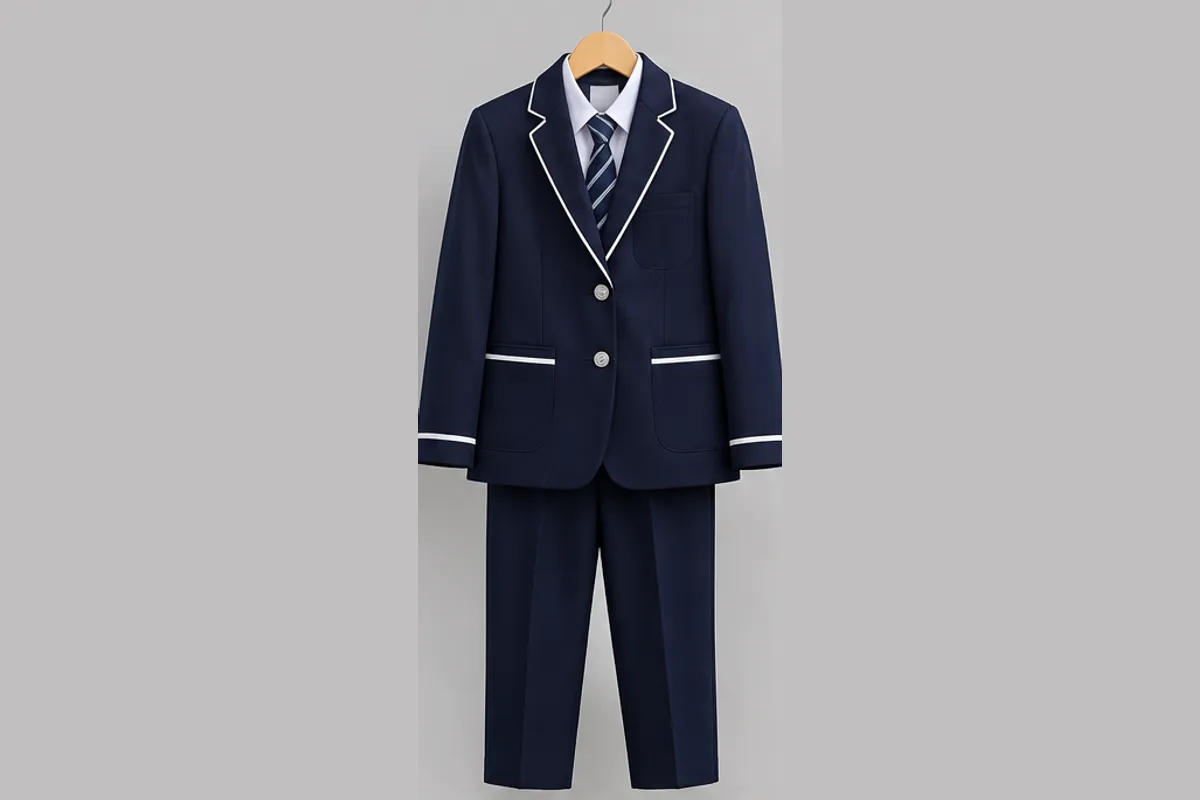
Most single-breasted school blazers have two or three front buttons, and a few have one. Three buttons give a higher, more traditional front with a shorter lapel; two buttons open the neck and lengthen the lapel; a single button is a lighter, more modern look often used on girls’ blazers. Any of the three can be specified, and the count you choose shapes the pattern, so it needs settling before the sample.
This is one of the first questions a school asks when it reviews its uniform, and it matters more than it seems. The button count decides where the lapel breaks, how much shirt and tie shows, and how the blazer sits when students fasten it badly, which they will.
What changes with each button count?
| Detail | One button | Two buttons | Three buttons |
|---|---|---|---|
| Lapel length | Long, rolling low | Medium, breaking near the waist | Short, breaking high on the chest |
| Shirt and tie on show | Most | Moderate | Least |
| Look | Light and modern | Classic business style | Traditional, formal |
| Fastening habit | Easy for young students | Top button usually fastened | Middle button usually fastened |
| Suits | Girls’ cuts, senior years | Both cuts, all ages | Boys’ cuts, schools keeping an older look |
The table is a guide to how the counts tend to look, not a set of rules. A three-button blazer can be cut with a soft roll so the top button sits behind the lapel. A two-button blazer can be cut high. If you have an existing blazer you like, the simplest instruction is “button position as current”, and we work from the garment.
Does the button count affect fit across sizes?
It does, mainly at the extremes of the range. On small junior sizes, three buttons can crowd a short front, leaving little space between them and a stiff, buttoned-up appearance. On long senior sizes, a single button can leave the front gaping below it. Many schools solve this with two buttons, which sits comfortably at every size from the youngest year group to the oldest.
Button spacing is graded with the size chart, so the gaps grow with the body length. You see the spacing on the sample size, and the grading follows the same proportions. If the uniform list runs from age bands into chest sizes for senior students, mention that, because the jump between the two systems is where spacing is most likely to look off.
What about the girls’ blazer?
The boys’ and girls’ blazers do not have to share a count. A two-button boys’ blazer next to a one-button girls’ blazer is a common pairing, and both can carry the same braid and badge. Two points to settle:
- whether the girls’ blazer buttons on the left (the usual convention) or the same side as the boys’
- whether the button finish is identical on both, which it normally should be
Each cut is a separate style with its own pattern, so changing the count on one does not affect the other.
How do you write the button count on a specification?
Keep it short and complete. A typical line reads: “Two front buttons, 20 mm, navy, sewn with a thread shank; three sleeve buttons, 15 mm, matching.” If you are unsure of sizes, give the count and finish and ask us to propose sizes to suit the lapel. Points to cover:
- number of front buttons for each cut
- button size, or “to suit”
- colour and finish, matching the cloth or the braid
- sleeve buttons, if any, and how many
- a spare button sewn inside, if you want one
Uniform suppliers writing a specification on behalf of several schools often keep the count the same across all of them and vary only cloth, braid and badge. That makes one pattern serve many schools; our page for schoolwear suppliers and distributors explains how that works on an order.
Once the count is settled, send it with the rest of your blazer details. We quote each style on our school blazers range by fabric, quantity and branding, and the button layout is confirmed on the sample you approve.
Questions buyers ask
Can we change from three buttons to two on our next order?
Yes, but the lapel and front are re-cut, so it is a new specification with its own sample. Existing three-button blazers will still be in use, so families and staff should expect both versions in school for a few years.
Is a double-breasted blazer an option for schools?
It is a much rarer school style and changes the whole front pattern. If your uniform uses one, send a current blazer at enquiry and we will confirm what can be made to match it before quoting.
Should junior and senior blazers have the same number of buttons?
They usually do, so the uniform looks consistent across the school. Some schools use the button count to mark senior students, but braid or a different badge is a clearer and simpler signal to change.