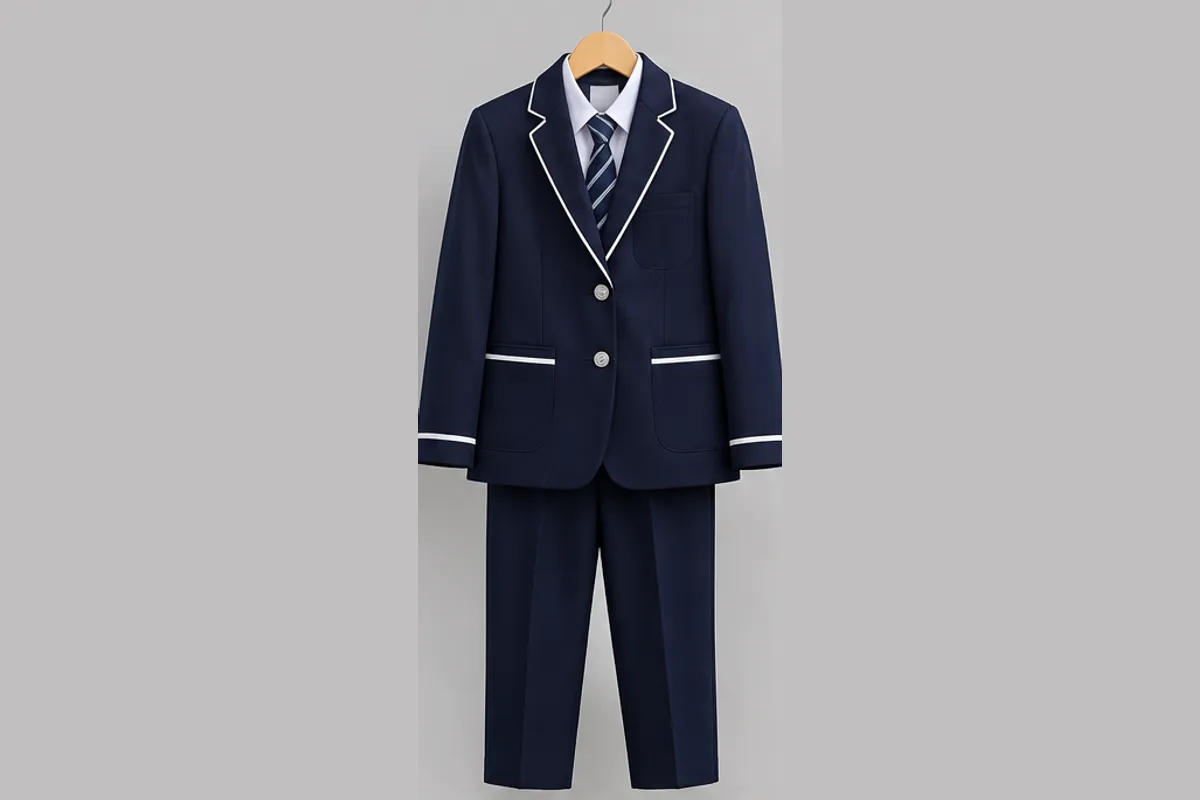
Plan for one blazer per student at a time, replaced when it is outgrown, lost or badly damaged. Unlike shirts or polo shirts, which families buy in sets of three or more, a blazer is worn all week and cleaned occasionally, so a second blazer is uncommon. Your order quantity therefore depends less on the number per student and more on how often students need a replacement.
This post turns that one-blazer pattern into numbers a uniform shop, distributor or school can order against.
Why is it usually one blazer per student?
Three reasons keep blazer ownership to one each:
- It is worn over other layers. The blazer does not touch the skin much, so it does not need washing after every wear the way a shirt does.
- It is cleaned less often. Most families sponge it, air it, and clean it in a holiday, rather than washing it weekly.
- It is the costlier item on the list. Families are slow to buy a second one while the first still fits.
Some families do buy a spare, often for a student who is hard on clothes, or when a younger sibling will inherit it. Boarding schools and schools with long days sometimes recommend two. Those are exceptions you can plan for in small numbers.
Where blazer demand actually comes from
If each student owns one, demand in a year comes from four sources. Each needs its own estimate.
| Source of demand | Who buys | How to estimate it |
|---|---|---|
| Entry year | Every new student in the first blazer year | Expected intake, from the school |
| Growth replacements | Students who outgrow their blazer | Past sales of replacements, or a share of each year group |
| Loss and damage | Students who lose or ruin a blazer | Past mid-year sales outside the main rush |
| New joiners mid-year | Students arriving after term starts | School’s usual mid-year admissions |
Add those four up and subtract any stock left over from last year, and you have a total to split by size.
Working out growth replacements
Growth replacements are the hardest part to estimate and the one most affected by age. Younger students tend to outgrow blazers faster than seniors, whose growth slows. In the senior years many students keep one blazer for a long stretch.
A shop with past sales can count blazers sold to existing students, as opposed to new starters, in each size. That figure, set against the number of students in the matching year groups, gives your own replacement rate. Without history, a school can ask parents in a short survey how long their child’s last blazer lasted.
Do not assume every student replaces every year. That overstates demand, especially in senior sizes, and leaves cartons on the shelf.
Spares for the school itself
Schools buying direct often keep a few spare blazers in common sizes. They cover a student whose blazer is lost on a trip, a visitor at a formal event, or a new joiner who arrives before their own order. A small spare set across the main sizes is enough; there is no need to keep a full run.
- Entry-year quantity based on expected intake
- Replacement estimate by size, from sales or survey
- Allowance for loss and damage through the year
- Mid-year joiners included
- Spare blazers for the school counted separately
- Last year’s leftover stock subtracted
Once the total is set, check that each style meets the 50-piece minimum. Sizes can be mixed within a style. If you are a school buying direct, our page for schools and school groups explains how direct orders are handled.
Our school blazers are made to order in your colours. Send us your estimate for the year, split by source if you have it, and we will quote the order with a suggested size spread.
Questions buyers ask
Should we recommend families buy two blazers?
For most day schools, one is enough. If students board, travel daily in wet weather, or wear the blazer for long hours, a second blazer may be worth suggesting. Make it a recommendation, not a requirement, and stock a small extra quantity to match.
Does a second-hand scheme reduce blazer demand?
Yes, mostly in middle sizes, where blazers are outgrown before they wear out. If your school runs a pre-loved sale, reduce your estimate for growth replacements in those sizes and watch the effect on your sales.
How do blazers compare with jumpers in quantity?
Families often buy two jumpers or cardigans, because they are washed more frequently. A blazer is normally a single purchase per student. That makes blazer orders smaller per student but more sensitive to getting each size right.