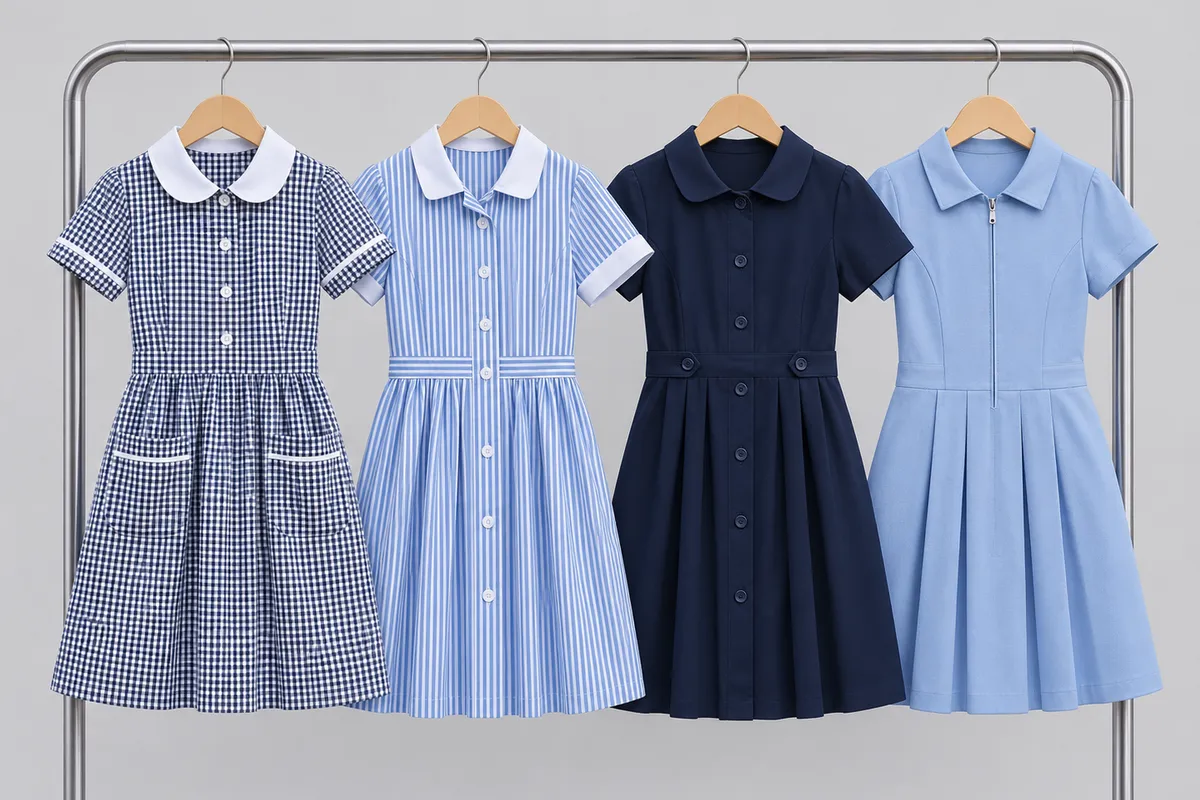
Most schools set school dress length for summer dresses at the knee or just below it. That length is easy to describe in a uniform policy, looks tidy when children sit on the floor, and still leaves room for growth across a school year. The finished length is set for each size in the agreed size chart, so every dress in that size comes out the same.
This post explains how schools choose a length, how it is measured and how it carries across a range of sizes.
What lengths do schools use?
| Length | Where the hem sits | Typical reason for choosing |
|---|---|---|
| Above knee | A few centimetres above the kneecap | Cool and active; less common in school policies |
| On the knee | Hem at the middle of the kneecap | Simple to describe; a common default |
| Just below knee | Hem a little below the kneecap | Allows a year of growth while staying within policy |
| Midi | Halfway between knee and ankle | Modest dress codes; a more formal look |
| Ankle or full length | Near the ankle | Specific dress codes; usually a different garment |
The just-below-knee length is popular because a child who grows over the year will still be close to the knee by the summer term. A dress made to sit exactly on the knee in September may be above it by June.
How is dress length measured?
Dress length is usually measured from the highest point of the shoulder, where it meets the neck, straight down to the hem. This is called the shoulder-to-hem or centre-back length, depending on where the tape starts. Both are common, so whichever one your size chart uses should be stated.
The length for each size is set in the size chart. When you approve the sample, check the length on a real wearer, not only on the flat garment. A dress that measures correctly flat can sit higher on a child with a longer body.
How does length grade across sizes?
Children grow faster in some years than others, so lengths do not rise by the same step in every size. A well-graded chart follows typical growth, with the dress length rising in proportion to height. When you set lengths:
- Decide the rule in words first (“hem just below the knee”)
- Check it on a wearer in at least two sizes
- Compare the small and large sizes side by side; the proportion should look the same
- Consider whether senior sizes need a longer length for modesty
- Decide whether a deeper hem should be added for letting down
Where a school’s policy uses wording like “no shorter than knee length”, a dress designed just below the knee gives some margin for growth.
Length and the school’s dress code
A clear length rule makes life easier for staff, families and the shop. Vague wording, such as “a sensible length”, leads to disputes. Writing a specific point on the leg, such as the knee, and showing it in a photo on the uniform list, avoids most arguments.
Some schools allow families to shorten dresses; others forbid it. If shortening is a recurring problem, a just-below-knee length with a modest hem depth gives less room to take up than a long dress with a deep hem. Our page for schools and school groups explains how schools set the details of their uniform with us.
Length and style together
Length interacts with the rest of the dress. A dropped waist makes a short skirt section look shorter. A full gathered skirt looks longer than an A-line dress of the same measured length, because it stands away from the leg. A belt raises the hem slightly when pulled tight. These effects are small, but they are why length should be judged on the finished sample rather than on paper.
Once approved, the length for each size is fixed and repeated on every order. Summer dresses start at a minimum of 50 pieces per style, sizes mixed. The styles and size range we make are on our school summer dresses page. Send us your length rule and size chart, or a current dress, and we will quote per style, by fabric, quantity and branding.
Questions buyers ask
Can different sizes have different length rules?
Yes. A school can set the hem on the knee for younger sizes and just below the knee for older students. The size chart records the length for each size, so the rule is built into production rather than left to judgement.
How much length should be allowed for growth?
Many schools simply choose a just-below-knee length, which allows a year of growth while staying within the policy. A deeper hem that can be let down is another option, though the let-down line may show on some fabrics.
Does dress length affect how the shop sizes children?
It can. If a child’s dress is too short but fits elsewhere, families often go up a size. A sensible length helps the shop fit by chest and age rather than by hem, which keeps the size spread steadier.