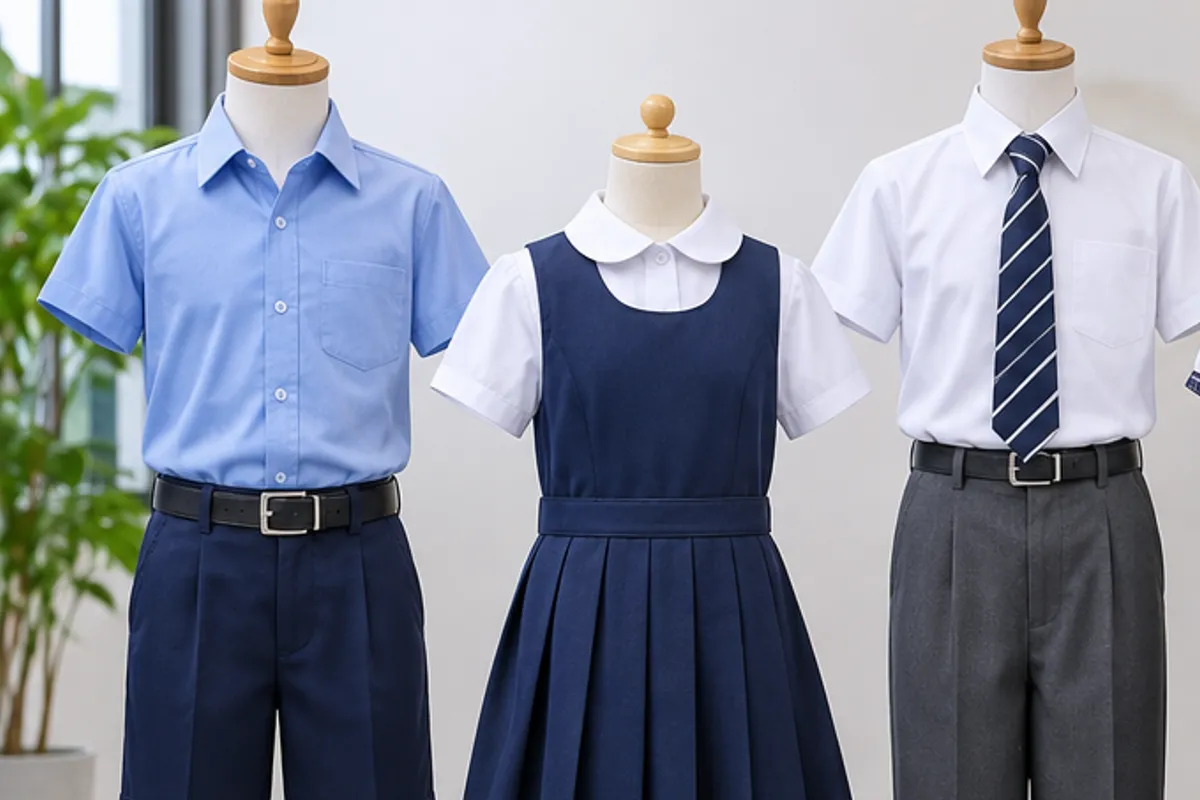
A half pant school uniform is the shorts that younger boys wear in many schools in India and across South Asia, the Gulf and parts of Africa, while “full pant” means long trousers for older classes. Planning the order means deciding at which class students move from half pant to full pant, splitting quantities around that point, and timing delivery for the start of the academic year.
The words are local, but the planning problem is the same as anywhere: two garments in one fabric, with a hand-over point that sets how much of each to buy.
Half pant, full pant and what they mean
In everyday school language in India and nearby countries:
- Half pant means shorts, usually with a waistband, pockets and a hem above the knee.
- Full pant means full-length trousers.
- Elastic half pant often refers to shorts with an elastic waist for the youngest classes.
We use your wording in quotations, tickets and size labels. Our shorts run from age 3–4 to 13–14, the elastic-back style up to 11–12, and trousers from age 3–4 up to 15–16 before senior waist sizes. Your size range is agreed for each order.
Where does the switch from half pant to full pant fall?
Each school decides. The table shows common patterns and what they mean for an order. Treat them as planning examples.
| Switch point | Half pant classes | Full pant classes | Order shape |
|---|---|---|---|
| After the early primary classes | Nursery to the early primary classes | Rest of primary and all secondary | Trousers lead |
| At the end of primary | Nursery to end of primary | Secondary only | Roughly balanced in a combined school |
| Seasonal | All primary in the hot months | All in the cool months | Two deliveries a year |
| By choice in upper primary | Younger classes | Older classes, with a choice in between | Hold both in the in-between sizes |
Once you know the switch point, count students on each side of it. That gives the split before sizes are even considered.
Planning quantities around the switch
A school buying direct, or a shop serving it, can work through these steps.
- Count students by class for the coming year, including new admissions.
- Place each class on the half pant or full pant side.
- Choose pairs per student, often two of each garment the student wears, more in the youngest classes.
- Add the students at the switch class, who may need both: half pants that still fit and their first full pants.
- Spread each total across sizes by age band, using last year’s issue or sales records.
Half pant and full pant are separate styles, each with a minimum of 50 pieces, with sizes mixed within each. Cut them from the same fabric and colour so the change at the switch class looks natural.
Timing for different academic years
Academic years vary. Many schools in India start in April or June. Schools following other curricula, in India or abroad, may start in August or September, and schools in the southern hemisphere start in January. Work back from your own start date:
- Confirm the start date and the date families collect uniform
- Allow time for sample and shade approval if the style is new
- Use the production lead time confirmed in your quotation
- Allow for shipping if the order is going abroad
- Keep a margin for late admissions in the first weeks of term
For schools in the Gulf or Africa that follow an Indian curriculum, the April start can fall at a different time from other local schools. Plan that calendar on its own.
Issuing half pants and full pants to students
Schools that issue uniform directly often hand it out by class. Packing by class or by size can be agreed in the quotation. A simple issue sheet per class, listing each student’s size in half pant or full pant, makes distribution quicker and gives you the size record for next year’s order.
Our page for schools and school groups explains how schools buy from us directly, and every trouser and shorts style is shown on our school trousers and shorts page. We manufacture in Konni, Kerala, India. Send your class list and switch point, and we will quote both styles.
Questions buyers ask
Should half pants have an elastic waist?
For the youngest classes, an elastic-back waist helps children dress themselves and fits a wider spread of sizes. From the middle primary classes, a fixed waistband with a button and zip usually looks neater. Many schools use both, split by class.
What length should a school half pant be?
Most sit above the knee, with the exact length set by the school. Give the length you want for each size, or send a pair you use now, and we confirm it on the sample before production.
Can half pants and full pants be in different colours?
They can, but most schools keep them the same so students look consistent across classes. If the colours differ, each needs its own shade approval, and the two styles cannot share a fabric order.