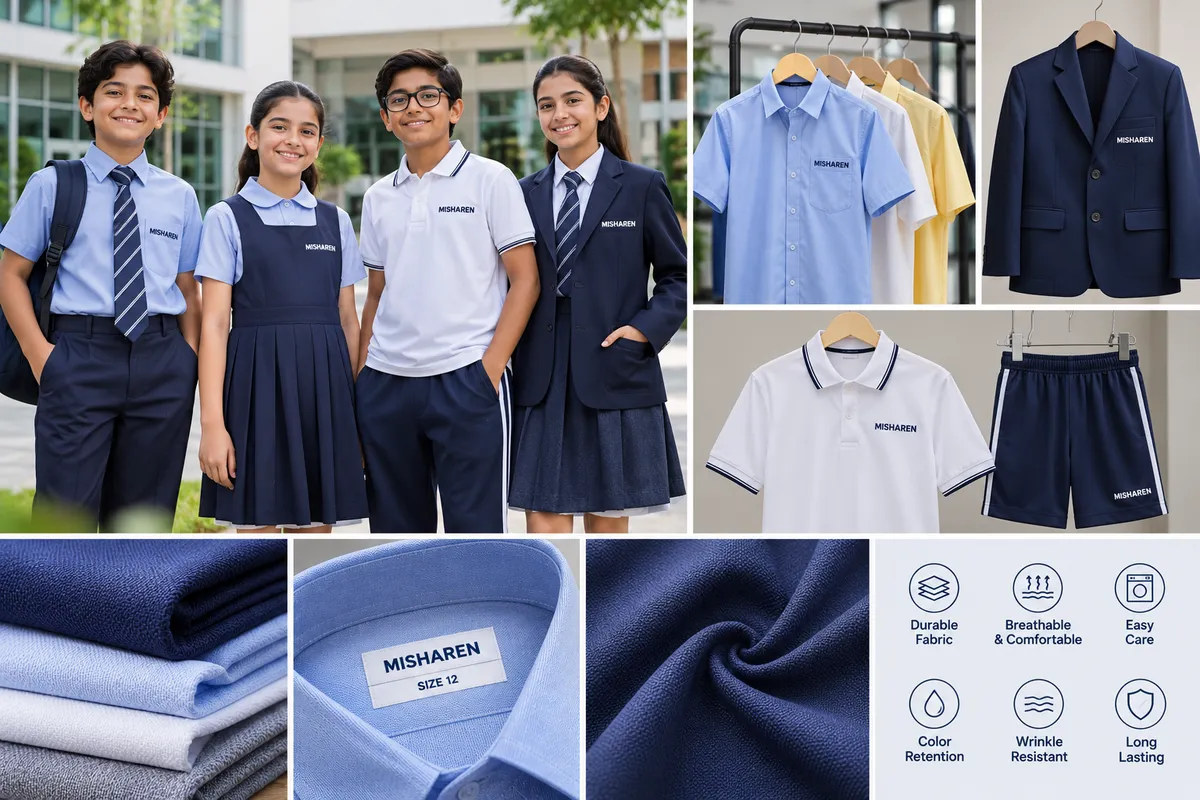
A school uniform designed for reuse is specified so each garment can pass from one child to the next, often several times, before it wears out. That means durable fabrics, a badge that does not change, construction that allows for growth, and no details that tie a garment to one year or one student. A school that plans for reuse at the design stage makes its pre-loved scheme far more effective, because more garments come back in a state worth passing on.
This guide is about the specification choices. Running the second-hand scheme itself is a separate task.
Why design for reuse?
Most uniform is outgrown, not worn out. A jumper bought for a seven-year-old may still be in good order when it no longer fits. If it can go to a younger child, the family who bought it gets value from it twice, and the next family pays nothing. That only works when the garment:
- still looks like the current uniform
- has kept its colour and shape
- carries no marks of its first owner beyond a name that can be removed
- fits a range of children in that size
Each of those points can be designed in.
Specification choices that help reuse
| Design choice | Helps reuse because | Applies to |
|---|---|---|
| Keep the badge stable for years | Old garments still match new ones | Every badged item |
| Avoid year-specific prints | A garment is not tied to one year group | PE kit, sweatshirts |
| Use firm, durable fabrics | Garments survive more washes and owners | Trousers, skirts, pinafores |
| Deep hems on skirts and pinafores | Length can be let down as the next child grows | Skirts, pinafores, dresses |
| Reinforced knees and seat | Trousers survive longer before wearing through | Trousers |
| A name panel on the label | Names can be changed without cutting the garment | Every garment |
| Plain colours with a matched shade | Fading shows less against new garments | Knitwear, polos |
A knitted jumper or cardigan in acrylic or cotton-acrylic, made to one approved shade and badge for several years, is one of the most reusable items on a uniform list. Poly-viscose school pinafores and tunics with a deep hem can serve two or three children each.
Badges, labels and names
The badge is where reuse most often fails. When a school updates its badge, every garment with the old badge becomes harder to pass on. If a change is planned, allow old-badge garments to stay in use, or keep the badge change for a single garment.
Labels matter too. A woven or printed own label can include a blank panel for names, so families write a name on the label rather than on the fabric. When the garment changes hands, the name is crossed out and replaced. Label design is confirmed with the sample.
Colour consistency across years
A garment bought three years ago should still look like part of today’s uniform. That depends on each reorder being made to the same approved sample, with the same shade. Keep a sealed sample of each garment and send it with each reorder. Avoid small colour changes that mark older garments out.
Planning for reuse in the size range
A pre-loved scheme runs more smoothly when garments come back in all sizes. A generous fit within each size, rather than a close fit, lets a garment suit a wider range of children. That is a fit decision to make with the sample.
Checklist for a reuse-friendly specification
- Badge design fixed for the long term
- No year-group or date prints on everyday items
- Durable fabric for every lower-half garment
- Deep hems on skirts, pinafores and dresses
- Labels with space for a name
- Shade recorded and matched on every reorder
Our page for schools and school groups explains how a school’s specification is sampled and approved. Send us your uniform list with the reuse features you want, and we will quote each style.
Questions buyers ask
Do reuse-friendly garments look different from ordinary uniform?
No. The changes are in fabric choice, hem depth, label design and long-term consistency. A student wearing a reuse-friendly jumper looks exactly like one wearing any other, which is what makes passing garments on comfortable for families.
Should leavers’ hoodies be designed for reuse?
Leavers’ hoodies are usually personal keepsakes with names and a year printed on them, so they are not meant for reuse. Keep year-specific designs to those garments and leave the everyday uniform free of them.
Does a durable fabric feel heavier to wear?
Not necessarily. Firm fabrics such as poly-viscose resist wear without being heavy. The sample is the place to judge weight and feel, and to balance durability against comfort for the climate.