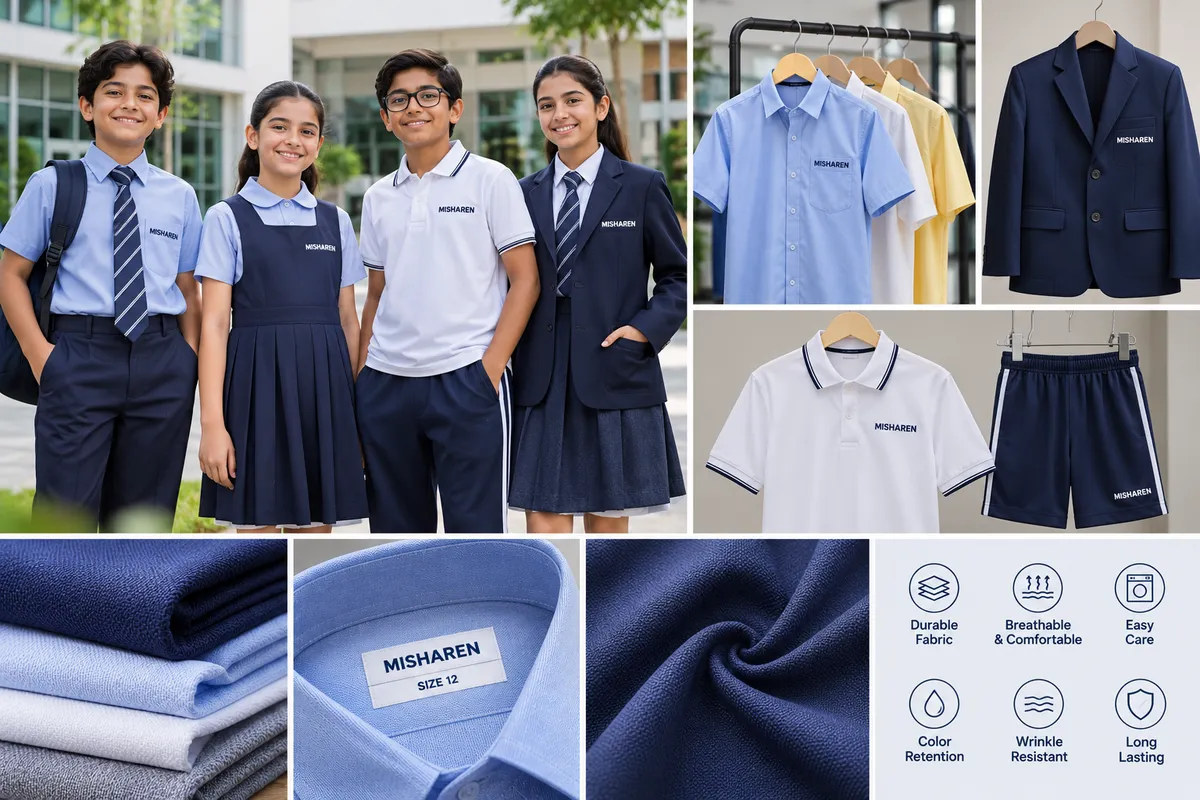
New school uniform design is easiest as a sequence: fix the school’s colours and badge, choose the garments for each age group, then write a short specification for every garment so a manufacturer can make a sample. A new school has no old stock and no habits to protect, which is a freedom, but it also means every choice has to be made on paper before anyone can see it.
This guide is for founders, heads and business managers setting up a school from scratch. It follows the order in which decisions usually fall into place, from the look of the uniform to the details a sample needs.
Where does uniform design start for a new school?
It starts with identity, not garments. Before you pick a single shirt, settle three things:
- A main colour and one or two supporting colours. The main colour usually goes on the knitwear, blazer or sweatshirt, because those are the garments people see from a distance. Supporting colours appear on trims, ties sourced separately, or a check skirt.
- The badge. A new school often has a logo designed for its website and signage. Check that it works small and in a few thread colours, because it will be embroidered on a jumper or printed on a polo.
- The tone of the school. A formal uniform with blazers sends a different message from a polo-and-sweatshirt uniform. Neither is right or wrong, but the choice shapes the whole list.
Write these down in a single page and get the leadership team to agree to it before any garment work begins. Changing a main colour later means changing every sample.
Choosing the garments for each age group
Most schools end up with a core everyday uniform, a cold-weather layer and PE kit. The detail changes with age. The table below shows a typical starting point that you can adapt.
| Age group | Everyday top | Bottom half | Cold-weather layer | Sport |
|---|---|---|---|---|
| Nursery and reception | Polo shirt | Elastic-back shorts or trousers, pinafore | Sweatshirt or sweatshirt cardigan | Not usually separate |
| Junior years | Polo shirt or shirt | Trousers, shorts, skirt, pinafore or summer dress | Sweatshirt or knitted jumper | PE T-shirt and shorts |
| Senior years | Shirt or blouse | Trousers or skirt | Knitted jumper, blazer or both | PE kit and tracksuit |
Use it as a sketch, not a rule. A school in a hot climate may drop the blazer altogether. A school with a strong sports culture may add a tracksuit from the first year. What matters is that every garment on the list has a reason to be there, because each style is a separate order with its own minimum.
Keep the style count in proportion
Each new style adds a sample, a stock line and a minimum quantity. Our minimum is 50 pieces per style for woven garments and 100 for knitwear and sportswear, with sizes mixed inside a style. A new school with a small first intake should keep the list short and add garments as numbers grow.
Writing a specification a manufacturer can sample
Once the list is agreed, describe each garment in enough detail that a sample can be cut. For a school polo shirt that means the fabric (poly-cotton or polyester piqué), the colour, the collar style, the sleeve length and where the logo goes. For a knitted jumper or cardigan, it means the neckline, the yarn, any striped trim and the badge position.
For each garment, write down:
- the style name and the age groups it is for
- the fabric and colour, with a physical reference if you have one
- logo method and position: logo embroidery or printing is available, and the size is confirmed on the sample
- label: our neck label or your own woven or printed label
- the size range you expect to need
How do you test the design before the first order?
Ask for a sample of each style, made in your colours with your badge. Lay the samples out together, because a jumper that looks right alone can clash with the skirt next to it. Put them on a mannequin or a student volunteer if possible, and look at them in daylight.
Expect to change something. A badge may need a larger size on the jumper than on the polo. A grey may read too blue next to the navy. These are small fixes at sample stage and costly ones after production. Our page for schools and school groups explains how sample approval fits into an order.
Lead time is confirmed in the quotation. A new school should plan backwards from its opening day and allow a full round of sample changes, because there is no previous uniform to fall back on.
When the colours, badge and garment list are agreed, send them to us with your expected size range and we will quote per style, by fabric, quantity and branding. We manufacture in India and take enquiries from schools in any country.
Questions buyers ask
Should a new school copy the uniform of a nearby school?
It is better not to. A uniform close to a neighbouring school’s causes confusion on buses and in town, and makes lost items hard to return. Choose colours and a badge that are clearly your own, even if the garment types are similar.
How many garments should a first uniform list include?
Keep it to what students wear every week: an everyday top, a bottom half, a cold-weather layer and PE kit. Optional extras such as blazers or summer dresses can be added in a later year once you know how many students you have.
Can we change the design after the first year?
Yes, but each change creates a mix of old and new garments in school. Small changes such as a badge position are easy. Changing a main colour affects every garment, so it is worth getting the colours right before the first order.
Do we need a designer to create the uniform?
Not usually. Most schools work from a clear brief, colour references and a logo file. The sample is where the design becomes real, and changes are made at that stage before bulk production starts.