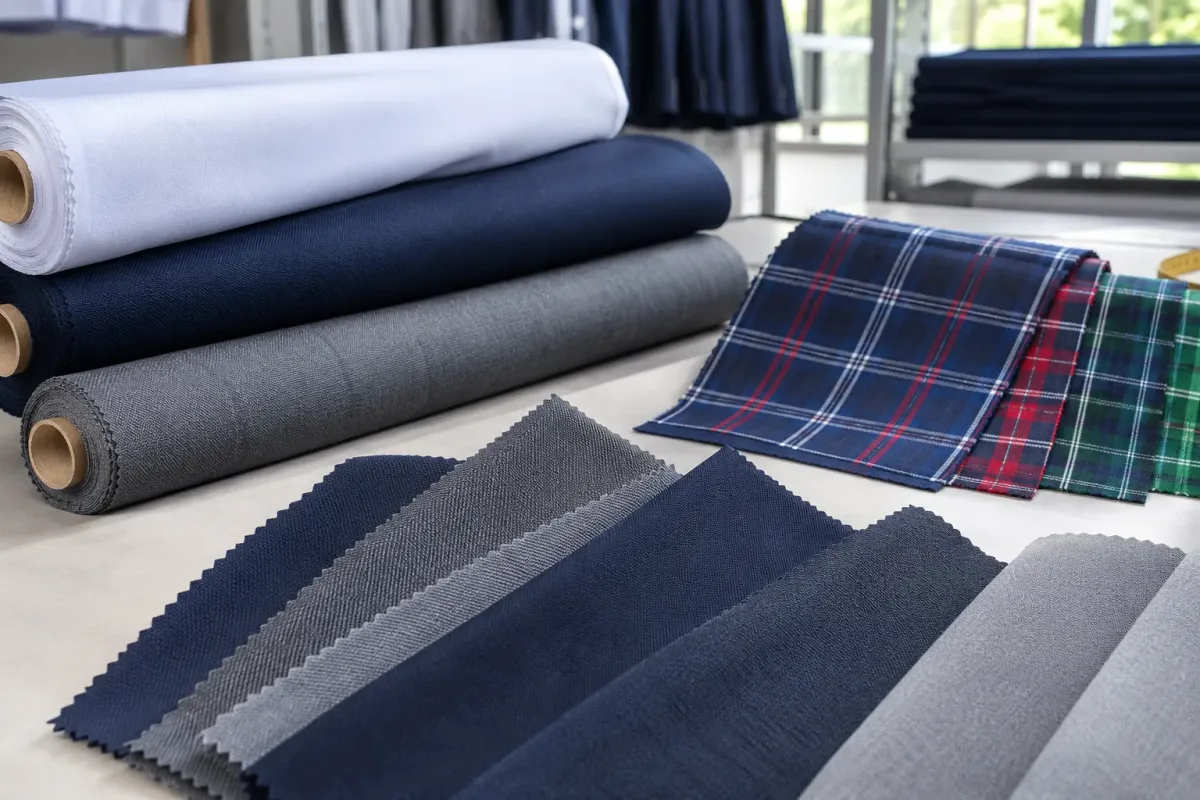
A school check colourway is the set of colours, and their proportions, woven into a check fabric used for skirts, pinafores or summer dresses. A good colourway takes its ground colour from the main uniform colour, adds one or two lines from the school’s accent, and keeps the number of colours small enough to match reliably on every reorder.
A check is the most recognisable fabric on many uniform lists. It is also the hardest to change once chosen, because new fabric must be woven to match. Time spent designing it is time well spent.
What makes up a check colourway?
A check is built from a few elements. Each one affects how the fabric looks from a distance and how it sits with the plain garments.
- Ground colour. The colour that covers most of the cloth. It sets the overall tone.
- Overcheck lines. The narrower lines that cross the ground. They carry the accent.
- Number of colours. Most school checks use between two and four.
- Scale. The size of the repeat. Small checks look neat on young pupils; larger checks look bolder on older ones.
Ginghams are a simple form of check, made from one colour and white in equal stripes both ways. Tartans and multi-colour checks are more complex.
How should the check relate to the plain garments?
The check rarely stands alone. A check skirt is worn with a plain jumper, a check pinafore with a plain blouse, and a gingham dress with a plain cardigan. The colourway should connect them.
| Check garment | Worn with | Ground colour should | Overcheck should |
|---|---|---|---|
| Pleated skirt | Plain jumper or blazer | Match or sit close to the jumper | Pick up the trim or badge colour |
| Pinafore | Plain blouse and cardigan | Match the cardigan | Pick up the blouse colour or an accent |
| Gingham summer dress | Plain cardigan or sweatshirt | Use the school’s main colour | White, by definition of gingham |
| Kilt-style skirt | Plain trousers for other pupils | Contain the trouser colour | Carry the school accent |
If boys or other pupils wear plain trousers, choose a trouser colour that appears in the check, usually the ground or the darkest line. Then the two read as one uniform in a group.
Practical rules for a new check
- Start from the plain garments. Fix the jumper, blazer and lower garment colours first, then build the check from them.
- Limit the colours. Each colour in the check is a yarn to dye and match on every reorder. Three is usually plenty.
- Test at a distance. A check that looks lively close up can blend into a muddy tone across a playground. Step back before you approve.
- Think about wear. Mid-tone grounds hide marks better than very pale ones.
- Check the scale on small sizes. A large repeat can look out of proportion on a skirt for a young child.
- Keep a generous cutting. Once approved, store a piece covering at least two repeats for reorders.
Our check skirts are made in yarn-dyed fabric, where the colours run through the yarn rather than sitting on the surface. Yarn-dyed checks and ginghams are matched to a fabric sample. See our page on fabrics and colour matching for how swatches are approved.
When the check already exists
If a school already has a check, the job is to match it, not redesign it. Send a piece covering at least two full repeats. If you want to adjust the colourway, for example to brighten a faded overcheck, treat it as a new design and approve a fresh swatch.
Yarn-dyed checks are used on our school skirts and skorts, and ginghams on summer dresses; ask at quotation if you want a check on another garment. Each check garment is its own style, from 50 pieces per style. Send us your colour ideas or an existing piece, and we will quote each style by fabric, quantity and branding.
Questions buyers ask
How many colours should a school check have?
Two to four is typical. Two-colour checks and ginghams are simple and easy to match. Three or four colours give a richer look but add yarns to dye and approve, and more chances for a single line to drift between orders.
Can the same check be used for skirts and summer dresses?
It can, though most schools use a heavier check for winter skirts and a lighter gingham or stripe for summer dresses. If you want one check for both, ask how it behaves in each fabric weight before approving.
Should the check match the blazer colour?
The ground or darkest line of the check usually sits well with the blazer, but it does not need to match exactly. What matters is that the skirt and blazer look related when worn together, which is easiest to judge on the sample.