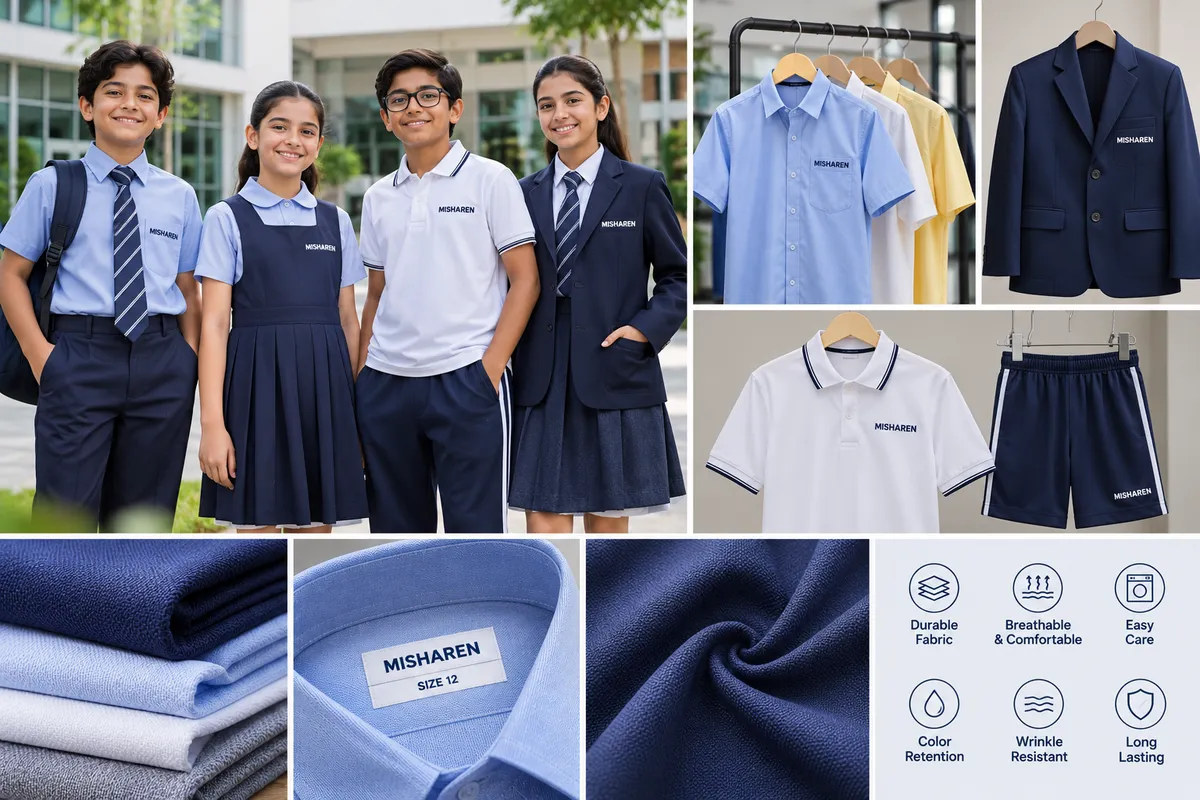
A charity school uniform programme buys new uniforms in bulk and delivers them to children who would otherwise go without. The planning has four parts: deciding which garments to provide, choosing plain or school-branded versions, arranging packing so each school or distribution point gets the right items, and running the programme the same way each year so families know what to expect.
We manufacture the garments; the charity decides who receives them. This guide covers the buying and logistics side of a programme, from the first enquiry to repeat years.
Which garments should a programme provide?
Start with the items families find hardest to afford and that children wear every day. A typical core set looks like this:
| Garment | Plain option | Logo option |
|---|---|---|
| Shirt or polo shirt | White shirt or white polo | Polo in a school colour with the school badge |
| Trousers or shorts | Grey or navy | Same, usually without a badge |
| Skirt or pinafore | Grey or navy pleated | Same, or a school check |
| Jumper or sweatshirt | Navy, grey, maroon or bottle green | School colour with badge |
| PE kit | White T-shirt and navy shorts | House or school colour with badge |
Plain garments in common colours suit programmes that serve many schools, because one item fits several uniform lists. Logo garments suit a programme working closely with a small number of schools, where children should look the same as their classmates.
Plain or logo: deciding per garment
Most programmes mix the two. Lower-half garments are usually plain in every school anyway, so a grey trouser or navy skirt serves everyone. Tops are where schools differ. Some programmes buy plain school shirts and blouses and a plain knitted jumper in the most common colour, and add logo garments only for schools where the badge is compulsory.
Each colour and each logo version is a separate style for ordering. Woven styles start at 50 pieces and knitted ones at 100, and a programme can mix sizes freely inside each. Keeping the number of colours small helps a programme meet those minimums.
Packing for distribution
How garments arrive decides how much sorting volunteers do. Agree packing before production.
- By set: a shirt, trousers or skirt and a jumper bagged together by size. Easy to hand out, but sizes in a set must match.
- By garment and size: single garments packed by size, so distributors can mix sizes for each child.
- By school or distribution point: cartons labelled for each destination, with a packing list inside.
Many programmes combine these: single garments by size, in cartons labelled by school. Packing is confirmed in the quotation.
A timeline for each programme year
Plan the year backwards from the date the uniforms are handed out.
- Confirm the schools or areas served and the number of children per age band.
- Send an enquiry with garments, colours, logos and packing instructions.
- Approve samples of each style, including any logo.
- Pay the advance so production can start.
- Production and quality check.
- Dispatch after the balance is paid, with shipping terms confirmed in the quotation.
- Distribution to schools, families or collection points.
Lead time is confirmed in the quotation. Leave time after delivery for sorting and handing out before term begins. Our page for charities and uniform programmes sets out the details we ask for.
Running the programme year after year
The second year is easier than the first. Repeat orders are made to the same approved sample, so garments match those already given out. Keep a record of what was ordered, which sizes ran short and which were left over, and adjust the size split each year. Families who know what the programme provides, and when, can plan around it.
If you are setting up or renewing a programme, send us the garments, colours, age bands and packing needs, and we will quote each style by fabric, quantity and branding.
Questions buyers ask
Can a programme order uniforms for schools in more than one country?
Yes. We take enquiries from buyers in any country. Shipping method, terms and documents are confirmed in the quotation, and cartons can be labelled for each destination so the garments are easy to sort on arrival.
Should a charity buy one size up to allow for growth?
Many programmes lean slightly towards larger sizes because children grow through the year. Base the split on the ages served, then shift a small share to the next size up. Records from the first year will show whether the shift was right.
Do children receiving charity uniforms look different from classmates?
Not if the programme buys the same garments the school uses, in the same colours and with the same badge where required. Plain items like trousers and skirts are identical to any other student’s.