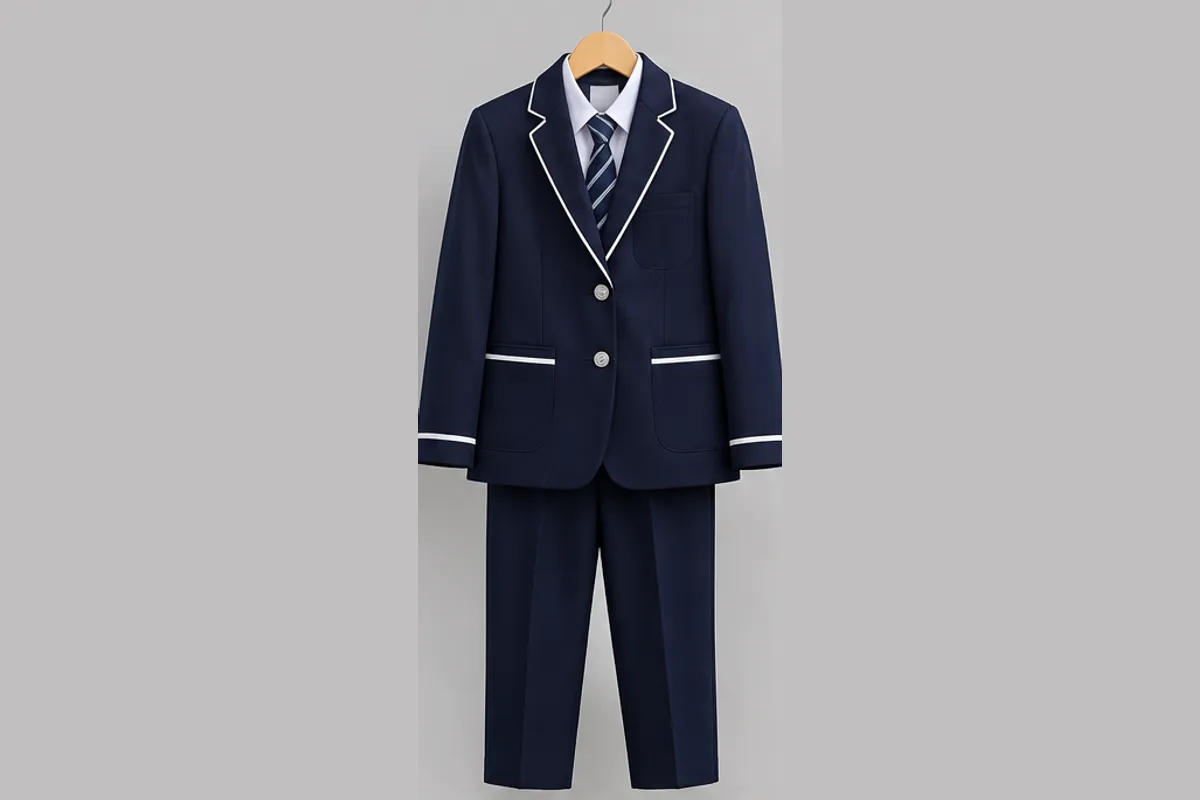
Branding a school uniform range means setting rules once, then applying them to every garment: which version of the badge appears, in which colours, at what size and position, and which label sits inside. When those rules are written into a single brand sheet, a blazer, a jumper, a polo and a PE T-shirt bought in different years still look like one family. Without them, each garment drifts a little, and the uniform starts to look patched together.
Think of the uniform as one range
Schools and shops often specify uniform one garment at a time, as needs arise. A polo is added one year, a fleece the next, a new PE top after that. Each is sampled separately, and each comes out slightly different: a badge a little larger, a thread colour a little warmer, a different neck label.
The fix is to step back and write a brand sheet for the whole range before the next order. It takes an afternoon and saves years of small mismatches.
What goes on a brand sheet
| Element | What to fix | Example of a rule |
|---|---|---|
| Badge versions | Which versions exist and where each is used | Full crest on blazers; compact crest on knitwear and polos |
| Badge colours | Named references for every colour | Gold, red and white, each with a reference |
| Badge widths | Width per garment | Polo and jumper the same width; shirt pocket smaller |
| Badge positions | Height and side per garment | Left chest, measured from shoulder seam |
| Method | Embroidery or print per garment | Embroidery on knitwear; print on PE T-shirts |
| Garment colours | Shade references for each colour used | One navy for jumpers, sweatshirts and blazers |
| Labels | Neck and waistband label style | One woven brand label across the range |
| Packing | Sticker layout and polybag style | Same sticker on every item |
The brand sheet becomes the document that every new garment is specified against.
Steps to brand a range
- Collect what you have. One of each current garment, plus the logo files used for each.
- Lay the garments out together. Note where badges differ in size, colour or position.
- Choose the master version of each element: one badge file, one set of colour references, one label.
- Write the brand sheet using the table above.
- Re-sample the garments that do not match. Logo embroidery or printing is available on all of them. The method, size and position are confirmed with each sample against the brand sheet.
- Approve the samples as a set, side by side.
- Use the brand sheet for every future garment, including anything added later.
Step 6 is where most of the value lies. A polo that looks fine on its own may look wrong next to the jumper that is worn over it.
Shops that brand their own range too
A uniform shop has two brands to manage: each school’s badge, and its own label. The same principle applies to the shop’s side. Use one label style, one sticker layout and one packing style across every school you serve. Customers then recognise the shop’s range, whichever school they buy for.
- One neck and waistband label design for every garment
- One polybag sticker layout
- One carton labelling format
- A brand sheet per school for badges and colours
- A shared folder with every school’s approved artwork
Our page for schools and school groups explains how a school’s complete uniform list is quoted and sampled. Knitted jumpers are often where branding drifts first, because they are reordered in winter batches; see our knitted jumpers and cardigans page. The full set of label and packing options is on our logos, embroidery and labels page.
We manufacture in India to the buyer’s specification, and each repeat order is made to the approved sample. Send your current garments’ details and your brand sheet, or ask us to help you put one together, and we will quote the range as a whole.
Questions buyers ask
Does every garment need the same badge size?
Not necessarily. A brand sheet can set different widths for different garments, such as a smaller badge on a shirt pocket than on a sweatshirt. What matters is that each width is written down and used every time the garment is reordered.
How often should a school review its uniform branding?
A review whenever a new garment is added, or when a supplier changes, catches most drift. Laying one of each current garment side by side once a year is a simple way to see whether the range still looks consistent.
Can a shop’s own label sit inside a school-branded garment?
Yes. The school badge sits on the outside and the shop’s label sits inside, at the neck or waistband. This is common for shops that sell under their own name across several schools.