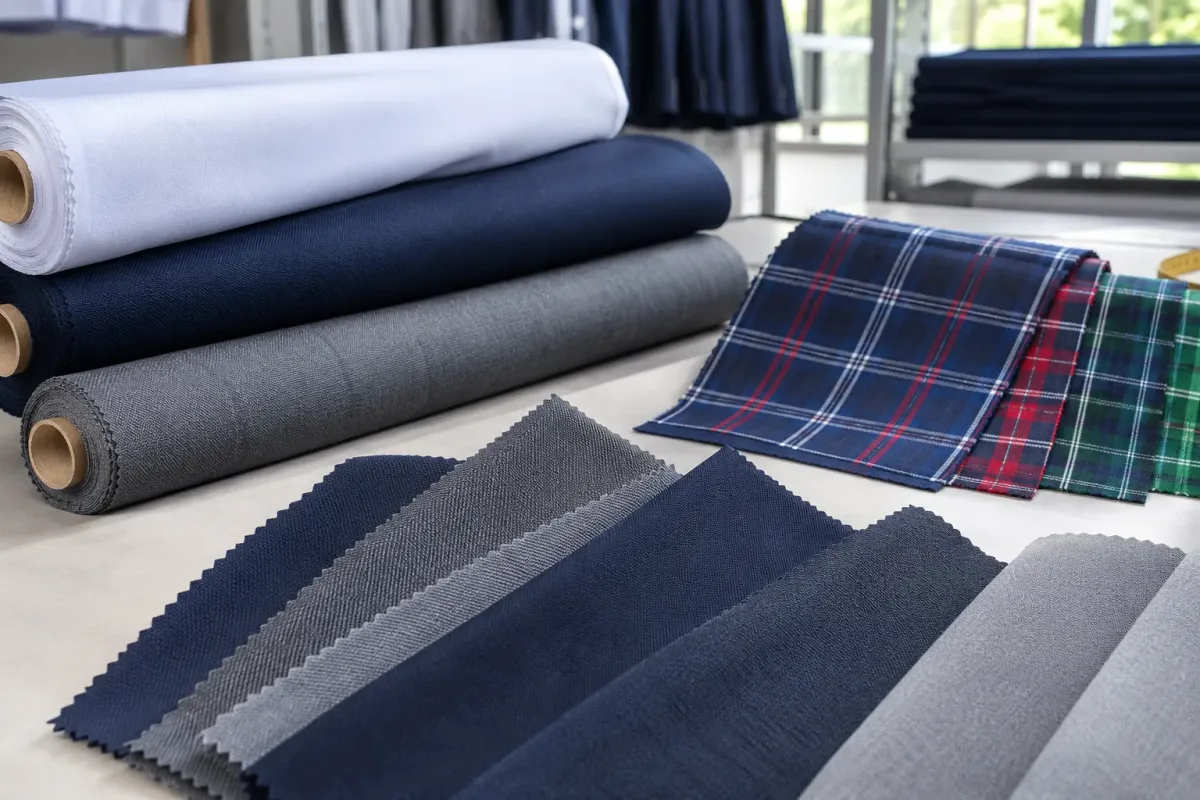
School uniform procurement from overseas needs a few internal decisions that a local purchase does not: who can approve paying an advance to a supplier abroad, who is responsible for the import at your end, who signs off samples that arrive by courier, and what the fallback is if goods arrive late. Settling these before the enquiry keeps the order from stalling inside your own organisation.
This checklist is for schools, school groups, charities and shops whose purchasing rules were written with local suppliers in mind. It does not replace your own policies; it highlights the points that change when the maker is in another country.
Before the enquiry: internal approvals
Most delays on overseas orders happen on the buyer’s side, at points where nobody was sure who could decide. Name those people first.
- Who approves the purchase, and up to what value
- Who can approve an advance payment to a supplier in another country
- Who signs off samples, and who can overrule them
- Who handles import arrangements and paperwork at your end
- Who receives the goods and checks them on arrival
- Who talks to the supplier day to day
If one person holds several of these roles, that is fine, but make sure they will be available across the whole order, including school holidays.
The overseas-specific steps, in order
The steps below follow the order an overseas purchase runs in, with the internal action each one triggers.
| Stage | What happens with the supplier | Internal action |
|---|---|---|
| Specification | You send garment list, sizes, colours, logo | Specification agreed by whoever owns the uniform |
| Quotation | Written quotation per style, with terms | Purchase approved against your budget |
| Samples | Physical samples arrive by courier | Sign-off by the named approver, in writing |
| Advance | Advance paid to start production | Payment approved and made to an overseas account |
| Production and check | Bulk made and checked against the sample | Progress tracked; evidence requested if needed |
| Balance and dispatch | Balance paid; goods shipped | Second payment approved; import arrangements ready |
| Arrival | Goods arrive in your country | Receipt, count and check; any issues reported |
Payment in two stages is often the point that needs a policy check. Some organisations’ rules assume payment after delivery; an overseas order is usually an advance to start production and the balance before dispatch. Confirm early that your finance team can work that way.
Import responsibility
Who arranges what at the border depends on the terms agreed in the quotation. Requirements, duties and documents vary by country, and we do not give advice on them. Before ordering, ask whoever handles imports for you, such as a customs broker or freight agent, what they need from the supplier, and include it in your enquiry.
Plan a fallback
An order shipped across the world has more points where time can be lost. A fallback plan does not mean expecting failure; it means knowing what you will do if a date slips.
- Keep a small stock of the previous year’s garments in the most-needed sizes.
- Decide which garments families can wear temporarily if new ones are late, such as last year’s PE kit.
- Know which styles could be split off and shipped separately if one holds up the rest.
- Agree with the supplier, at quotation, how delays will be communicated.
Simple garments with a short sampling stage, such as school summer dresses in a stock gingham or PE kit in standard colours, are lower risk than a new blazer or a matched check. Put the higher-risk styles at the front of the schedule.
After delivery: closing the purchase
When the goods arrive, close the purchase properly so the next order starts from a good record. Count cartons against the packing list, check a sample of garments against the approved sample, report any issue promptly, and file the approved samples, the quotation and the decision trail together.
Our minimum order and samples page sets out the minimum per style: 50 pieces for woven garments and 100 for knitwear, sizes mixed. Send your list and your internal timetable, and we will reply with a quotation that fits it.
Questions buyers ask
Can our tender or purchasing paperwork be used with an overseas supplier?
Yes. Send us your documents with the enquiry, and we respond to the specification and questions in them. Points that depend on your country’s own rules, such as import terms, should be checked at your end.
Who should sign off samples for a school buying from overseas?
The person who owns the uniform decision, often a head teacher, bursar or uniform committee lead. Name them before samples arrive, and give them a deadline, so approval does not wait for a meeting that is weeks away.
What records should we keep after an overseas uniform order?
Keep the quotation, written sample approvals, the decision log, the packing list and one approved sample of each style. Together they let any reorder be placed quickly and matched exactly to the first.