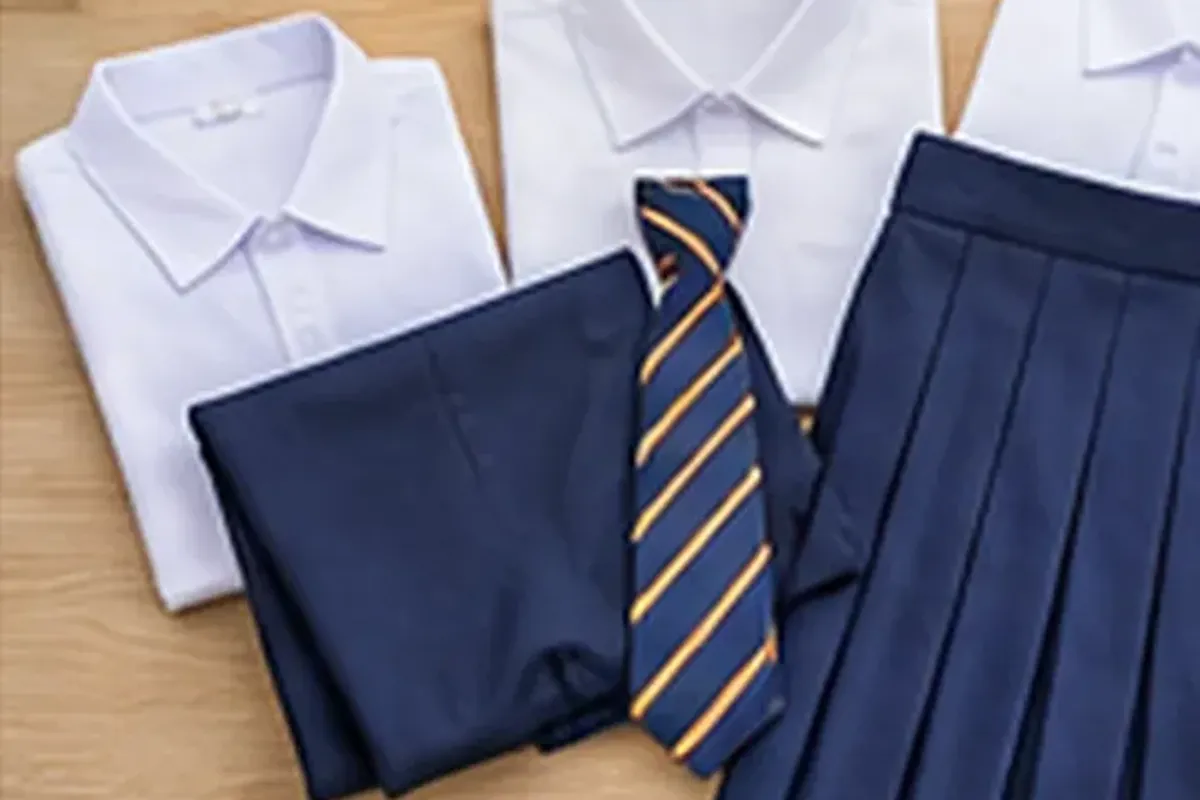
A box pleat school skirt has pairs of folds turned away from each other, so each pleat forms a flat panel on the outside with the folds meeting behind it. To specify one, give the width of each box on the face, the number of boxes round the skirt, the depth folded in behind, and how far down the pleats are stitched. Those four numbers decide how the skirt looks on the hanger and on the child.
Box pleats give a skirt a squared, structured look that stays neat when a student sits and stands all day. They are a common choice for primary and junior skirts because the flat panels hide small creases well.
What does a box pleat look like from the outside?
From the front, a box pleat skirt shows a row of flat panels separated by vertical lines where the folds meet. Each panel is the “box”. Behind each box, the fabric folds in on both sides, so two folds face each other under the panel. When the student walks, the folds open a little and close again.
The width of the visible box is the main thing a school notices. Wide boxes read as bold and simple. Narrow boxes look busier and closer to a knife pleat skirt from a distance.
The numbers that define the layout
Buyers sometimes describe a box pleat skirt only as “box pleated, navy, knee length”. That leaves a lot open. A clear layout uses these measurements:
| Measurement | What it controls | How to give it |
|---|---|---|
| Box width on the face | How bold or busy the skirt looks | Centimetres, measured at the hip line |
| Number of boxes | How the pleats are spaced round the body | Total, or front and back counts |
| Fold depth | Swing and fullness when walking | Centimetres folded behind each side |
| Stitched-down length | How the skirt sits over the hip | Centimetres from the waistband seam |
| Position of the first box | Whether a box or a fold sits at centre front | “Box at centre front” or “fold at centre front” |
The last row is often overlooked. Most schools want a full box centred on the front, so the skirt looks symmetrical. If a seam or zip must fall on a fold, the layout is planned round it.
Does the box width change across sizes?
On a well-graded skirt, the number of boxes usually stays the same across sizes and the box width grows a little as the waist grows. Some buyers prefer a fixed box width and add a box in larger sizes. Either works; it just needs stating so each size in your range is graded the same way.
Box pleats and fabric choice
We make pleated skirts in poly-viscose or polyester twill, with yarn-dyed check as a further option. The fabric affects how crisp the box edges stay:
- Poly-viscose gives a softer, slightly fuller box that drapes well.
- Polyester twill holds a sharper edge and recovers well after washing.
- A check fabric adds the question of where the check lines fall on each box face.
Deeper folds behind each box use more fabric. That makes the skirt fuller and a little heavier, and it is one of the points that changes the quotation. If you want to compare two depths, ask for them side by side on the sample.
Common box pleat variations
A few layouts come up again and again on school lists:
- Box pleats all round. Even boxes on the front and back. The most traditional look.
- Box pleats on the front only. A plain back panel with an elastic-back waistband, which suits younger sizes.
- A single centre box with knife pleats either side. A mixed layout some schools use to give the skirt a clear centre line.
- Wide box pleats with a short stitched section. Gives more swing from the hip down.
If your current skirt follows one of these, say so and send the garment. If you are designing a new skirt, choose the layout first and then the numbers.
Writing it into your enquiry
A useful box pleat specification sits on one line per measurement. Uniform shops that stock skirts for several schools often keep one box layout across all their plain colours, which keeps stock simple. Our page for uniform shops and retailers explains how we handle ranges like that, and the styles we make are on our school skirts and skorts page.
We manufacture in India and fix the pleat layout on the approved sample, so repeat orders follow the same boxes. Send us your current skirt or your box width, count and stitched length, and we will quote each style by fabric, quantity and branding.
Questions buyers ask
Is a box pleat skirt harder to iron than a knife pleat skirt?
Box pleats are usually easier for families to press because each flat panel can be ironed on its own. Knife pleats all lie one way and need lining up one after another, which takes longer.
Can a box pleat skirt have an elastic back?
Yes. A common junior layout has box pleats across the front panel and a flat back with elastic set into the waistband. The pleats stay even at the front while the back gives a little stretch for comfort and growth.
How do I measure box width on a skirt I already sell?
Lay the skirt flat and measure across one visible box at the hip line, from fold edge to fold edge. Count the boxes all the way round, then measure from the waistband seam to where the stitching on the pleats stops.