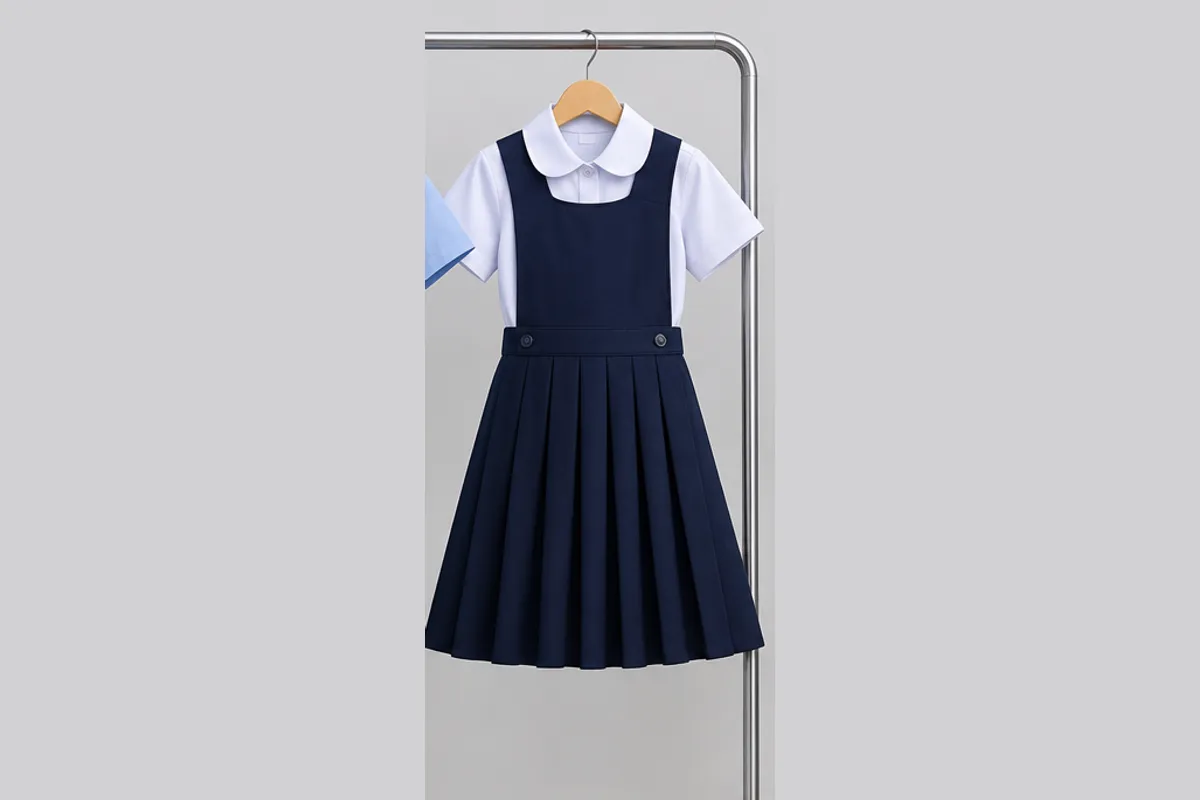
A zip front pinafore opens from the neckline down the centre front, so a child can step into it, pull it up over a blouse and zip it closed without help. When you specify one, the zip itself is the key decision: how far it runs, whether it matches or contrasts with the fabric, and what kind of pull sits at the top. Getting those right is what makes the style work for young children.
Schools and shops choose this style mainly for independence. Children who can dress themselves after PE or a messy activity save time for staff, and parents notice how easy the garment is on a busy morning.
How far should the zip run?
There are two usual lengths.
To the waist seam. The zip opens the bodice only. The skirt stays closed, which keeps the front of the skirt neat and the pleats unbroken. The child steps in feet first and pulls the dress up.
Further into the skirt. A longer zip opens the garment wider, which helps on smaller sizes and with children who find stepping in awkward. It does break the front of the skirt, so it suits A-line or side-pleated skirts better than pleats all round.
Choose by age band if you like: a longer zip on the smallest sizes, a waist-length zip from the middle sizes up. That is a pattern decision we agree at the sample stage.
Matching or contrast zip?
| Option | How it looks | When buyers choose it |
|---|---|---|
| Zip tape matched to the fabric | Discreet; the zip almost disappears | Schools wanting a plain, smart front |
| Contrast zip tape, for example white or a house colour | Visible stripe down the front | Where the zip is a design feature, or to help children find it |
| Concealed zip | Only the pull shows | A dressier look on older sizes |
| Exposed metal-look or chunky teeth | Sporty, robust appearance | Rare on school pinafores; ask on the sample |
Most bulk orders use a tape matched as closely as possible to the body colour. Zip tapes come in set shades, so an exact match to a custom fabric shade is not always possible; we show you the nearest on the sample.
The pull and the top stop
The pull is the part a child holds. For young children, a larger pull, or a small fabric or cord loop through it, is easier to grip than a plain slim pull. Ask for that on the specification if the garment is for nursery or reception.
At the top, the zip should finish below the neckline edge with a neat stop, so it does not scratch the chin. A small fabric guard behind the top of the zip adds comfort. We follow your current garment on these details or propose them on the sample.
Where does the logo go?
With a zip running down the centre, the logo cannot sit in the middle. It goes on the left chest, beside the zip, at a size that fits the narrower panel. Logo embroidery or printing is available, and the exact size and position are confirmed on the sample.
Fabric, colour and the rest of the order
The zip front pinafore is made in poly-viscose or polyester twill, in grey, navy, bottle green, maroon, or a colour matched to your reference. Many schools put it on the list beside a skirt in the same shade for older girls, so send that skirt as your colour reference.
The minimum is 50 pieces per style, with any size mix. See the other styles and sizes on the school pinafores and tunics page. If you are a school setting up a new junior uniform, our page for schools and school groups explains how direct orders run.
Specification checklist
- Zip length: to the waist, or into the skirt
- Zip tape: matched, contrast or concealed
- Pull: standard, large, or with a loop
- Skirt style that suits the zip length
- Logo: left chest, or plain
- Fabric and colour reference
- Size range and mix
Send the list with a photo of any style you already sell, and we will quote per style, by fabric, quantity and branding, with the lead time stated.
Questions buyers ask
Do zip-front pinafores wear out faster than button styles?
A zip is one more part that can be strained, mostly by being pulled when not fully opened. A sensible zip length for the size and a clear care note to close zips before washing help it last.
Can the zip be at the back instead?
Yes, but then the garment is no longer a zip-front style and the child usually needs help. If independence is the reason for choosing it, keep the zip at the front.
Should the zip be lockable?
A locking slider stays where it is put, which stops the zip sliding open during play. It is worth asking about on the sample for the younger sizes.