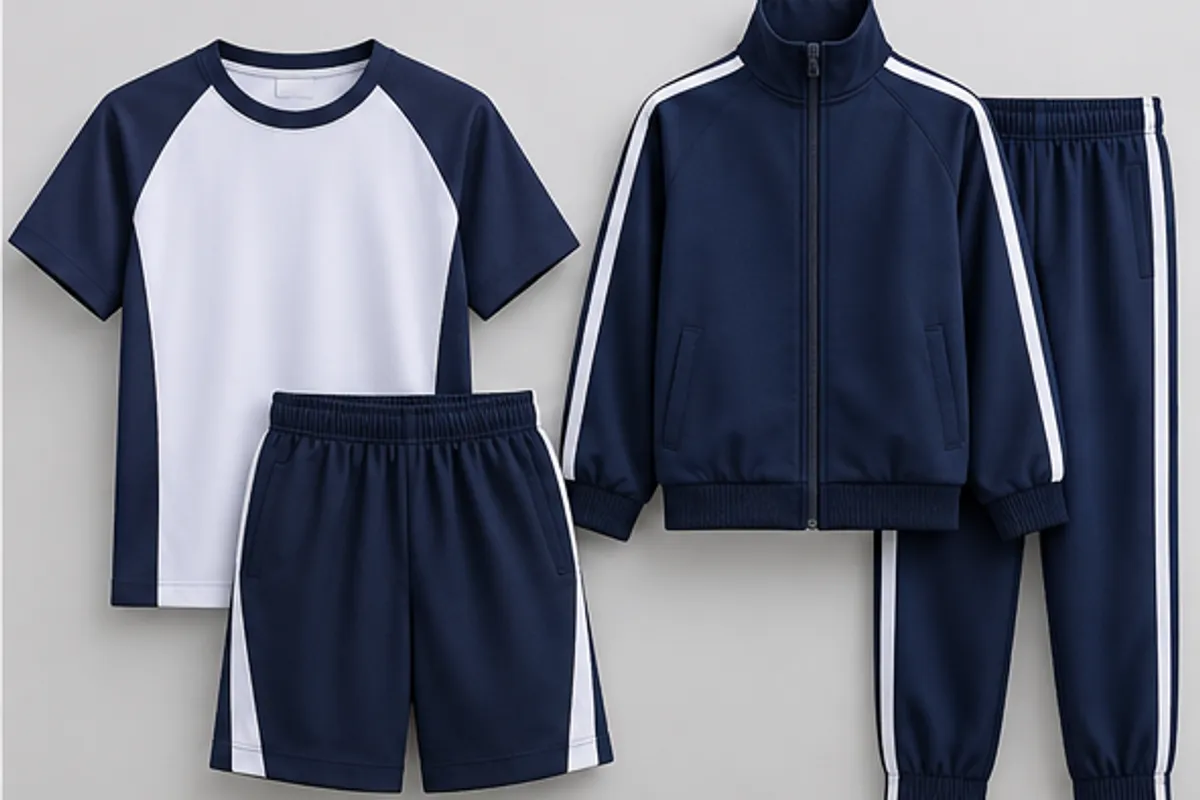
Tracksuit colour bleeding happens when loose dye from a dark or strong colour moves onto a light part of the same garment during washing, most visibly onto white piping, stripes or panels. It is usually caused by hot water, long soaking or leaving the tracksuit wet and bunched up after the wash. Careful fabric and colour choices at the design stage and simple care habits at home both reduce the risk.
Uniform shops sometimes see tracksuits returned with pink-tinged white piping beside red panels, or grey-tinged white beside navy. This post explains why, and what buyers can do about it.
Why does dye move?
Fabric is dyed and then rinsed to remove surplus dye. Strong shades such as red, maroon, royal blue and black take a lot of dye, and a little can be released in the first washes, especially in warm water. When the garment is wet, that dye can travel into a nearby light fabric. It is most likely when:
- the wash is hot
- the tracksuit soaks for a long time
- it sits wet in the drum, a bag or a pile after the cycle
- white and dark areas are pressed together, such as folded piping
Polyester tricot generally holds dye well, but strong contrasts make even a slight transfer visible.
Design choices that reduce the risk
| Choice | Lower risk | Higher risk |
|---|---|---|
| Piping colour | A school colour close in strength to the body | White beside red or maroon |
| Panel layout | Light panels away from dark ones | White panel sewn between two dark panels |
| Trim material | Same fabric type as the body | Mixed fabrics with different dye behaviour |
| Stripe on bottoms | Narrow light line | Wide white panel next to dark body |
None of these rule out white; many schools use white piping on navy successfully. They simply show where to take care.
Checking at sample stage
The sample is the time to test, before bulk production:
- Wash the sample once at the temperature the care label will show, with a white cloth in the drum.
- Leave it damp for a short time after the cycle, as a family might, then dry it.
- Look at light areas next to dark ones in daylight. Any tint shows first along seams.
- Check the white cloth for colour picked up in the water.
If you see transfer, raise it before approving. Colour and fabric matching for each panel and trim is covered on our fabrics and colour matching page. We make no colour-fastness rating claims; the sample lets you judge the behaviour of your actual colour combination.
Care advice to pass on
The most effective prevention is at home. Shops and schools can share these points:
- Wash the first few times on its own or with similar dark colours
- Use a cool wash; hot water releases more dye
- Do not soak or leave to stand in water
- Remove promptly when the cycle ends and hang to dry
- Do not store damp in a PE bag
- A colour-catcher sheet in the wash can help with new strong colours
These are general points; the care label on your order carries the wording you specify.
If a tint has already appeared
A light tint on white piping sometimes fades with a few more cool washes. Strong staining is hard to reverse. Shops handling a complaint can ask how the tracksuit was washed and dried, which usually shows the cause, and use it to refine the care card. Our tracksuits and jackets are shown on the school tracksuits and jackets page.
If your colour scheme pairs white with a strong shade, mention it with your enquiry, and we will pay particular attention to it on the sample.
Questions buyers ask
Is red more likely to bleed than navy?
Strong warm shades such as red and maroon are often the ones that show transfer most, because a pink tint stands out on white. Navy and black can also release dye, but a grey tint is less noticeable.
Should tracksuits with white piping be washed separately?
For the first few washes, yes, or with similar dark sportswear only. After that, a cool wash with similar colours is usually enough, provided the tracksuit is hung promptly once the cycle ends.
Can bleeding be fixed by bleach?
Bleach is not suited to coloured polyester sportswear. It can strip the strong panel colours and damage prints. A dedicated colour-run remover may help on white areas, used strictly following its own instructions.