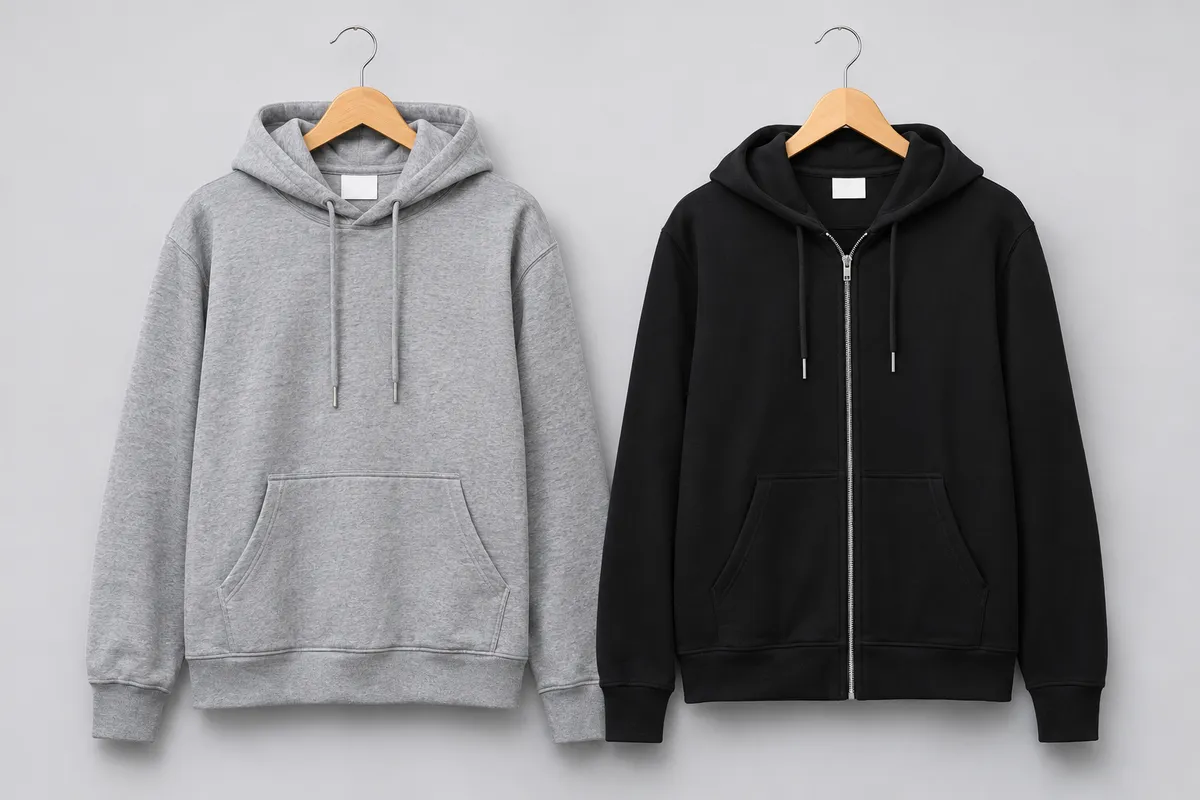
A sweatshirt top-up order replaces the sizes that have run short since the main order, and with a 100-piece minimum per style it is built by putting most of those pieces into the sizes you are missing. Sizes can be mixed freely within the style, so a top-up does not have to mirror the original ratio. The skill is in choosing which sizes to fill, and how deep, so the 100 pieces earn their place.
This post shows how to plan a top-up when you only need a handful of sizes.
When a sweatshirt top-up is needed
Sweatshirts sell in two waves: at the start of the school year and again when the weather turns cold. A shop that orders well for the first wave can still find gaps by the second. Typical triggers are:
- A middle size sells out in the first weeks of term
- A school’s intake is larger than expected, emptying the smallest band
- The cold arrives early and second sweatshirts sell faster than planned
- A new school joins your shop in the same colour mid-year
Each of these leaves a few sizes empty and the rest healthy. That is the situation a top-up solves.
Building 100 pieces from a few empty sizes
Start from what you need to last until the next main order, not from the original ratio. Then fill the rest of the minimum with the sizes most likely to run short next.
| Size | Stock now | Expected sales to next main order | Top-up quantity |
|---|---|---|---|
| 5–6 | Healthy | Low | 0 |
| 7–8 | Empty | High | 35 |
| 9–10 | Low | High | 30 |
| 11–12 | Low | Medium | 20 |
| 13–14 | Healthy | Low | 10 |
| 15–16 | Healthy | Low | 5 |
| Total | 100 |
The figures are an example to adjust against your own sales and stock count. Notice that sizes with healthy stock still receive a few pieces. Topping them up now avoids a second, separate order later.
Ways to reach the minimum when you need fewer than 100
If the gaps add up to far less than 100, look for other needs on the same style before ordering. The minimum applies per style, and the colour split is confirmed at quotation.
- Add sizes you expect to need before the next main order, not only today’s gaps
- Check whether another school you supply uses the same sweatshirt in the same colour
- Bring forward part of next season’s order in the slowest-moving sizes
- Ask at quotation whether two colours of the same style can be split within one order
- Hold the top-up until the gaps grow, if your remaining stock will last
Do not stretch a top-up with sizes that already have deep stock. That moves money into slow stock and solves nothing. The minimum order and samples page explains how styles and sizes are counted.
Keeping the top-up matched to the main order
A top-up only works if the new sweatshirts look the same as the ones on your shelves. Because each order is made to the approved sample, the colour, fit and badge position follow that sample. Help us keep them consistent:
- Quote the reference of the original order when you enquire
- Send a garment from current stock if your shop has noticed any difference
- Keep the size chart unchanged, unless there is a reason to adjust it
- Confirm the neck label wording matches the main order
Lead time is confirmed in the quotation. Plan the top-up before the cold-weather peak, because a top-up that arrives after the cold has set in misses the sales it was meant to catch.
Recording what the top-up taught you
Every top-up is evidence that the main order’s ratio was slightly wrong. Note which sizes ran short and when, then move quantity into those sizes next time. Over two or three seasons, the need for top-ups shrinks. Our size charts page explains how sizes are agreed for each order.
Once you know the sizes and quantities, send them for a quotation, mentioning that it is a top-up to an earlier order. Each sweatshirt style is listed on our school sweatshirts and hoodies page.
Questions buyers ask
Can a top-up be all one size?
Yes, if one size really needs 100 pieces. In practice that is rare, and spreading the minimum across the sizes likely to run short next gives better value from the order than a deep stack of a single size.
Does a top-up need a new sample?
Usually not, because it is made to the sample already approved. If anything has changed, such as the badge, the label or the chart, a new sample is worth approving before production so the new and old stock still match.
Can crew necks and cardigans be combined to reach 100?
No. Each is a separate style with its own 100-piece minimum. Within each style, sizes are mixed freely. If the cardigan only needs a few sizes, it may be better to wait and combine it with a later order.