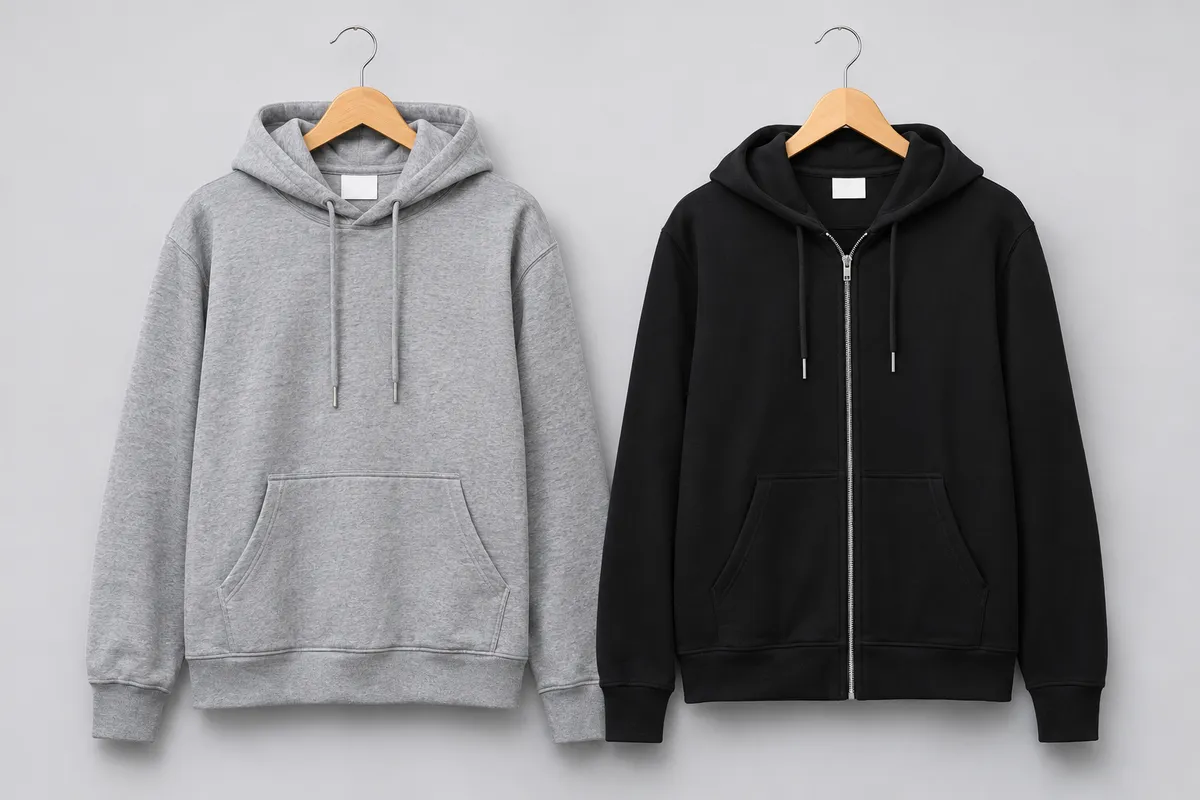
The sweatshirt cardigan fastening is usually either sewn buttons with buttonholes or metal or plastic press studs, and we make it with buttons or press studs, as specified. Buttons look traditional and are easy to replace at home; press studs are quicker for young children and leave no buttonholes to stretch. The right choice depends mostly on the age of the wearers and on what the school’s other cardigans use.
Neither option is wrong. The aim is a front that stays closed through a school day, opens without damage, and survives weekly washing for as long as the child wears it.
How do buttons and press studs compare?
| Question | Buttons | Press studs |
|---|---|---|
| Ease for a four-year-old | Fiddly at first, a skill many children are still learning | Push together and pull apart, usually easier |
| Appearance | Traditional, matches knitted cardigans | Clean, flat front with small visible caps |
| Strain on fleece | Buttonhole edges can loosen over time | The stud base must be backed so it does not tear out |
| Replacement at home | Simple with a needle and thread | Needs a tool and matching parts |
| Washing | Buttons can crack if very thin | Metal studs should resist rust; check on the sample |
| Colour matching | Buttons dyed or chosen to tone with the fleece | Caps can be colour-matched or plain metal |
Which fastening suits which age?
For nursery and the first years of primary school, many buyers prefer press studs, because children can manage them alone and teachers spend less time helping after playtime. From the middle of primary school upwards, buttons are easy for most children and match the look of knitted cardigans if those are on the same list.
If one cardigan specification covers a wide age span, think about who buys most of it. A shop whose cardigan sales are mostly in the youngest sizes may choose press studs for the whole range. A shop that sells mainly to older primary children may prefer buttons.
Making either fastening last in fleece
Fleece is softer and stretchier than a woven shirt fabric, so the front band needs support behind the fastening.
For buttons, the band is usually reinforced so that buttonholes hold their shape. Check on the sample that each buttonhole is cleanly cut, densely stitched round the edge, and sized so the button passes through without force. Buttons should be sewn with enough thread to survive being tugged.
For press studs, each stud is fixed through the band with a backing layer so the pressure of pulling does not tear the fleece. Check that the two halves line up from top to hem, that they snap firmly, and that they open with a steady pull rather than a wrench.
In both cases, fasten and unfasten the sample cardigan twenty or thirty times before approving it. That simple test shows more than a quick look.
A checklist before you decide
- Ages of the children who will wear most of the stock.
- What the school’s knitted cardigan, if any, uses.
- Whether families or the school have asked for one type.
- Colour of buttons or stud caps against the fleece.
- Number of fastenings per size, evenly spaced.
- A spare button sewn inside, if you want one.
Uniform shops that sell to several schools sometimes hold one cardigan specification for everyone, which makes the choice of fastening a single decision rather than one per school. Our page for uniform shops and retailers explains how we quote a range like that.
Tell us your choice, or send a cardigan you already sell, and we will make it into a sample for your approval. We will then quote the sweatshirt cardigan by fabric, quantity and branding.
Questions buyers ask
Can one order mix buttoned and press-stud cardigans?
Yes, but they count as two separate styles, because the front construction differs. Each needs at least 100 pieces, with sizes mixed within each style. Tell us the split when you ask for a quotation.
Will press studs scratch when the cardigan is washed?
Studs are closed flat against the band, so they are less likely to snag than open studs. Advising families to fasten the cardigan and turn it inside out before washing reduces rubbing on the studs and the fleece.
Should buttons be the same colour as the fleece?
Most schools choose buttons that tone with the fleece so the front looks quiet. A contrast colour can make the cardigan stand out and is a matter of taste. You see the chosen buttons on the sample before bulk production.