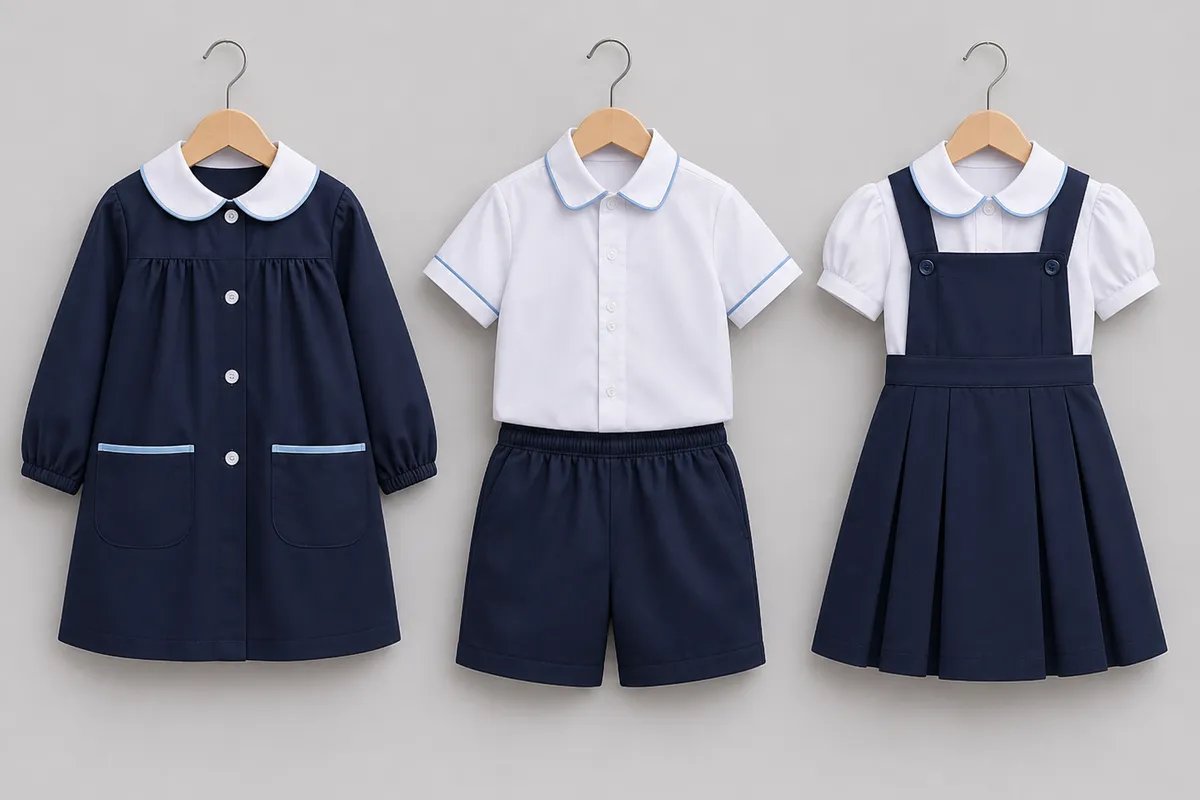
A nursery chain uniform supplier should build one shared range for every setting in the chain, in small sizes with easy fastenings, carrying the chain’s single logo, and deliver it in batches that match each setting’s intake. Because every nursery wears the same garments, a chain behaves like one large school spread across many addresses.
For a shop or distributor, a nursery chain can be steady business: the same styles, reordered through the year as children join.
What makes a nursery chain different from a school?
| Point | A school | A nursery chain |
|---|---|---|
| Logo | One per school | One for the whole chain |
| Range | Often long, with formal items | Short and practical |
| Sizes | Wide, across many years | Narrow, the youngest ages only |
| Intake | Mostly once a year | Children join all year round |
| Delivery | One school address | Many settings, different sizes of intake |
| Who decides | Head teacher or governors | Central office, with input from managers |
Year-round joining is the big one. A nursery chain needs stock on hand in every month, not just before September.
Which garments make up a nursery chain range?
Keep it short. Young children are dressed and changed several times a day, so practical comes first.
- Logo sweatshirts or sweatshirt cardigans, as the main branded layer. See our sweatshirts.
- Logo polo shirts or T-shirts, worn under the sweatshirt.
- Smocks for messy play, with fastenings of buttons or press studs, as specified.
- Simple bottoms: elastic-back trousers, shorts or a pinafore set.
- A summer option such as shorts or a light dress, for warm months.
Our nursery and kindergarten uniforms include smocks, shirt-and-shorts sets and pinafore sets.
What should the chain specify before quotation?
Agree these centrally, once, so every setting gets the same thing.
- Colours. One main colour for the branded layer, matched to a physical reference.
- Logo. Final artwork, its size on small garments, and its position. Logo embroidery or printing is available; the method is confirmed with the sample.
- Size range. Usually the youngest age bands only; set the exact range per order.
- Fastenings. Wide neck openings, elastic waists, press studs or buttons, as specified, chosen so children can manage them.
- Fabric. Soft and easy to wash. Poly-cotton and cotton are the usual choices for nursery garments.
- Labels. Soft, flat labels, and a name panel for staff to mark garments.
How should deliveries reach many settings?
There are two common patterns, and the choice affects packing.
- Central stock, local top-up. The supplier or the chain holds stock centrally and sends each setting what it needs. Bulk cartons packed by style and size suit this.
- Direct packs per setting. Each setting receives its own packed allocation. Ask for cartons packed and labelled per setting, with a contents list.
Packing is confirmed at quotation. Either way, keep a small reserve for children who join mid-month.
Planning quantities for year-round joining
Ask the chain’s central office for monthly joining numbers across all settings, and the age mix. Because the logo is shared, every setting’s demand adds into one style per garment, which makes the minimum easier to reach. The minimum is 100 pieces per style for knitwear such as sweatshirts and polos, and 50 for woven garments such as smocks and shorts, with sizes mixed. Plan a main order for the busiest joining period and top-ups through the year.
The schoolwear suppliers and distributors page explains how we pack cartons to a supplier’s plan. If you supply a nursery chain, send us the range, the logo and the list of settings, and we will quote each style with packing per setting.
Questions buyers ask
Can different nurseries in one chain have different colours?
They can, but each colour becomes its own style with its own minimum. A single colour across the chain keeps the range simple, reaches minimums easily and lets children move between settings without new uniform.
Who usually pays for nursery chain uniform?
It varies. Some chains provide uniform to families, others ask families to buy it. Agree the arrangement with the chain early, as it affects whether you deliver to settings or sell to parents.
How often should a nursery chain reorder?
Several times a year, because children join continuously. Small, planned top-ups weighted to the sizes in demand work better than one large annual order that leaves gaps by spring.