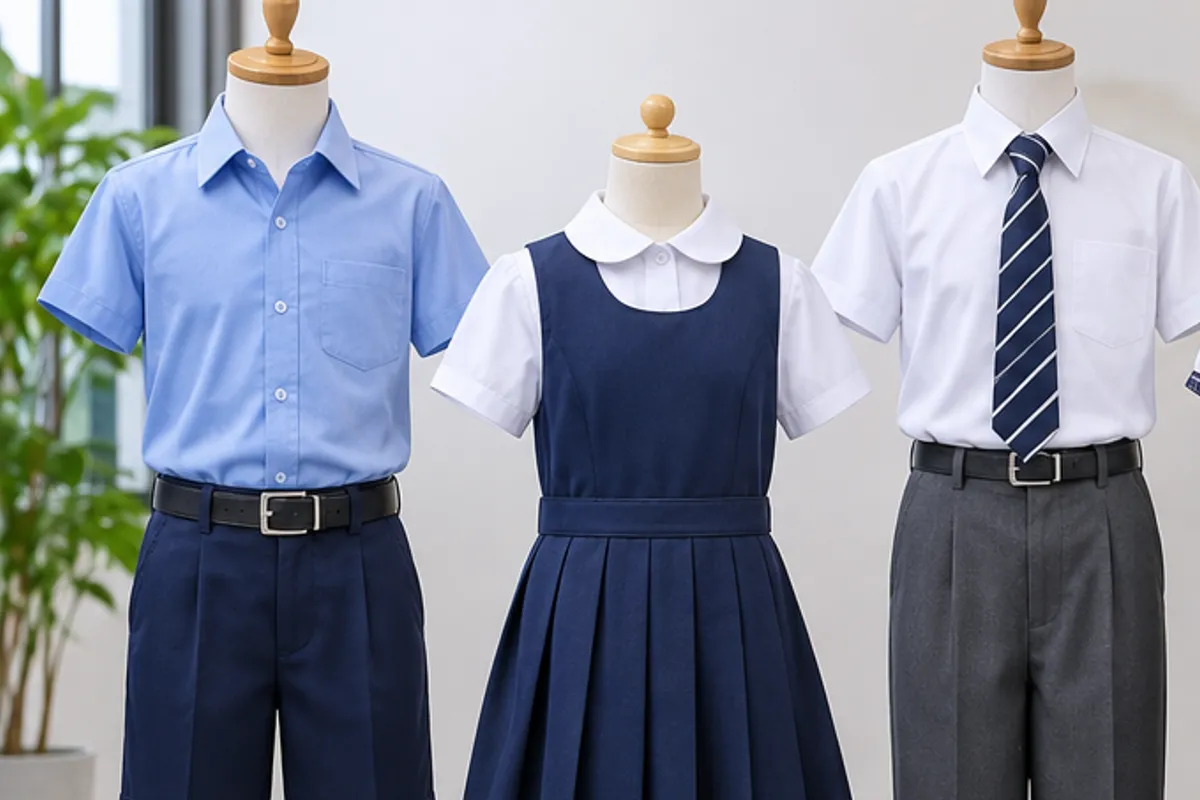
School trousers stock for uniform shops is easiest to run as a small set of plain styles held all year: grey and black regular fit in every size, with slim, girls’ and elastic-back fits added where the schools you serve list them. Because trousers are usually sold without a logo, one well-planned style can serve many schools, which makes trousers one of the steadiest lines a shop holds.
That steadiness is the advantage to plan around. Trousers rarely need to be cleared at the end of the year if the colour and fit stay on the lists.
What a typical trouser wall carries
Most shops build their range in layers, from the styles every school needs to those only a few ask for.
| Layer | What it includes | Why |
|---|---|---|
| Core | Grey regular fit, black regular fit, full size range | Listed by most schools, sold all year |
| Second | Girls’ trousers in the core colours | Needed where girls choose trousers |
| Third | Slim fit in the colour most seniors wear | Bought by older students who want a slimmer cut |
| Younger years | Elastic-back trousers and shorts | For nursery and infant classes |
| Specials | Navy or a school’s own colour | Only for schools that list it |
Start with the core and add a layer when the schools you serve list it, not before. Each style is its own order line with a minimum of 50 pieces, so every layer you add needs enough demand to reach it.
How deep should each trouser size be?
Depth means how many pairs of each size are on the shelf and in the stockroom. For trousers, a simple way to set it is weeks of cover:
- Look at how many pairs of each size you sell in a normal week.
- Decide how many weeks of stock you want to hold, which depends on how long a reorder takes to arrive.
- Multiply the two to get the depth for that size.
- Add extra depth for the back-to-school weeks, when sales jump.
Because lead time is confirmed in each quotation, use the figure from your last order when you set the weeks of cover. Sizes that sell slowly can carry fewer weeks; sizes that sell out often need more.
Keeping the wall full through the year
Trouser sales have a shape: a peak before the school year starts, a smaller rise when the cool term arrives in climates with a shorts season, and a steady flow in between from knee wear and mid-year joiners.
A routine keeps stock level through all of it.
- Count trouser stock by size and fit every week during the peak, monthly otherwise
- Flag any size under your target weeks of cover
- Group flagged sizes into a top-up that reaches the minimum for that style
- Keep one pair of each core size as a fitting pair, not for sale
- Note requests for sizes or fits you do not carry
- Review the layers once a year against the schools’ current lists
Own label and plain stock
Most schools do not ask for a logo on trousers, so a shop can sell one grey trouser to every school that lists grey. That is a strong reason to put your own label in the waistband. We sew in your woven or printed label with size and care details, so the trousers carry your shop’s name across every school you serve.
If a school does want its logo on trousers, keep that style separate from your plain stock. It can only be sold to that school, so plan its depth from that school’s roll alone.
Avoiding slow trouser stock
Slow stock in trousers usually comes from one of three places: extra lengths in senior sizes that rarely sell, a special colour for a school that then changes its list, or too many fits in one colour. Before adding any of these, check that the demand is real and lasting. A request from one family is a reason to take an order, not to add a size.
Our page for uniform shops and retailers explains how we supply shops. You can see every trouser fit we make on our school trousers and shorts page. Send us the layers and sizes you want to carry, and we will quote each style.
Questions buyers ask
Should a shop hold both grey and black trousers?
Hold the colours the schools you serve list. Where both are listed, carry both in full size runs. Where only one school lists black, a smaller black range with orders taken for the rarer sizes may be enough.
Is it better to stock trousers in age sizes or waist sizes?
Most shops use age sizes for juniors and waist sizes for seniors, with a short overlap. Stocking only waist sizes makes junior buying harder for families, while age sizes alone fit older students poorly.
How much trouser stock should be left at the end of the year?
Enough to cover the quiet weeks until your next delivery arrives. Plain trousers in core colours do not date, so a sensible carry-over is fine. The risk sits in special colours and rare sizes, which should run low by the year’s end.