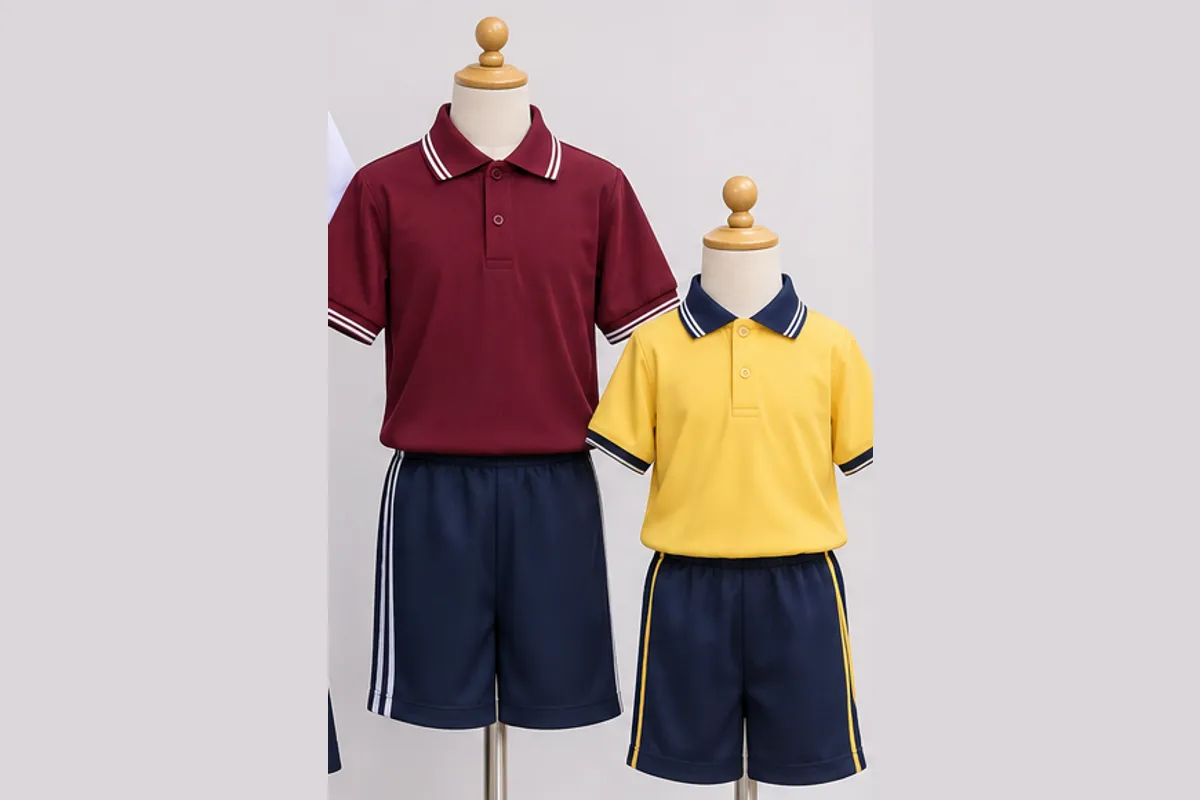
The simplest way to plan PE kit sizes by year group is to map each year group to two neighbouring age bands, then weight the order towards the larger of the two. PE kit is worn loose and moved in, so many families buy a size up, and your ratio should lean the same way.
This post is about the size plan itself: which bands to stock, where to switch from age sizes to chest and waist sizes, and how T-shirts and shorts differ. The ratios below are a starting example only. Adjust them against your own sales history or the school’s roll.
Map year groups to age bands
PE T-shirts and shorts are made in your size range. A typical range for planning runs from age 3–4 to 15–16, then chest sizes for senior T-shirts and waist sizes for senior shorts. Sports polos usually start later, from around age 5–6. The size chart is agreed for each order, so these are examples, not a fixed range.
Year groups do not line up neatly with age bands. A class holds students born across a full year, and growth varies widely within it. That is why each year group needs at least two sizes, and often three.
| Year group stage | Typical age | Sizes to stock for PE T-shirts | Sizes to stock for PE shorts |
|---|---|---|---|
| Early years and infants | 4–7 | 3–4, 5–6, 7–8 | 3–4, 5–6, 7–8 |
| Lower junior | 7–9 | 7–8, 9–10 | 7–8, 9–10 |
| Upper junior | 9–11 | 9–10, 11–12, 13–14 | 9–10, 11–12 |
| Lower secondary | 11–14 | 11–12, 13–14, 15–16 | 11–12, 13–14, 15–16 |
| Upper secondary and senior | 14 and over | 15–16, then chest sizes | 15–16, then waist sizes |
The pattern to notice is the upper junior row. T-shirts often run one band ahead of shorts at this age, because shoulders and chest grow before the waist does. If you order matching quantities by size for tees and shorts, you can end up with spare small tees and short of larger ones.
When to switch to chest and waist sizes
Age bands work well while students are still growing at a fairly even rate. From the early teens the spread widens, and an age label stops meaning much. A 15–16 T-shirt can be too tight for one student and too loose for another in the same class.
For senior students, consider:
- T-shirts and polos by chest size. Give us your chest measurements, or send a garment in each size you sell, and we set the chart on the sample.
- Shorts by waist size. The elastic waist gives some stretch, but a stated waist size helps students and shop staff choose quickly.
- Fewer senior sizes, deeper stock. Senior PE kit is often a smaller part of an order. Two or three chest sizes in depth often serve better than a long run of thin sizes.
Whichever you choose, keep the size marking on the neck label in the same form your shop or school office uses, so a request for a size can be filled without converting it. Our size charts page sets out how a chart is agreed.
A starting split for a first order
The example below is for a junior school ordering house colour T-shirts and shorts. It is a planning starting point only. Replace it with your own sales or roll data as soon as you have it.
| Size | T-shirts (share of order) | Shorts (share of order) |
|---|---|---|
| 3–4 | Small | Small |
| 5–6 | Medium | Medium |
| 7–8 | Large | Large |
| 9–10 | Large | Large |
| 11–12 | Medium to large | Medium |
| 13–14 | Small to medium | Small |
Notice that the T-shirt column carries more into the top sizes than the shorts column. That reflects the size-up habit for tops and the earlier chest growth noted above.
If the order covers several house colours, apply the size split to each house separately. Houses can differ in age spread, and a tidy overall ratio can hide a shortage in one colour.
Top-ups and year-to-year planning
PE kit runs out in a predictable pattern. The new intake each year needs the smallest sizes, and the top sizes sell steadily through the year as students grow. Plan for that:
- Review sales by size and colour at the end of each term
- Note which sizes ran out first, and which were left
- Order the incoming year’s smallest sizes well ahead of the intake
- Keep a small reserve of the top junior sizes for mid-year growth
- Reorder to the approved sample, so new stock matches the old in fit and colour
Our minimum for PE kit is 100 pieces per style, with sizes mixed within it, so a top-up can be weighted heavily towards the sizes you need. Lead time is confirmed in the quotation; plan back from your term start. The minimum order and samples page explains how mixed sizes work.
When you have a size plan, even a rough one, send it to us with your styles and colours. We will prepare a quotation for your PE kit and sports uniforms, quoted per style, by fabric, quantity and branding, and can suggest where the split might need adjusting.
Questions buyers ask
Do sports polos need their own size split?
Yes. Sports polos often go to teams and older students, so their split usually leans to the upper sizes, unlike a PE T-shirt worn by every year. Treat the polo as its own style, with its own ratio and quantity.
How do I measure chest size for senior PE tops?
Measure round the fullest part of the chest, under the arms, with the tape level and the student breathing normally. Compare the result with the chart for the garment, allowing for the looser fit students expect in PE.
Can labels show both age and chest size?
They can. Size labels and pack stickers are printed in the form you specify, so a senior size could show a chest measurement beside an age band. Families and staff then find the right size without a conversion table.