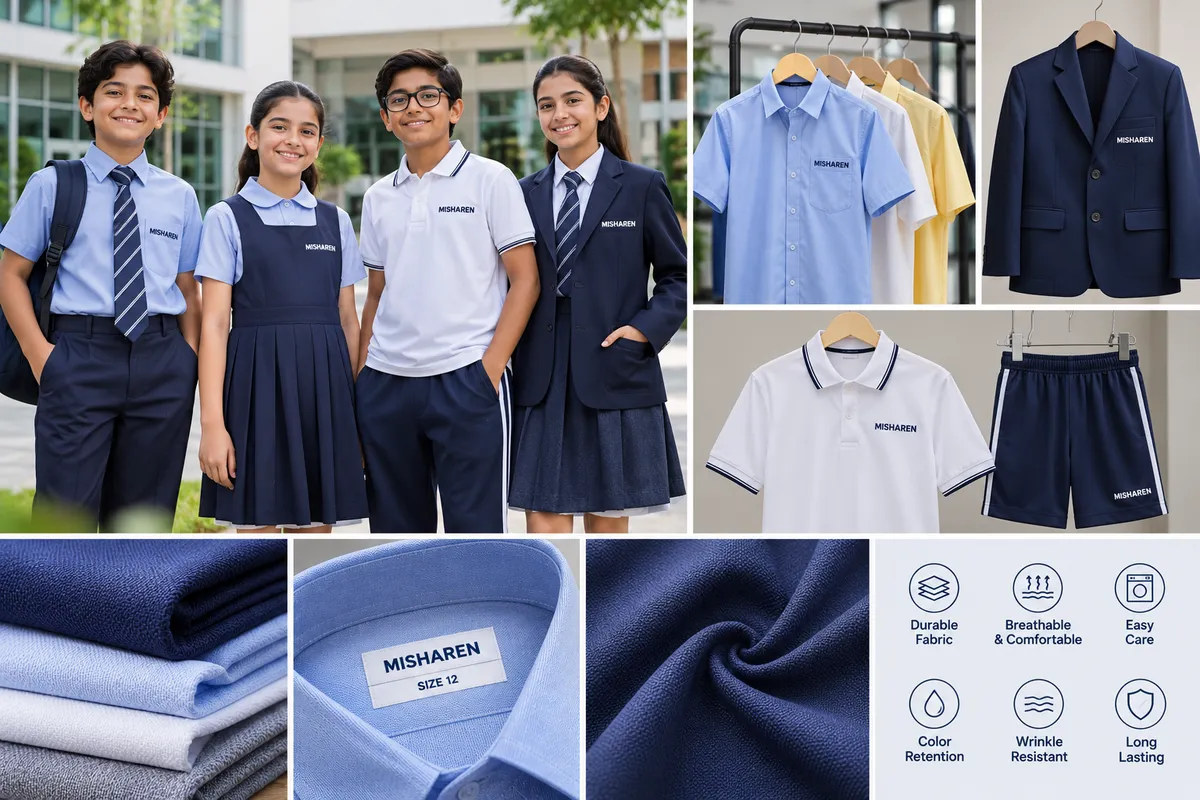
Shortlisting school uniform manufacturers means cutting a long list of possible makers down to three to five worth asking for a quotation. Filter on four things you can check before any price is discussed: whether they make your garments, whether their minimums fit your quantities, whether they sample in your colour and logo, and whether their answers to a first message are clear.
A shortlist saves effort on both sides. You compare fewer, better quotations, and the manufacturers you approach receive an enquiry they can actually answer.
Which filters come first when shortlisting?
Apply the filters in order of how quickly they rule a maker out.
1. The garments they make. Read each manufacturer’s product list against your uniform list. If your uniform has summer dresses, sweatshirts, blazers and PE kit, a maker of only knitwear covers part of it. That may be fine if you plan to use two makers, but note it now.
2. Minimum order per style. Compare their minimum with your smallest style, not your largest. A school that sells few long-sleeve summer dresses or few senior-size blazers needs a maker whose minimum per style fits those low-volume items. Check whether sizes can be mixed within the minimum.
3. Samples. Ask whether they make a sample of each style in your colour, with your logo and label, before bulk production. A maker that offers only a stock-colour sample leaves the most important checks until the goods arrive.
4. Clarity. Send a short first message with your garment list and a delivery country. Judge the reply on whether it answers what you asked, in writing, without vague promises.
A shortlist scoring table
Keep a simple table as you go. One row per manufacturer, and a column per filter.
| Manufacturer | Makes our garments | Minimum fits smallest style | Samples in our colour and logo | First reply clear | Shortlist? |
|---|---|---|---|---|---|
| A | All | Yes | Yes | Yes | Yes |
| B | Knitwear only | Yes | Yes | Yes | Maybe, for knitwear |
| C | All | No, for two styles | Not stated | Slow | No |
| D | All | Yes | Stock colour only | Yes | Ask again |
The “maybe” and “ask again” rows are useful. A maker that covers only knitwear might be right if you split the uniform between two. A maker that did not mention samples might simply need the direct question.
What to look for on a manufacturer’s own pages
Before writing to anyone, a manufacturer’s website tells you a lot.
- It names the garments it makes, with fabrics for each
- It states minimum order quantities, and what counts as a style
- It explains its order process from enquiry to dispatch
- It says how logos and labels are handled
- It says how it deals with buyers in other countries, if you are abroad
- It says plainly where it manufactures
Missing information is not always a bad sign, but a maker that explains its process openly is usually easier to work with when something needs to change.
As an example of the information to expect, we manufacture in India and set out our minimums in plain terms: 50 pieces per style for woven garments such as dresses, shirts and blazers, and 100 for knitwear and sportswear such as sweatshirts and PE kit, with sizes mixed. Our process runs from enquiry and quotation through a sample, then advance payment, production, quality check and dispatch.
Mistakes that weaken a shortlist
Shortlisting on price alone. A quick verbal figure from a maker who has not seen your specification tells you little. Shortlist on fit, then ask for quotations on the same written request.
Too many names. More than five quotations is hard to compare carefully, and each one takes time to request and follow up.
Ignoring the smallest garments. Low-volume items such as nursery smocks, girls’ blazers or long-sleeve dresses are where minimums bite. Test the shortlist against them.
No one owning the list. Decide who in the school or shop keeps the shortlist and the replies, so the trail is in one place when quotations arrive.
Our minimum order and samples page sets out what counts as a style and how sampling works. Our range covers garments such as school sweatshirts and hoodies and school summer dresses. If we fit your shortlist, send us your uniform list and we will reply with a quotation per style.
Questions buyers ask
How many uniform manufacturers should be on a shortlist?
Three to five works for most schools and shops. That gives enough to compare without making the comparison itself a large job. If your organisation has rules on how many quotations are needed, follow those and shortlist to that number.
Should we visit a uniform manufacturer before shortlisting?
A visit is not usually needed to shortlist. Garment lists, minimums, sample terms and a clear first reply can all be checked remotely. Samples in your own colour and logo, made before production, tell you more about the finished garment than a tour would.
Can we shortlist a manufacturer that makes only part of our uniform?
Yes, if you are willing to split the uniform between makers. Many buyers use one maker for woven garments and another for knitwear and sportswear. The extra work is in matching colours and logos across both, so ask each for samples against the same reference.