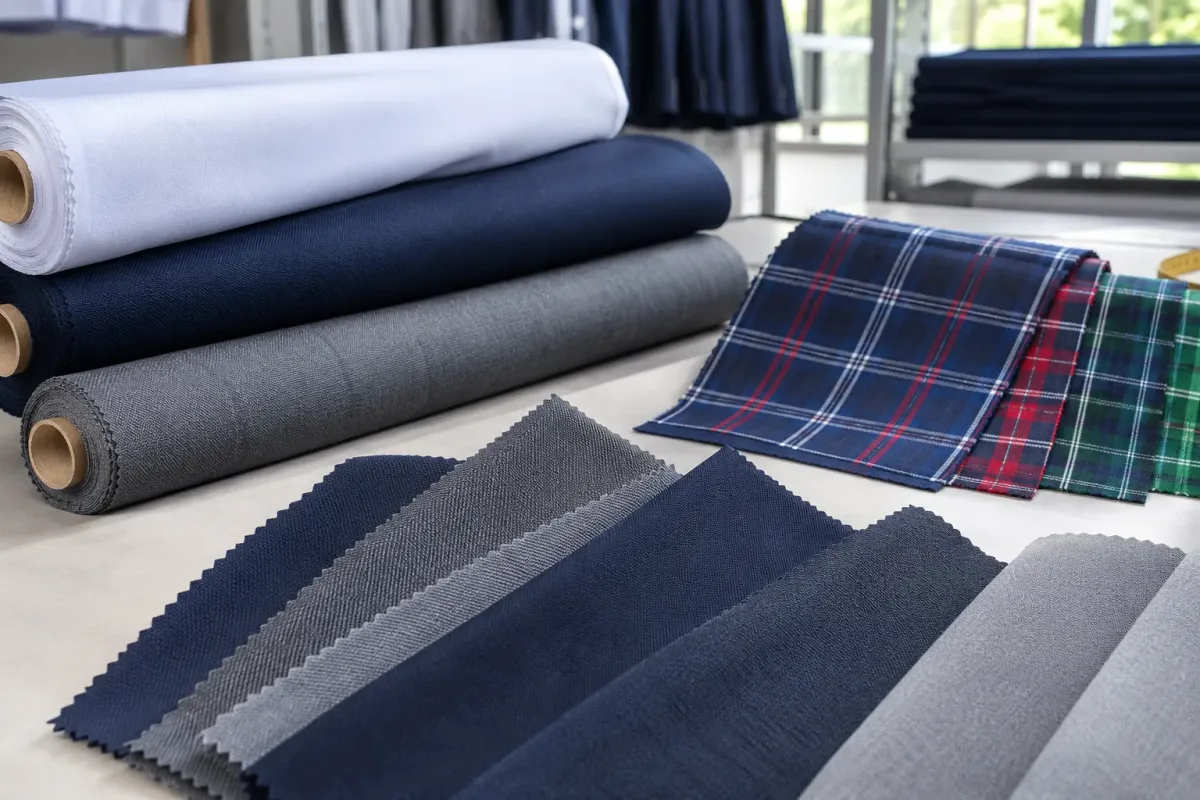
Secondary school uniform colours are usually deeper and more formal than primary ones: a dark blazer or jumper as the main colour, white or pale shirts, and grey, black or navy lower garments. The brightness moves out of the main garments and into small details such as blazer braid, jumper stripes and the badge.
Older students are harder on a uniform in some ways and easier in others. They wear it for longer days, often with a blazer, and many care about how it looks. A palette that feels grown-up helps them accept it.
How do secondary colours differ from primary?
At primary level, the sweatshirt often carries a bright school colour. At secondary level, that role usually passes to the blazer or knitted jumper, which tend to be in darker shades. The table below shows the shift in a typical school that runs both phases.
| Garment role | Primary version | Secondary version |
|---|---|---|
| Main identity garment | Royal blue sweatshirt | Navy blazer with sky blue braid |
| Everyday top | Sky blue polo | White shirt or blouse |
| Knitwear | Royal blue cardigan | Navy V-neck jumper with sky blue stripes |
| Lower garments | Grey shorts, pinafore | Grey or black trousers, pleated skirt |
| Summer | Blue gingham dress | Short sleeve shirt, sometimes a summer skirt |
The two phases share a family resemblance. The primary blue survives as an accent on the secondary uniform, so the school still looks like one school.
Choosing the blazer and knitwear colour
The blazer is the most expensive item and the slowest to replace, so its colour should be one the school is happy to keep for many years. Black, navy, bottle green, maroon and royal blue are all common. Darker cloth hides wear and keeps a sharper look as it ages.
The jumper usually matches the blazer, or picks out its braid colour. If the blazer is black, a black jumper is simplest, though some schools use a grey or coloured jumper to soften the look.
Because blazer cloth is woven and jumpers are knitted, they are matched to your reference separately. We show you both before bulk production, ideally side by side, because “navy” on a blazer and “navy” on an acrylic jumper can look slightly different under classroom lights.
Senior and sixth-form variations
Some schools give older students a different look, such as a different blazer colour, a different stripe, or permission to wear a plain dark suit. If so, choose a colour that sits clearly within the school palette, such as a black blazer with the same braid, rather than an unrelated colour.
Shirts and lower garments
White remains the most common shirt colour at secondary level, but pale blue, striped and coloured shirts are also used, sometimes to mark year groups. If you assign different shirt colours by year, keep them close in tone so the uniform does not look mismatched in assemblies.
Lower garments in grey, black or navy suit almost any blazer. The key is to pick one and use it for every trouser, skirt and skort, so that students wearing different styles still look uniform. Specify a single fabric reference for all of them.
Here is a short checklist before you request a quotation:
- Blazer cloth colour, braid colour and badge thread colours
- Jumper body colour and stripe colours, matched to the blazer
- Shirt or blouse colour, and any year-group variations
- One lower garment colour for trousers, skirts and skorts
- Any sixth-form or senior variation, and how it relates to the main palette
Suppliers serving several secondary schools can read how we handle multi-school orders on our page for schoolwear suppliers and distributors. Our school blazers page lists the styles and fabrics we make.
When your colours are settled, send us the list with a reference for each shade. We will quote each style by fabric, quantity and branding, and send samples for approval before production begins.
Questions buyers ask
Is black a good colour for a secondary blazer?
Black looks formal and hides marks, which is why many schools choose it. It can show dust and lint, and some black cloth takes on a slight colour cast in sunlight over time. Approve the shade under daylight as well as indoor light.
Should year groups have different colours?
Some schools use different tie or stripe colours by year group, while keeping the main garments the same. Changing the main garment colour by year makes stock planning harder for shops and makes hand-me-downs between siblings less practical.
Can a secondary uniform use the same colour as the primary?
Yes. Many all-through schools keep the same main colour and simply make the secondary garments more formal. Others darken the main colour for older students and keep the brighter primary shade as an accent in braid, stripes or logo thread.