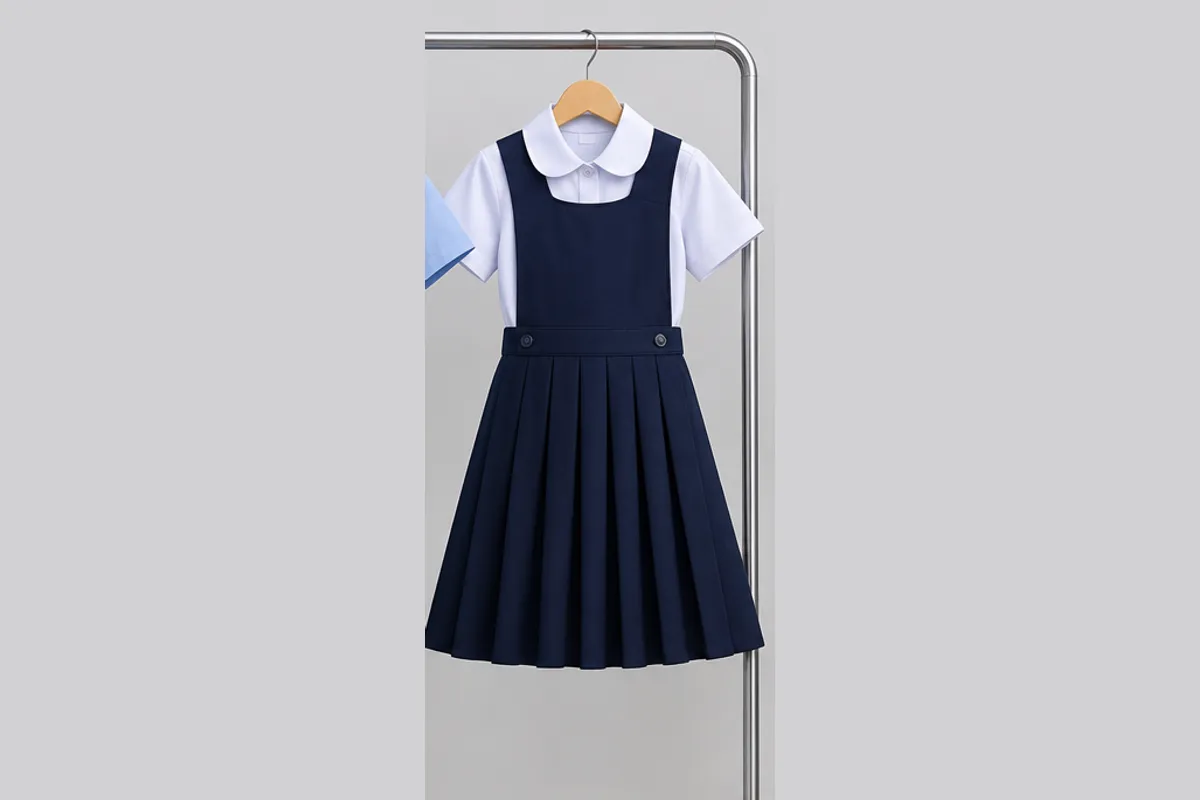
A good school tunic specification sets out six things: the yoke or bodice shape, the pleat style below it, the finished length for every size, whether there is a belt or sash, where the opening sits, and the logo. Because tunics are worn by older girls as well as younger ones, the length and proportions across the size range matter more than on a pinafore.
In our listing, tunics run from age 3–4 up to age 13–14, which is further than the pinafore styles. That longer range is the main reason a school or shop chooses a tunic.
What is a school tunic?
A school tunic is a sleeveless one-piece garment that hangs from the shoulders, usually from a yoke across the chest and back, with pleats falling from the yoke to the hem. It is worn over a shirt or blouse and is looser through the body than a pinafore dress. Some designs have a belt or sash at the waist to draw the line in.
The six parts of the specification
| Part | Typical choices | Note for older sizes |
|---|---|---|
| Yoke | Square yoke front and back, or a shaped bodice | A deeper yoke looks more grown-up |
| Pleats | Box pleats from the yoke; knife pleats; or a few inverted pleats | Wide box pleats suit taller girls |
| Finished length | Set per size from shoulder to hem | Must suit both the youngest and oldest in each size |
| Belt or sash | None, a self-fabric belt in loops, or a tie sash | Older girls often prefer no sash |
| Opening | Side zip, shoulder buttons or a front placket | Must sit flat under a jumper or blazer |
| Logo | Left chest on the yoke, or plain | Keep the logo clear of the pleats |
Length is the hardest decision
On a short garment a centimetre or two hardly shows. On a tunic it does. Two girls of the same age band can differ a lot in height, and a tunic cut for the shorter one looks short on the taller one by the end of the year.
Ways to manage this:
- Measure the length from the shoulder point to the hem on a garment you like, and give us that figure for each size.
- Ask for a deeper hem on the older sizes so families can let the tunic down.
- If your size chart includes long-length options for the older bands, tell us; it becomes part of the agreed chart.
We agree the size chart for each order, so the lengths you set are the lengths we cut.
Fitting a tunic under other garments
Older girls often wear a tunic under a blazer or a knitted jumper. Check on the sample that:
- the shoulders are not so wide that they bunch under a blazer
- the opening and any buttons do not press through a jumper
- a belt, if used, sits at a height that does not clash with the hem of the jumper
Fabric and colour
We make tunics in poly-viscose or polyester twill. Box pleats from a yoke hang well in either, and the deciding factor is usually what the school’s skirts or trousers are made from. Colours are grey, navy, bottle green and maroon, or a shade matched to the reference you send.
Ordering a tunic range
A tunic is its own style, with a minimum of 50 pieces, and sizes can be mixed. Because the range runs into early secondary ages, a school may want the older sizes in a slightly different cut; that becomes a separate style if the pattern changes. See all our styles on the school pinafores and tunics page, and if you are a school or trust specifying for several sites, read our notes for schools and school groups.
Send us the six parts above, your size range and quantities, and any tunic you want us to follow. We quote per style, by fabric, quantity and branding, and the quotation gives the lead time.
Questions buyers ask
Can a tunic be worn without a blouse?
Not on most school uniforms. A tunic is sleeveless with an open neckline, so a shirt or blouse goes underneath. In warmer terms schools often switch to a summer dress instead.
Does a tunic need to match the school skirt exactly?
It looks better when it does, especially where younger girls wear tunics and older girls wear skirts. Send the skirt as a colour reference and we match the shade on a swatch for you to approve.
Are tunics suitable for the youngest children?
They can be, and our listing starts at age 3–4. Many schools still prefer a bib or zip-front pinafore for the very youngest because the shorter body and simpler opening are easier for small children.