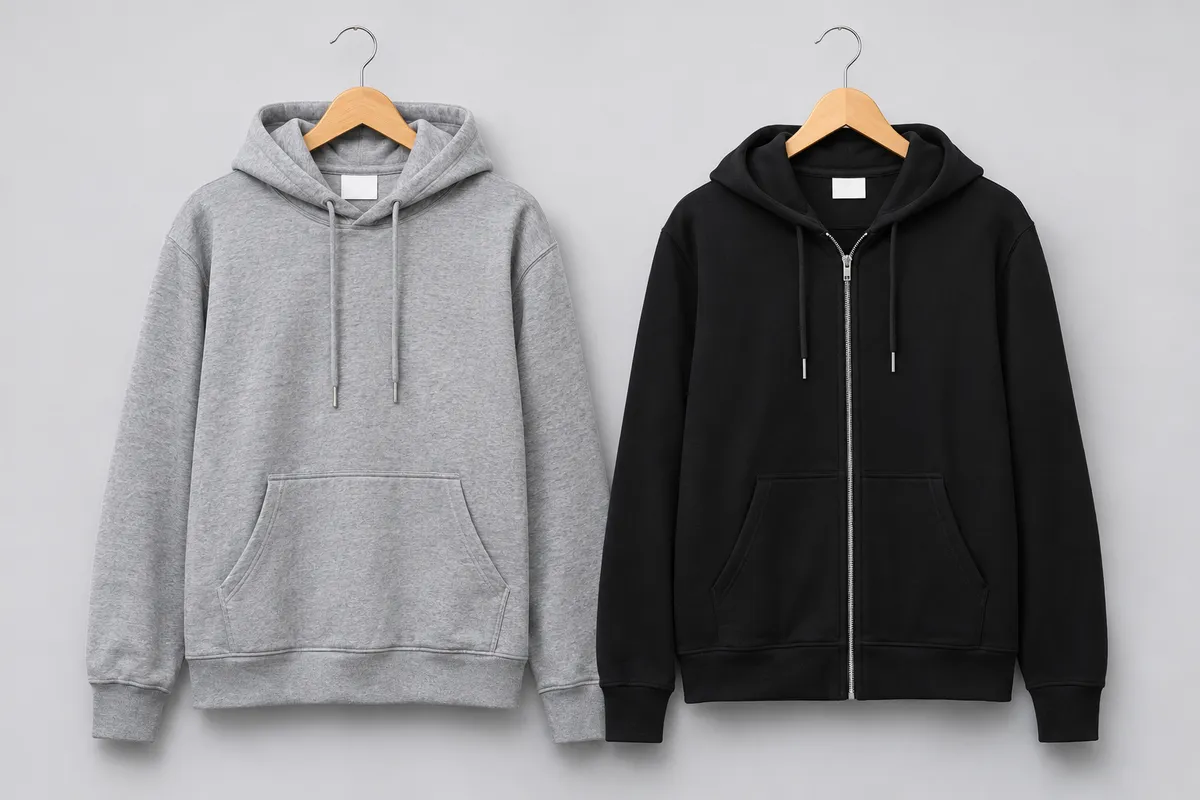
The school sweatshirt colours seen most often are navy, grey, royal blue, bottle green and red, with other school shades matched to a reference when needed. Each behaves a little differently in fleece: dark shades hide marks but show lint, light grey shows stains, and bright reds and blues need careful matching to the rest of the uniform. Choosing well means thinking about the fabric as well as the school’s colour scheme.
For a uniform shop, the sweatshirt is often the most visible garment on the list, worn over everything else for much of the year. Its colour sets the look of the whole uniform.
How do the main colours behave in fleece?
| Colour | Looks in fleece | Day-to-day wear | Pairs easily with |
|---|---|---|---|
| Navy | Deep and even | Hides most marks; shows pale fluff and chalk | White or pale blue polos, grey trousers or skirts |
| Grey | Soft and neutral | Shows food and paint stains more readily | White, red, navy or maroon polos |
| Royal blue | Bright and lively | Shows fading on the elbows and cuffs over time if washed hot | White or yellow polos, navy or grey bottoms |
| Bottle green | Rich and dark | Hides marks well | White or gold polos, grey bottoms |
| Red | Strong and warm | Shows fading most clearly; wash advice matters | White or grey polos, grey or navy bottoms |
These are general tendencies of dyed fleece, not test results. The sample is where you judge a colour in your own conditions.
Should a school colour be matched or chosen from a standard?
If the school already has a colour in its jumpers, PE kit or blazers, match the sweatshirt to that. Send a garment or a fabric swatch, and we match the fleece to it and send the colour for your approval before cutting. An unworn garment from current stock is the truest reference, since repeated washing softens a shade.
If the school is choosing a colour for the first time, starting from one of the common shades is simpler. It is easier to keep consistent over years of reorders, and plain stock in that colour can be sold to other schools that list it too.
The ribs and the badge are part of the colour
On a sweatshirt, the colour is not only the body. Three other elements change how the colour reads:
- Ribs. The cuffs, hem and neck are knitted separately. They should match the body closely, especially on red and royal blue, where a mismatch is easy to see.
- Badge thread or ink. A white badge on navy stands out; a navy badge on royal blue can disappear. Pick badge colours with contrast in mind.
- Neck label. A small point, but a white label shows through on very thin fleece in light colours.
Check all three on the sample, in daylight, next to the polo and bottoms the sweatshirt will be worn with.
Questions to ask before fixing the colour list
- Which colours do the schools you serve actually list?
- Do any schools share a colour, so one plain specification can serve them all?
- Is there an existing garment to match for each school colour?
- Does any school use a colour outside the common five?
- Should cardigans and crew necks share every colour, or only some?
A shop serving several schools will often find that three or four colours cover most of its list. Each colour is a separate style for minimum order purposes, at 100 pieces per style with sizes mixed. Retailers can see how we quote a multi-colour range on our page for uniform shops and retailers.
We manufacture in India and match each colour to your approved reference. Send your colour list and any garments to match, and we will quote your school sweatshirts colour by colour.
Questions buyers ask
Is black a practical colour for school sweatshirts?
Black hides stains but shows dust, chalk and pale fluff clearly, and it can fade towards a greyish tone with frequent washing. Some schools choose it; others prefer navy, which looks dark without showing marks as sharply.
Can a sweatshirt be two colours, such as a contrast collar?
A contrast colour on the neck rib or cuffs can be requested in your specification. Whether it can be produced in your shades is confirmed at quotation, and you see it on the sample before production.
Why does the same named colour look different from two makers?
Colour names are not standards. One maker’s royal blue can be brighter or deeper than another’s. Matching to a physical garment or swatch rather than a name is the surest way to get the shade the school expects.