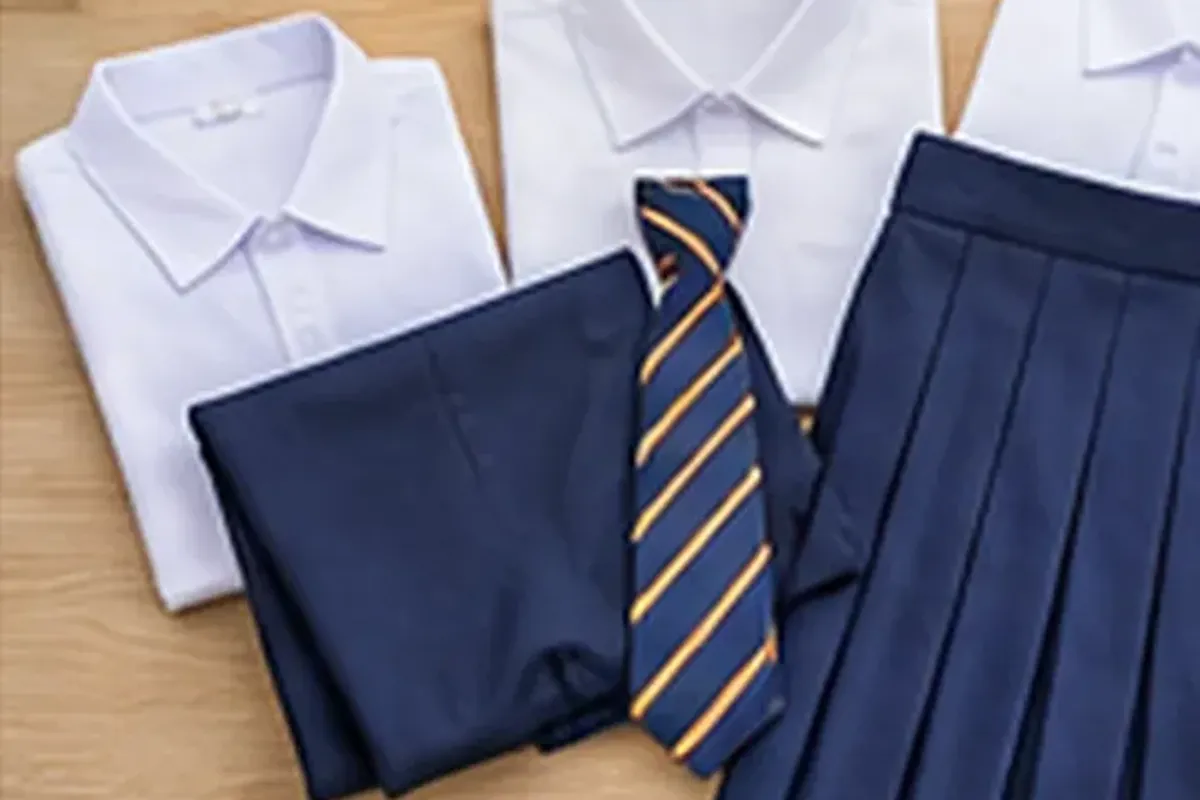
School skirts for charity programmes are usually plain skirts in a common colour, sized by age band and packed by size, so they can be handed out quickly to girls across several schools or communities without individual fittings. The planning questions are which style suits the widest group, how to estimate sizes when nobody has been measured, and how to split funds between skirts and other garments.
Charities and uniform programmes face a different problem from shops. They may not know the exact children in advance, they often distribute in one or two big events, and every piece has to be useful to someone.
Which skirt style suits a charity programme?
A style that is easy to wear, easy to size and acceptable at many schools works well.
| Option | Strengths for a programme | Watch for |
|---|---|---|
| Plain pleated skirt, elastic-back | Familiar on most uniform lists; elastic covers a wide span of waists | Pleats need ironing to look smart |
| Plain A-line skirt, elastic-back | Simple to wear and wash; no pleats to set | Some schools list pleated only |
| Skort | Practical for active younger children; modest when playing | Not on every school’s list |
| Check skirt | Matches one school’s uniform exactly | Only useful for that school |
Most programmes choose a plain skirt with elastic at the back in navy, grey or black, because it fits more children per size and suits more schools. A skort is a sensible addition where the schools served allow one.
How do you size girls you have not measured?
Programmes often work from age, not measurements. A sound approach:
- Collect ages, not sizes. Schools or community leaders can usually give age and year group.
- Map each age to its age band, with a share in the size above for growth.
- Size up rather than down. A skirt slightly large with an elastic back is wearable; one too small is not.
- Hold a reserve in the two or three most common sizes to swap on the day.
The example below is a starting split to adjust against your own data, for a programme serving girls aged about 5 to 12.
| Age band | Pieces per 100 (example) |
|---|---|
| 5–6 | 14 |
| 6–7 and 7–8 | 28 |
| 8–9 and 9–10 | 30 |
| 10–11 and 11–12 | 22 |
| Reserve in core sizes | 6 |
Packing for a distribution day
How skirts arrive decides how fast volunteers can hand them out.
- Pack each skirt in its own bag with the size printed large
- Group bags by size in cartons, with the size on every side of the carton
- Add a carton list showing quantities by size
- Pack skirts with other garments as a bundle only if every child receives the same set
- Keep the reserve sizes in separate, clearly marked cartons
If you need skirts packed in sets with blouses or other garments, tell us at the quotation stage. Our guide for charities and uniform programmes explains how programmes usually order.
Spreading funds across garments
A fixed budget raises a hard choice: more skirts, or a fuller set for fewer children. A few points to weigh:
- Two skirts per child lets one be washed while the other is worn.
- One skirt with a second lower garment, such as trousers or a skort, gives variety for weather.
- Plain skirts without a logo can be shared between schools that use the same colour.
We quote each style separately, by fabric, quantity and branding, so you can compare options. Skirts start at 50 pieces per style, with sizes mixed within that.
Timing a programme order
Plan backwards from the distribution date, which is usually just before the school year starts. Allow time for the quotation, sample approval, production, the quality check and shipping. Lead time is confirmed in each quotation.
We manufacture plain school skirts and skorts in India for charities and uniform programmes. See the styles on our school skirts and skorts page, and send us the age range, numbers and distribution date for a quotation.
Questions buyers ask
Can a programme order skirts for several schools at once?
Yes. If the schools share a colour, one plain skirt can serve all of them. If they use different colours, each colour is a separate style with its own minimum, and all can be produced and shipped on one order.
Should a charity skirt carry a label?
A simple woven or printed label with the size and care wording helps families. Some programmes add their own name or a name strip so each child can mark their skirt, which reduces lost items at school.
What if sizes run short on the distribution day?
Bring the reserve cartons, and record every size you ran out of. That record becomes the basis of a small top-up, or a better split for the next distribution, so fewer children go home without the right size.