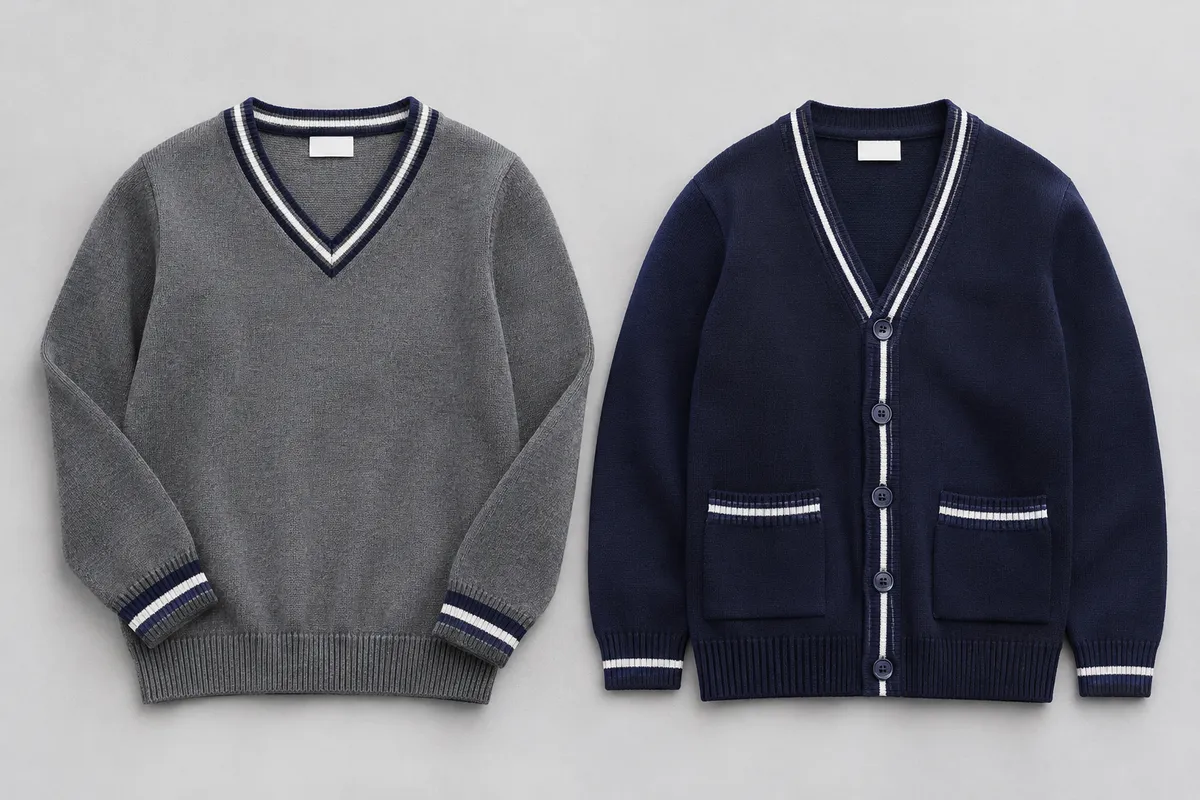
A school knitwear arrival date is the day your jumpers and cardigans need to be in your stockroom, unpacked and ready to sell, and it should be set before you send an enquiry, not after. Every other date in the order, from sample approval to dispatch, is worked out backwards from it.
This post shows how to choose that date for winter knitwear, the stages that sit between enquiry and shelf, and how the date shifts between the two hemispheres.
Choosing the date your knitwear must arrive
The arrival date is not the first cold day. It is earlier, because families start buying knitwear before they need it, and because the shop needs time to check and price stock.
Three questions fix the date:
- When does demand start? For a full-year uniform, demand starts in the weeks before the school year. For winter-only knitwear, it starts when evenings turn cool and the school announces the change to winter uniform.
- How long do you need to receive stock? Counting cartons, checking sizes, labelling shelves and loading a till system take days, not hours.
- How much buffer do you want? Freight can be delayed by weather, port congestion or paperwork. A buffer of a few weeks protects the selling season.
Write the arrival date down and share it with everyone involved in the order.
The stages between enquiry and shelf
Working backwards from the arrival date, each stage takes its own time. Lead times are not published; they are confirmed in the quotation for each order. What you can do is list the stages and give each a realistic allowance.
| Stage (working backwards) | What happens | Who acts |
|---|---|---|
| Stock on the shelf | Counted, checked and ready to sell | You |
| Delivery and unpacking | Cartons arrive and are opened by size | You |
| Shipping | Goods travel from India to your country | Agreed in the quotation |
| Quality check and dispatch | Garments checked, packed and sent | Us |
| Bulk production | Yarn prepared, garments knitted and finished | Us |
| Advance payment | Payment that starts production | You |
| Sample approval | You check and approve the sample | You and us |
| Quotation | Prices, lead time and terms confirmed | Us |
| Enquiry | Styles, colours, sizes and quantities sent | You |
Notice how many stages depend on the buyer. A sample left unapproved for two weeks moves the arrival date by two weeks. Our shipping and documents page explains how shipping method and documents are agreed.
How the date differs between hemispheres
Winter falls in different months either side of the equator, so the same plan lands at different points in the school year.
Northern hemisphere. The school year often starts in late summer, and the cold months come in the first and second terms. Many shops want all knitwear for the year in stock before the school year begins, with a top-up timed before the coldest weeks.
Southern hemisphere. The school year often starts early in the calendar year, in summer. Knitwear is needed from around the second term, when the weather cools. That gives a second planning point: knitwear can arrive separately from the summer uniform, a few months after the start of the year.
Warm-climate countries. Where winters are mild, knitwear demand may be short and driven by air-conditioned classrooms as much as weather. A single arrival date before the cooler months is often enough.
A simple arrival-date checklist
- Arrival date written down, with the reason it was chosen
- Buffer for freight delays added
- Sample review time agreed inside your team
- Advance payment approved in advance, so production is not held
- Top-up arrival date set at the same time, if needed
- Shop staff told when to expect delivery and how it will be packed
With the date fixed, the enquiry becomes simple: send your arrival date with styles, sizes and colours, and we will confirm the lead time and quote your winter jumpers and cardigans per style, by fabric, quantity and branding.
Questions buyers ask
Can knitwear arrive in two deliveries?
Yes. Some buyers ask for the core sizes first and the rest later, or a main order followed by a top-up. Each delivery and its timing are agreed in the quotation.
What if the arrival date is already too close?
Tell us the date anyway. The quotation will show whether it can be met with the method of shipping you choose. If it cannot, a smaller first delivery of key sizes may help bridge the gap.
Should repeat orders use the same arrival date each year?
Use last year’s date as a starting point, then adjust it for anything that changed: an earlier cold spell, a new school, a change in the uniform list or a delay you met last time.