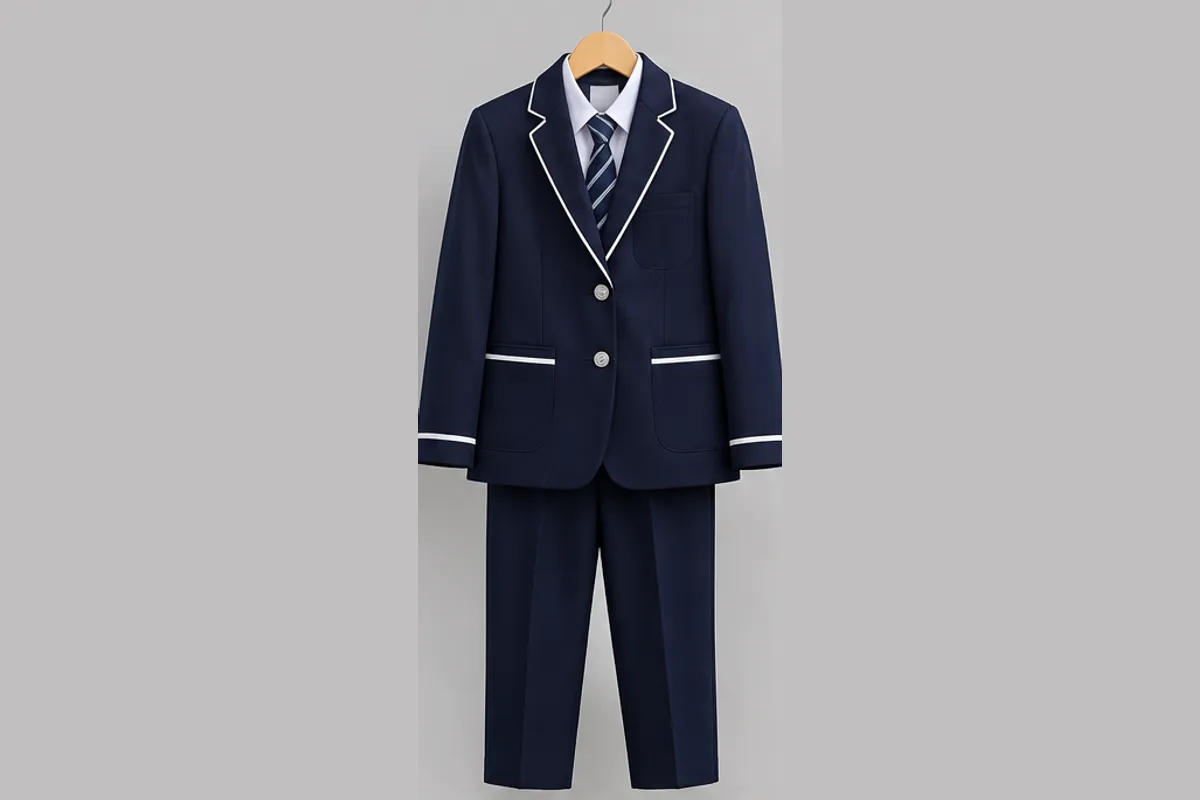
The main school blazer button types are plain plastic buttons in the blazer colour, horn-look or matt buttons with a natural texture, and metal-look buttons in gold or silver finishes. Each can be a sew-through button with holes, or a shank button with a loop on the back. For daily school wear, a sturdy plastic or horn-look button sewn with a thread shank is the practical default; metal-look buttons suit formal and senior blazers.
Buttons are small, but they are handled every day, dropped, chewed and caught on bag straps. A good choice keeps the blazer looking right and keeps replacement requests down.
The finishes compared
| Button type | Look | Strengths | Points to watch |
|---|---|---|---|
| Plain plastic, colour-matched | Quiet, blends with the cloth | Light, easy to replace, consistent | Can look plain on a formal blazer |
| Horn-look or matt | Natural, tailored texture | Smart without drawing attention | Shade should suit the cloth |
| Metal-look (gold or silver) | Formal, ceremonial | Echoes gold or silver braid | Finish can wear on edges; heavier |
| Embossed or crested | Traditional | Distinctive | Needs artwork and a longer lead in |
A crested button carries a design pressed into its face. It is a traditional detail, but it adds complexity; it is easier to put the school identity on the badge and braid.
Sew-through or shank?
Sew-through buttons have two or four holes. On a blazer they should be sewn with a thread shank: a short column of wrapped thread between button and cloth. This lifts the button so it sits above the thick blazer front and buttons smoothly.
Shank buttons have a loop moulded or fixed to the back. They sit naturally above the cloth and suit metal-look buttons. The loop takes the strain, so the attachment must be firm.
Without a shank of either kind, a blazer button pulls the cloth into a pucker when fastened, and the thread wears through quickly.
How big should blazer buttons be?
Front buttons are larger than sleeve buttons. A front button should be big enough to fasten easily for young students, but not so big that it looks clumsy on a junior size. Many schools use one front size across the range and one sleeve size, which keeps replacements simple. If you have an existing blazer, the button size can be matched from it.
Checks on the sample
- button colour suits the cloth and the braid
- sewn with a firm thread shank, or a secure shank fixing
- buttonholes cut cleanly and the right length for the button
- buttonholes sewn in a thread matching the cloth
- sleeve buttons a matching, smaller size
- spare buttons supplied, if wanted
Buttonholes deserve their own look. On a blazer, the front buttonholes take repeated strain; a dense, even stitch round the hole keeps them from fraying.
Buttons and care
Metal-look buttons may need protecting when the blazer is pressed or cleaned, since heat or chemicals can mark some finishes. Plastic buttons can soften under a very hot iron. Shops can pass on a general rule: press around the buttons rather than over them, and follow the care label. Our fabrics and colour matching page covers how cloth and trim colours are agreed together.
Choosing buttons for stock and repairs
Shops that sell blazers for several schools often prefer a single, colour-matched plastic button across all of them, so one stock of spare buttons serves every blazer. A school with a ceremonial senior blazer may choose metal-look buttons there and plain buttons on the daily blazer. Either approach works if it is set out clearly on the specification.
Send your button choice, or a sample button, with your blazer details. We quote school blazers by fabric, quantity and branding, and the buttons are shown on the approved sample.
Questions buyers ask
Why do blazer buttons keep coming off?
Usually because they were sewn tight to the cloth without a shank, so the thread is strained every time the blazer is fastened. A properly wrapped thread shank, and a firm button, reduce losses a great deal.
Can buttons be matched to our braid colour instead of the cloth?
Yes. Some schools prefer gold buttons with gold braid, for example. The button colour is shown on the sample with the braid, so you can judge whether the match works.
Are metal-look buttons heavier on small sizes?
Slightly. On junior blazers they can drag a light front a little. Many schools keep metal-look buttons for senior or formal styles and use plastic or horn-look buttons for younger students.