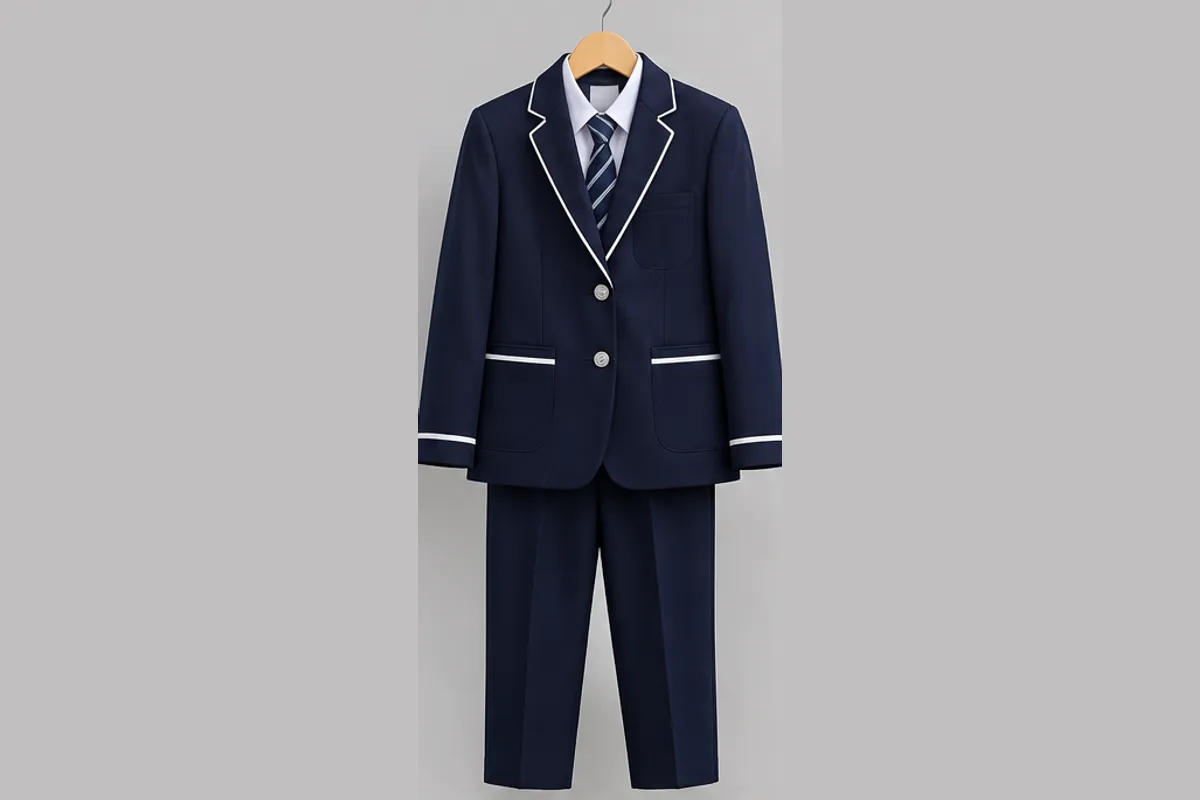
School badge embroidery is specified garment by garment, because the same crest behaves differently on blazer cloth, knitted acrylic and piqué. For each item on the list, the buyer decides the badge width, the position, the thread colours and whether the badge is stitched straight onto the garment or made as a separate patch. Write those four answers down per garment and the quotation and sample can follow without guesswork.
Logo embroidery or printing is available on every garment we make, and the method, size and position are confirmed with the sample. What follows is the thinking a school, shop or supplier should do first.
Why one badge file is not enough
A school usually has one crest. A uniform list usually has five to ten garments. The temptation is to send the crest once and say “same badge on everything”, but that rarely gives a good result.
Embroidery is made of stitches laid on top of fabric. A firm woven cloth such as blazer polyester holds dense stitching flat. A knitted jumper stretches, so dense stitching can pucker it. A piqué polo has a textured surface that can swallow very thin lines. A fleece sweatshirt sits somewhere between. The badge that looks crisp on a blazer pocket may need to be a little larger, a little simpler or a little less dense on a jumper.
So treat the crest as the master design and each garment as its own version of it.
What to decide for each garment
The table below is a starting outline. Copy it, add the garments on your list, and fill in each row.
| Garment | Usual badge position | Typical approach | Points to watch |
|---|---|---|---|
| Blazer | Breast pocket | Embroidered on the pocket, or a separate sewn-on badge | Pocket width limits badge width; braid near the pocket edge |
| Knitted jumper or cardigan | Left chest | Embroidered direct, lighter fill | Stretch and pucker; keep fine text to a minimum |
| Sweatshirt or sweatshirt cardigan | Left chest | Embroidered direct | Fleece pile can soften edges |
| Polo shirt | Left chest | Embroidered direct | Piqué texture; small lettering may fill in |
| Shirt or blouse | Pocket or left chest | Embroidered, smaller | Thin cloth; backing needed behind the badge |
| Pinafore or nursery smock | Bib or chest | Small embroidered logo | Narrow bib; keep the badge compact |
You do not need to know stitch types or densities. You do need to say where the badge goes, roughly how wide you want it, and which thread colours match the crest. Those answers let the sample be made properly the first time.
Direct embroidery or a sew-on badge?
There are two ways to put an embroidered badge on a garment.
Direct embroidery stitches the badge straight into the garment panel, usually before the garment is sewn together. It gives a flat, neat finish and cannot come loose. It suits jumpers, sweatshirts, polos and most blazers.
A separate embroidered badge is made on its own backing, then sewn onto the finished garment. It is most common on blazers. A shop that stocks plain blazers for several schools can keep them unbadged and have the right badge sewn on later. It also lets a school keep the same badge size on blazers of every size.
Decide this per garment. Many schools use a sewn-on badge for the blazer and direct embroidery on everything else.
A checklist before you send the artwork
- List every garment that carries the badge, and every one that stays plain
- Give an approximate badge width for each garment
- Say where the badge sits: left chest, pocket, bib or sleeve
- Name the thread colours, with a reference for each
- Choose direct embroidery or a sew-on badge for the blazer
- Mark any text in the crest that must stay readable, such as a motto
- Say whether the badge size stays the same across all sizes or scales down for small sizes
The last point is worth thinking about. A badge that suits an adult-size sweatshirt can look large on a garment for a five-year-old. Some schools keep one size for simplicity; others use two sizes, one for younger age bands and one for older. Either is fine, but say which.
More on methods and artwork is on our logos, embroidery and labels page. If you are a school or school group writing the uniform list yourself, our page for schools and school groups explains how an order runs from enquiry to dispatch.
Getting a quotation
We manufacture in India and make every garment to the buyer’s specification. Send your crest artwork, the garment list with badge positions and widths, and your size range. We will come back with a quotation, quoted per style, by fabric, quantity and branding, and a sample showing the badge on each garment for you to approve. Our school blazers page shows the badge pocket options in more detail.
Questions buyers ask
Does a school badge need to be redrawn for embroidery?
Often it needs light changes rather than a full redraw. Very thin lines, tiny lettering and soft colour gradients do not stitch cleanly, so they may be thickened, simplified or dropped. Any change is shown on the sample before bulk production starts.
Can the badge be the same size on every garment?
It can, but it may not look right everywhere. A blazer pocket, a jumper chest and a shirt pocket have different space and different fabrics. Many buyers choose one width for outerwear and a smaller width for shirts and blouses.
Is embroidery or printing more usual for PE T-shirts?
Printing is more usual on lightweight PE T-shirts and house-colour T-shirts, because it stays light and flexible on thin knit fabric. Embroidery is more common on polos, jumpers, sweatshirts and blazers. The choice is confirmed per style with the sample.