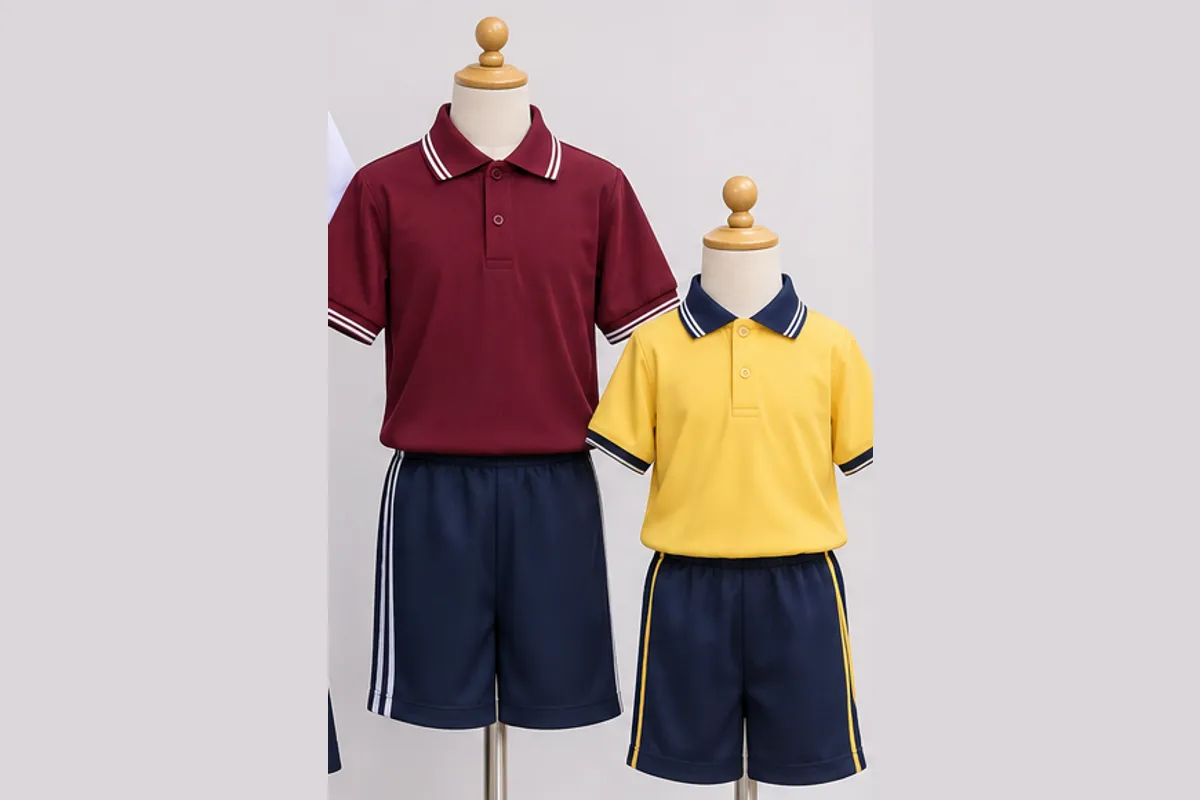
PT shirts for school are usually made with one of three necklines: a crew neck, a V-neck or a polo collar. The crew neck is the most common, because it is simple, hard-wearing and easy to pull on; the V-neck feels a little cooler and looks sportier; the polo collar is chosen when the shirt doubles as smart sportswear for fixtures. The right choice depends on how and where the shirt is worn.
“PT shirt” is the term many schools in India and the Gulf use for what UK schools call a PE T-shirt. Whatever the name, the neckline decision is the same.
What does each neckline involve?
Crew neck
A crew neck is a round neckline finished with a band of rib. It sits close to the base of the neck. It is quick to make, simple to size and suits every age group. The rib width can be narrow for a lighter look or a little wider for a sturdier collar.
V-neck
A V-neck is cut to a point at the front and finished with rib that is joined at the point, either overlapped or mitred. It opens the neckline slightly, which some schools prefer for hot weather. It takes more care in making, because the point must sit centrally on every shirt.
Polo collar
A polo collar is a flat knitted collar with a short buttoned placket. On PE kit this is normally the sports polo, made in polyester knit. It looks neater for matches and trips, but it is a separate style with its own construction.
Comparing the three
| Feature | Crew neck | V-neck | Polo collar |
|---|---|---|---|
| Look | Plain, everyday | Sporty, open | Smart, team wear |
| Ease of dressing for young children | Very easy | Easy | Buttons slow things down |
| Neck finish | Rib band | Rib band with a point | Knitted collar and placket |
| Logo position | Left chest or centre chest | Left chest | Left chest, usually embroidered |
| Typical use | Daily PT lessons | Older students, warm climates | Fixtures, teams, staff-led events |
Which neckline suits which students?
For nursery and lower primary classes, a crew neck is the practical default. Children can change quickly without help, and there are no buttons or points to go wrong.
For older students, a V-neck is a reasonable option if the school wants a sportier look. Some schools keep the crew neck for juniors and offer the V-neck from a certain age band upward. That creates two styles, each with its own minimum, so check your quantities before splitting.
For teams and representative sport, the polo collar is common. Our minimum for PE kit is 100 pieces per style, so a sports polo for a small team is often planned across several year groups or combined with reorders.
Details to agree for any neckline
The neckline is where a T-shirt first shows wear. Before approving a sample, check:
- The rib springs back after being stretched over the head
- The neck opening is large enough for the size, but not loose
- The back neck is taped or neatly finished, so it does not scratch
- On a V-neck, the point is central and lies flat
- The neck label sits flat and does not catch on the rib seam
You can ask for the neck rib in the body colour or in a contrast colour. A contrast rib, such as navy on a white shirt, is a small detail that makes plain PT shirts look finished.
Making the decision
Most schools need only one neckline for daily PT. Choose a second only when there is a clear reason, such as a sports polo for fixtures. If you are a school deciding the kit for the first time, our page for schools and school groups explains how we take an order from enquiry to dispatch. The styles we make, from PT shirts to shorts and sports polos, are on our PE kit and sports uniforms page.
We manufacture in India and make a sample of the shirt before bulk production, so you can try the neckline on students of different sizes. Tell us the neckline, the fabric and your size range, and we will quote it by fabric, quantity and branding.
Questions buyers ask
Is a PT shirt the same as a PE T-shirt?
Yes. PT stands for physical training, and it is the term many schools in India and the Gulf use. A PT shirt and a PE T-shirt describe the same garment, worn for games and physical education lessons.
Can the neckline differ between house colours?
It is possible but rarely useful. Keeping one neckline across all house colours means one pattern, one sample and simpler reorders. Differences between houses are better shown by colour and printed names than by changing the shape.
Does a V-neck need a different size chart?
Usually not. The body measurements stay the same, and only the neck opening changes. We confirm the neck depth on the sample so it suits each size in your range.