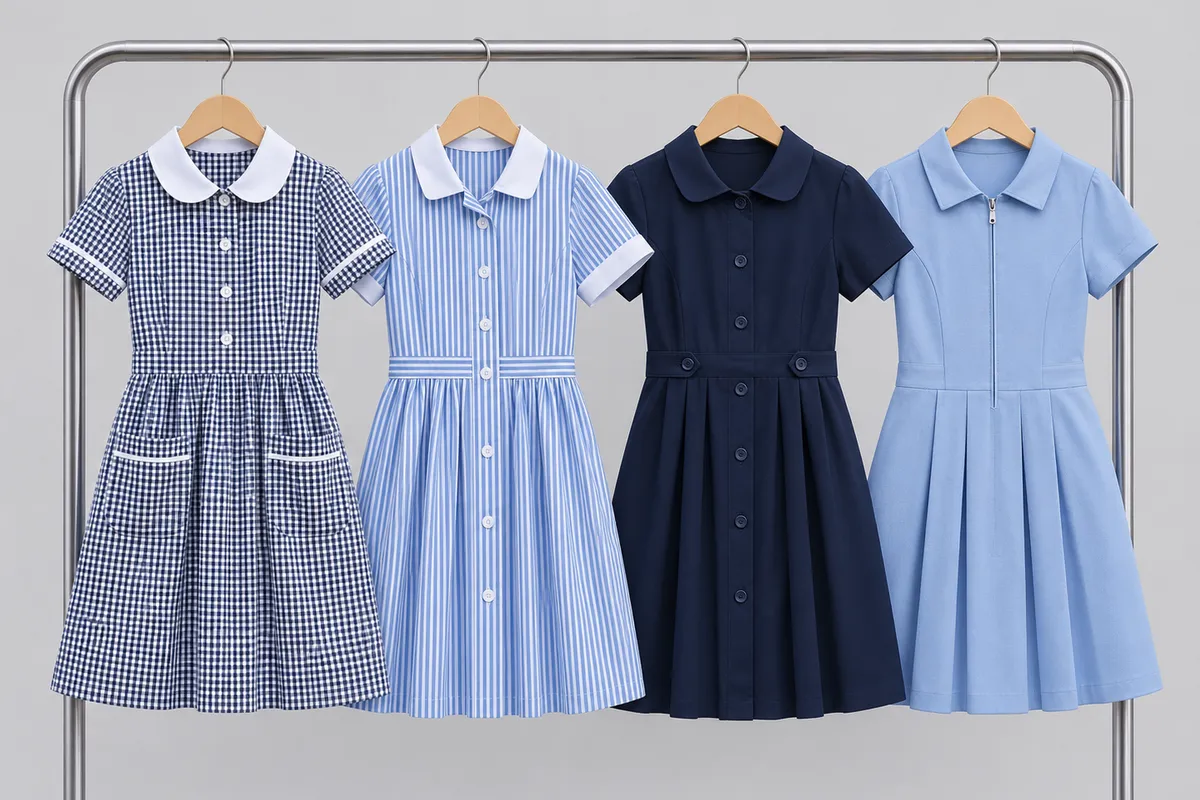
A primary school dress colour is normally a mid-tone gingham, such as blue, red or green on white, chosen to match the school jumper and to cope with paint, grass and lunch. Younger pupils are hard on clothes, so primary schools tend to favour a medium shade with a small or medium check rather than a pale shade or a very large repeat.
This guide is for primary heads, business managers and the shops that supply them, deciding the summer dress colour for children aged roughly four to eleven.
What makes primary different from secondary?
The dress itself is similar at both stages, but the wearers are not. Primary children sit on floors, paint, play on grass and eat at their desks. Families also wash dresses far more often in the warm months. These habits push the colour choice in a few clear directions.
| Factor | What it means for the colour |
|---|---|
| Frequent marks | Mid-tones hide spills better than pastels |
| Frequent washing | A shade that still looks right after many washes matters more than a striking one |
| Small sizes | A large check can swamp a small dress; a smaller repeat looks tidier |
| Visibility on trips | A bright shade is easy for staff to spot in a crowd |
| Hand-me-downs | A colour that stays the same for years lets dresses pass between siblings |
| Link to the jumper | Children wear cardigans over dresses on most mornings |
Secondary schools, by contrast, often move away from gingham for older girls or choose a stripe to look more grown-up. That is a separate decision from the primary dress.
Which shades suit younger pupils?
There is no single correct shade, but some work more easily in primary settings than others.
Blue. A mid or royal blue gingham is the most familiar summer dress colour. It pairs with navy, royal and grey, and it hides everyday marks reasonably well.
Red. Easy to see from across a field, and a natural match for red or grey knitwear. A deeper red keeps its look longer than a bright, light red.
Green. Suits schools with a green jumper. Bottle or mid green works better than a pale mint, which shows grass and food marks quickly.
Yellow. Cheerful and distinctive, often chosen to stand apart from neighbouring schools. Pale yellow does show marks, so a gold tone is a safer choice for younger children.
Lilac or purple. Less common, used by schools whose badge or jumper is purple. It can be matched from a reference.
Choosing with the whole class in mind
When a school sets its dress colour, it is choosing for every family in the school, often for many years. A few practical checks help the decision hold up.
- Hold the gingham swatch against the school jumper or cardigan in daylight
- Look at it from across a room, as staff will see it
- Ask whether the shade will still look right next to older, washed dresses
- Check that boys’ summer items (polos, shorts) sit comfortably beside it
- Confirm whether the collar is white or the dress fabric
- Decide whether the dress carries a logo or stays plain
The last point matters for primary schools in particular. A plain gingham dress in a common shade is easier for families to find second-hand and easier for local shops to keep in stock. A logo makes the dress unique to the school, which some schools prefer for identity on trips. Our page for schools and school groups explains how schools order direct or through a shop.
Fixing the shade once it is chosen
Once the school agrees a colour, the exact tone needs pinning down so that each delivery matches. Send us the current dress, a piece of fabric or the school jumper. We match the colour and check size, send a swatch, and make a sample dress after you approve it. Every later order is made to that approved sample.
If the school is new, or has no dress yet, we can send swatches of the usual shades so the governors or head can choose from real fabric rather than a printed picture.
The minimum is 50 pieces per colour and style, with sizes mixed within that. See the gingham and stripe options on our school summer dresses page. Send us the chosen shade, the jumper colour and your size range, and we will quote per style, by fabric, quantity and branding.
Questions buyers ask
Should a primary school dress match the PE kit colour?
It does not have to. PE kit often uses house colours or a bright school colour, while the dress follows the jumper. What matters most is that the dress and the knitwear worn over it look right together on the same child.
Is pastel gingham a good idea for infants?
Pastel gingham looks gentle on small children but shows paint, food and grass marks more readily. Many infant and primary schools choose a mid-tone instead, which still looks fresh after a term of washing and wear.
Can a group of primary schools share one dress colour?
Yes. A trust or group can use one gingham shade across its schools and tell them apart with a logo on the chest or pocket, or with different knitwear. One shade also simplifies stock for the shop that serves them.