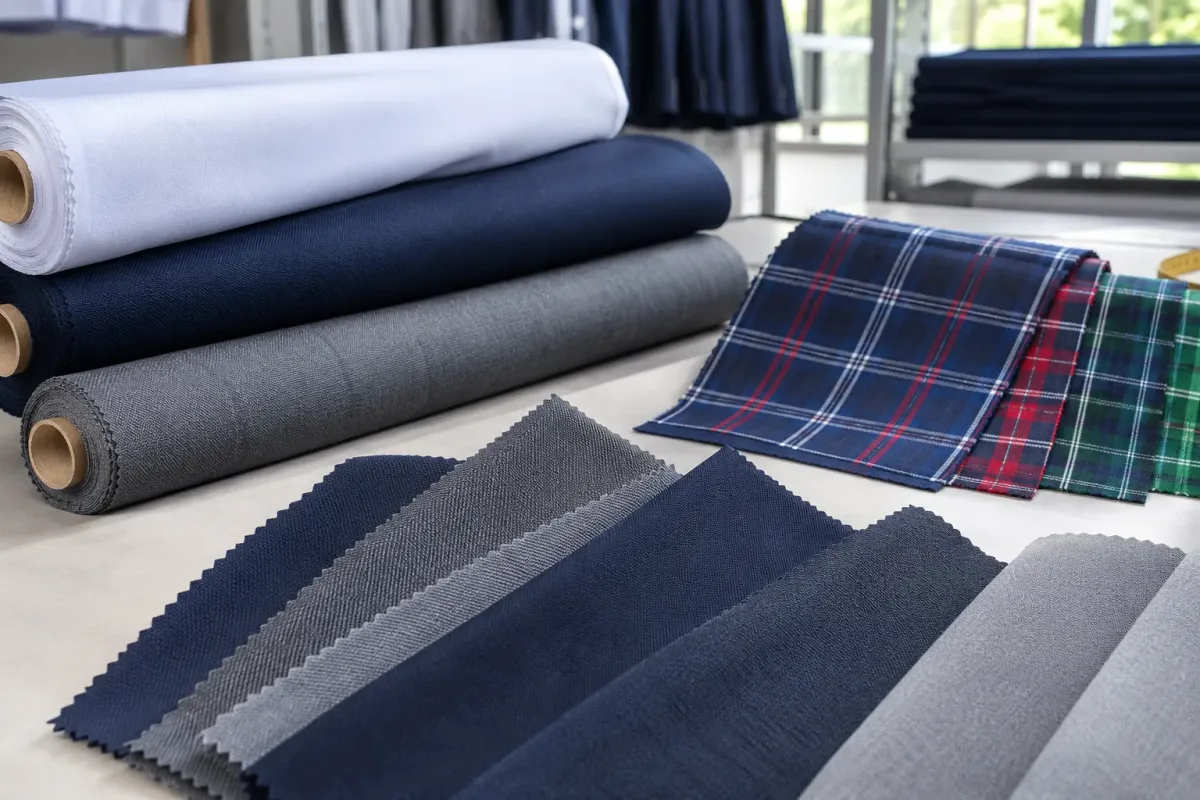
For most school shirts and blouses, poly-cotton poplin is the practical choice: it is smooth, light, quick to dry and easy to iron. Oxford suits a senior or sixth-form shirt where the school wants a heavier, more textured look and is happy for it to sit at a different point on the shelf.
Both are woven fabrics, and both are made into school shirts in our production. The choice is less about which is “better” and more about who wears the shirt, how often it is washed, and what the school wants the uniform to say.
How the two fabrics differ
Poplin is a plain weave with fine, tightly packed yarns. The surface is flat and slightly smooth to the touch. In a poly-cotton blend, the polyester helps the shirt keep its shape and dry quickly, and the cotton gives a softer hand than all-polyester cloth.
Oxford is a basket weave, where yarns are grouped in pairs. That gives a visible small texture, a slightly thicker cloth and a more casual, collegiate look. It is often paired with a button-down collar.
| Point to compare | Poly-cotton poplin | Oxford |
|---|---|---|
| Surface | Smooth and flat | Visible basket texture |
| Feel | Light and crisp | Thicker and softer |
| Drying after washing | Quick | Slower, as the cloth is heavier |
| Ironing | Easy; creases come out quickly | Takes a little longer |
| Look with a tie | Formal and neat | Smart but more relaxed |
| Typical wearers | All ages, from age 3–4 upwards | Older students, often from age 7–8 |
| Our styles | Long sleeve, short sleeve, revere-collar blouse | Oxford shirt |
The table describes general traits of the two weaves. Exact handle depends on the specific cloth, so judge it on a swatch and the approved sample rather than on a description.
Matching fabric to the wearer
Think about who washes the shirt and how often. A primary pupil may go through several shirts a week, washed at home and often not ironed. Poplin copes well with that cycle: it dries overnight and looks tidy with little effort.
For senior students, some schools prefer a shirt that looks different from the junior one. An Oxford shirt does that without a change of colour. It is also a common choice where the uniform is designed to look closer to office wear.
There are trade-offs to weigh as a buyer:
- Range simplicity. One poplin shirt across all ages means fewer styles to reach the minimum and fewer lines to manage in stock.
- Shelf position. Oxford gives a shop a second shirt at a different point in the range, but it is a separate style with its own minimum.
- Matching blouses. Our revere-collar blouse is made in poplin. If girls and boys should match closely, poplin for both keeps the colour and texture the same.
Colour and shade
Fabric choice affects colour too. White poplin looks bright and even. White Oxford looks slightly softer because of its texture, even in the same shade. Pale blue Oxford often shows a gentle two-tone effect from the weave.
If you need a shirt to match one you already sell, send us the shirt or a cutting. We match the shade and send it for approval before cutting. Our page on fabrics and colour matching sets out how that approval works.
One practical point: if you plan to sell poplin and Oxford shirts side by side in the same colour, approve both shades together. Two weaves can read differently under shop lighting even when both match the reference.
Construction that matters as much as cloth
Good fabric can still make a poor shirt. When you review a sample, look beyond the cloth:
- Collar sits flat and holds its shape after a wash
- Seams are straight, with no puckering along the side seams
- Buttons are firmly attached and buttonholes are clean
- Pocket, if any, is level and stitched square
- Hem length allows the shirt to stay tucked in
- Logo, if any, sits where agreed and does not pull the fabric
- Neck label is soft enough not to irritate
Wash the sample at home the way a family would, then check it again. That tells you more about how the shirt will be received than any description of the cloth. Our minimum order and samples page explains how the sample stage fits before production.
Making the decision
If you are building a range from scratch, start with poplin for every age group. Add an Oxford shirt only if a school asks for a distinct senior look, or if you want a second shirt at a different point in your range. If you are replacing a shirt you already sell, send it to us and we confirm the fabric in the quotation, so families see no change when the new stock arrives.
You can see all four shirt styles on our school shirts and blouses page. Send us your styles, colours and a current shirt if you have one, and we will quote each style by fabric, quantity and branding.
Questions buyers ask
Does an Oxford shirt have to have a button-down collar?
No. A button-down collar is a common pairing with Oxford cloth, but a standard shirt collar can be specified instead. Schools that require a tie often choose the standard collar, and the chosen collar is shown on the sample.
Can poplin and Oxford shirts share one size chart?
They can start from the same measurements, but the thicker Oxford cloth can feel closer at the chest and collar. Agree a chart for each style, and try the Oxford sample on a student before you approve it.
Which shirt fabric suits a hot climate?
Poly-cotton poplin is the lighter of the two and dries faster, so it is the usual pick for warm countries, often in short sleeves. Oxford is heavier and can feel warm in hot weather, so it tends to suit cooler terms.