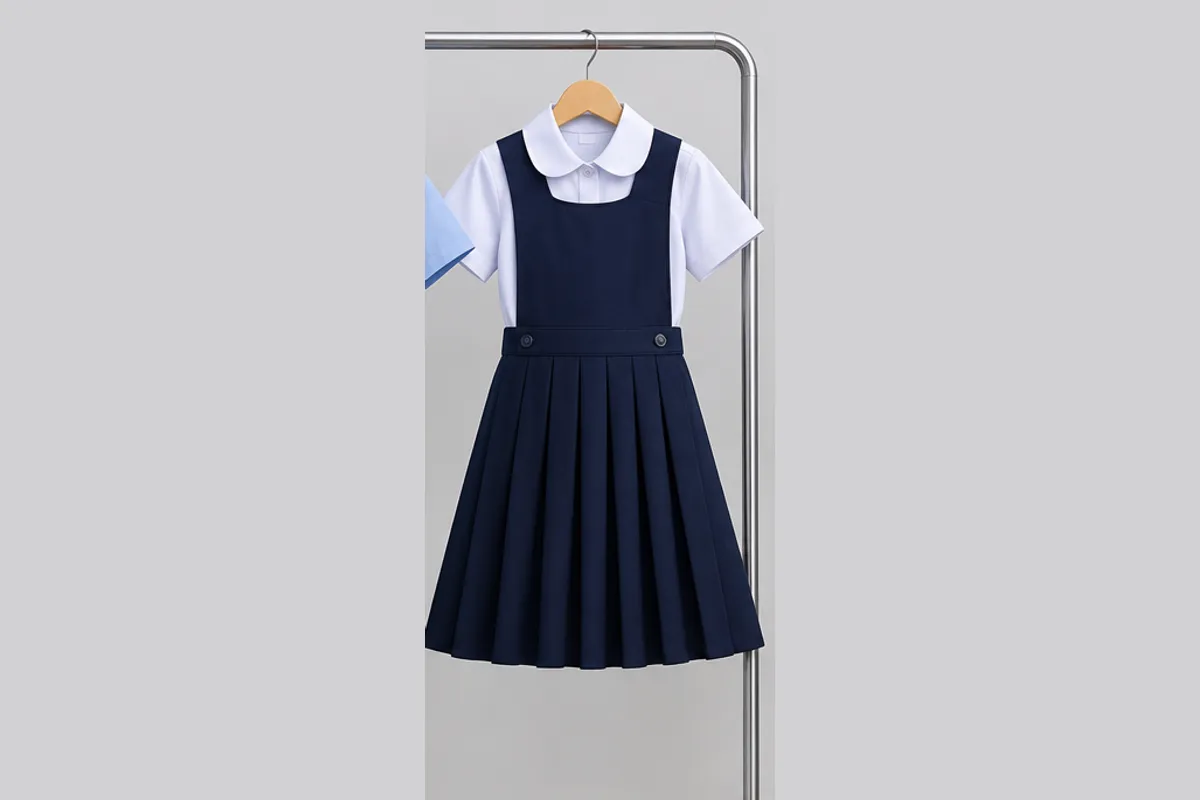
A poly viscose pinafore is made from a woven blend of polyester and viscose, which gives a softer handle and a smoother, more tailored drape than an all-polyester cloth. Buyers choose it mainly when the school’s skirts or trousers are already poly-viscose, so the pinafore sits beside them as one uniform, and when a slightly dressier look matters. It still needs sensible care to keep pleats sharp and avoid shine.
It is one of the two fabrics we make pinafores and tunics in, alongside polyester twill. The fabric is confirmed at quotation.
What is poly-viscose?
Poly-viscose is a blend of two fibres. Polyester brings strength and helps the fabric keep its shape. Viscose, a fibre made from wood pulp, brings softness, drape and a less shiny surface. Woven together, they produce a cloth widely used for school skirts, trousers and blazers as well as pinafores.
The blend ratio and weave vary between fabrics, so the actual cloth for your order is shown as a swatch and on the sample, not described by a number.
What it does well on a pinafore
| Quality | What it means for a pinafore |
|---|---|
| Softer handle | More comfortable on bare arms at the armhole and against the blouse |
| Tailored drape | Pleats fall smoothly and the skirt moves naturally |
| Matt to soft sheen surface | Looks smart, close to a traditional wool-look uniform cloth |
| Consistency with other garments | Matches poly-viscose skirts, trousers and some blazers well |
| Takes colour evenly | Deep navy, bottle green and maroon look rich |
Things to keep in mind
No fabric is perfect for every order. With poly-viscose:
- Pleats need pressing. The softer drape means pleats can relax over time, especially if dried in a heap. Stitched-down pleats and a good care note help.
- Ironing temperature matters. Too hot an iron can leave shine on dark shades. Pressing through a cloth avoids it.
- Creasing. A softer cloth creases a little more after a day of sitting, though creases usually drop out on a hanger.
These are normal behaviours of the fabric, and families who are told about them rarely complain.
When poly-viscose is the right choice
Choose it when:
- The school’s skirts or trousers are poly-viscose and you want the pinafore to match them in surface and drape as well as colour.
- The school wants the junior uniform to look as smart as the senior one.
- You are making a pleated pinafore dress or a tunic, where drape shows most.
Polyester twill may suit better where a crisp, firm finish and quick drying are the priority. If you are not sure, send us the garment your pinafore will be worn beside, and we suggest the closer fabric.
Matching colour across poly-viscose garments
When a pinafore, skirt and trousers are all poly-viscose, matching the shade is more straightforward than across different fabrics, because the same fibres take dye in a similar way. Even so, separate dye lots can differ slightly, so we send a swatch for approval against your reference before cutting. Our fabrics and colour matching page describes that step.
We manufacture in India, and every approved swatch and sample becomes the reference for later orders. The pinafore and tunic styles we make in poly-viscose are on our school pinafores and tunics page, from 50 pieces per style.
Care notes shops can share
- Wash at a moderate temperature with similar colours
- Hang to dry, smoothing the pleats into place
- Press along the pleat folds through a cloth
- Avoid high heat in a tumble dryer
Tell us which fabric your current pinafores are made from, or send one, and we will quote per style, by fabric, quantity and branding.
Questions buyers ask
Is poly-viscose more expensive than polyester twill?
The two fabrics are priced differently, and the difference depends on the cloth chosen and the quantity. We quote each style by fabric, so ask for both if you want to compare them on the same order.
Does poly-viscose fade?
Any dyed fabric can lose depth over many washes, especially in hot water or strong sunlight. Washing at moderate temperatures, inside out, and drying out of direct sun helps a poly-viscose pinafore keep its colour.
Can a poly-viscose pinafore be tumble dried?
Low heat is gentler on the fabric and the pleats. High heat can set creases in the wrong places and flatten pleats, so hanging to dry is the safer advice for families.