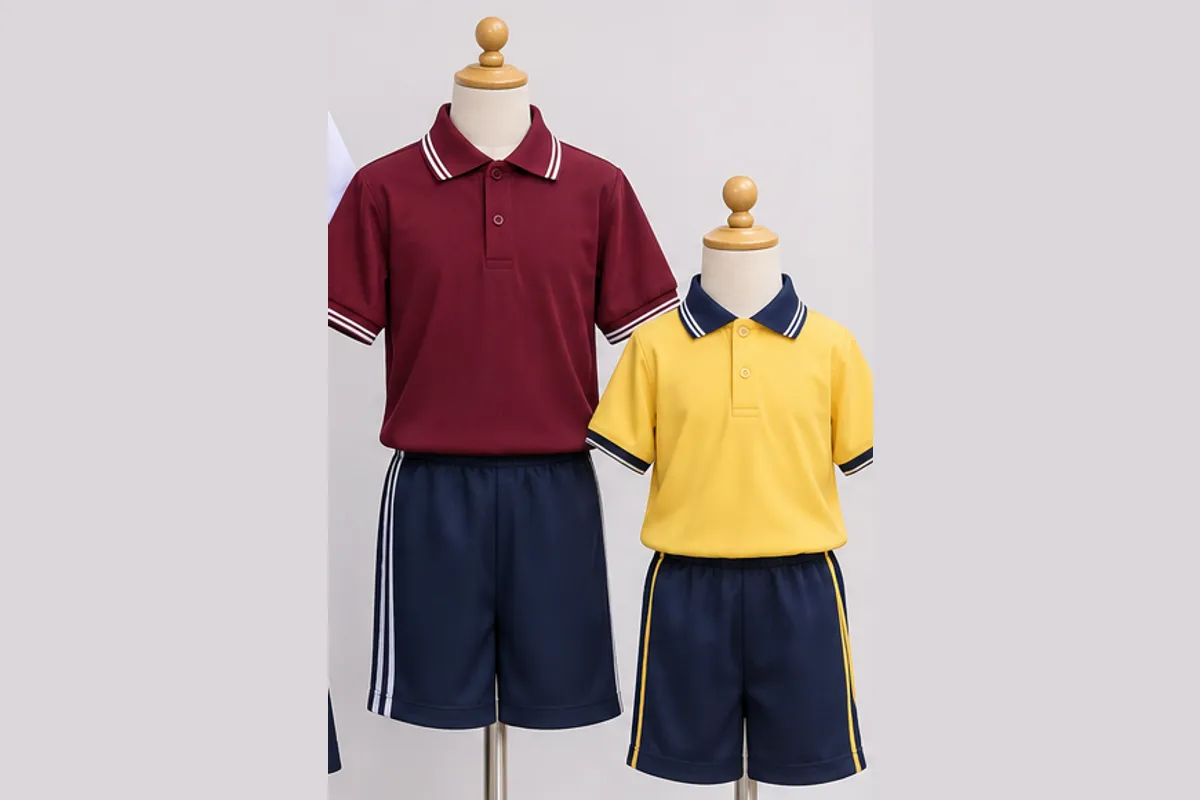
Pockets on PE shorts are optional, and for most school kit the plain answer is to leave them off. Students rarely need to carry anything during a lesson, and pockets add weight, seams and things to lose. Side-seam pockets can make sense for senior students or for shorts also worn on trips and casual days, and they are agreed at quotation and checked on the sample.
The decision is small, but it affects comfort, the quotation and how the shorts behave in games.
Why many schools choose no pockets
PE lessons are short and supervised. Phones, keys and money are usually left in a locker or bag. A pocket full of small objects is a hazard in contact games and gymnastics, and it bounces when the student runs.
Without pockets:
- The shorts are lighter and simpler to make.
- There are fewer seams to rub or tear.
- Nothing can be left in them and lost in the wash.
- The fit is cleaner over the hips.
For nursery and primary sizes, that settles it. Pockets on very small shorts are rarely used for anything but sand and stones.
When a pocket earns its place
Some situations make pockets worth considering:
- Senior students. Older students may carry a locker key or a small card between lessons.
- Shorts worn beyond PE. If the shorts double as summer casual wear or trip kit, pockets add everyday usefulness.
- Team kit for travel. Squads travelling to fixtures sometimes want shorts that work off the pitch, on the bus and at the venue.
If only senior sizes get pockets, those shorts become a separate style with a minimum of 100 pieces.
Pocket types compared
| Type | How it works | Points to weigh |
|---|---|---|
| Side-seam pocket | Opening hidden in the side seam | Neat, common, does not change the look |
| Zipped side pocket | Side-seam pocket closed by a zip | Holds a key securely; adds a zip to the wash |
| Back patch pocket | Patch sewn on the back | Easy to make; can bounce when full |
| Small key pocket | Tiny inner pocket at the waistband | Discreet; holds only a key or card |
For knitted PE shorts, a side-seam pocket is usually the tidiest choice. The pocket bag needs to be a light fabric so it does not show through the outer knit or pull the shorts down.
Things that go wrong with pockets
Pockets on knitted shorts bring a few problems you can prevent at sample stage:
- The pocket opening stretches and gapes after a few washes
- The pocket bag shows through a light outer fabric
- The pocket bag is too deep and flaps against the thigh
- Stitching at the pocket corners comes undone
- A zip scratches the skin or catches other kit in the wash
A small bar tack at the top and bottom of each pocket opening reduces strain. Ask for it if you add pockets.
Our suggestion for most orders
For daily PE, plain shorts without pockets are the sensible default. Offer a pocketed version only when there is a clear use. Uniform shops that sell to several schools can keep one plain style and add a pocketed style for the one school that asks for it; our page for uniform shops and retailers covers how separate styles are handled.
We make PE shorts in polyester knit with an elastic waist, and the full range is on our PE kit and sports uniforms page. Tell us whether you want pockets, which type and in which sizes, and we will quote by fabric, quantity and branding.
Questions buyers ask
Do pockets change the size of PE shorts?
No. The waist, hip and length measurements follow your size chart. A pocket bag sits inside the existing shape, so the fit is unchanged if the bag is cut to the right depth for each size.
Are zipped pockets a good idea for school kit?
They secure a key, but they add a metal or plastic part that can scratch in games and catch in the wash. For most school PE, a plain side-seam pocket or no pocket is simpler.
Can pockets be added to an existing shorts style later?
Yes, but the new version is a different style. Keep the plain style if it sells well, and introduce the pocketed one on a fresh order, so the two are not mixed on the shelf.