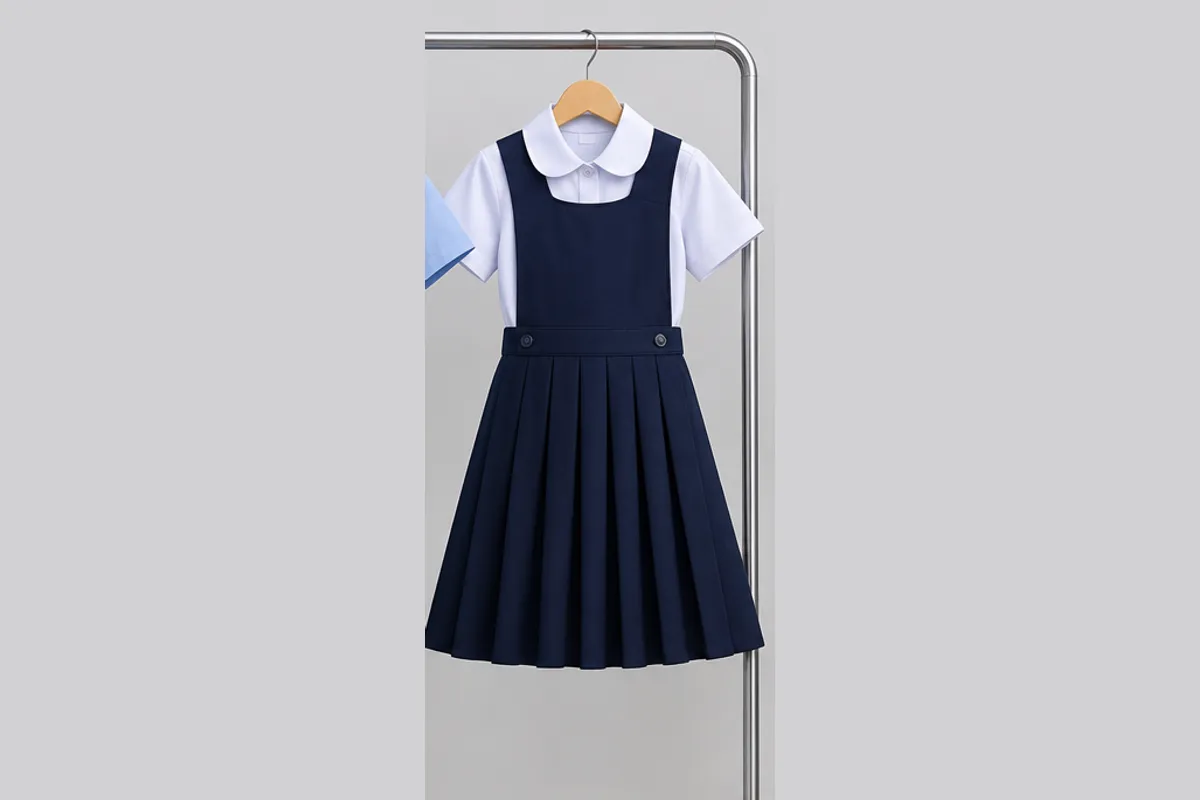
We make pinafores and tunics in poly-viscose or polyester twill, and the choice between them is mainly about handle, appearance and matching what you already sell. Construction matters just as much: how the pleats are set, how deep the hem is and where the fastenings sit decide how a pinafore looks after a term of wear.
This post sets out the fabric and construction points a trade buyer should agree before bulk production, and what to look at when the sample arrives.
Poly-viscose or polyester twill
Both fabrics are woven and both are used for school pinafores, skirts and trousers. Neither is right for every order.
Poly-viscose has a softer handle and a slightly duller, more tailored finish. Many schools use it across skirts, trousers and pinafores so the whole uniform looks the same. If your current skirts are poly-viscose, a poly-viscose pinafore will usually sit beside them more naturally.
Polyester twill has a firmer, crisper handle and a diagonal twill weave you can see up close. It tends to hold a set pleat well and is a common choice for hard-working garments in the younger years.
The practical rule is to start from the garments the pinafore will be worn with. Send us a skirt, a pair of trousers or a fabric cutting, and we match the colour and suggest the closer fabric. The fabric is confirmed at quotation, and a swatch comes to you for approval before cutting. Our fabrics and colour matching page explains how the swatch stage works.
Construction points to agree
Fabric is only half of the garment. The table below lists the construction details that change how a pinafore wears and how long it fits, with what to tell us for each.
| Construction point | Options to specify | Why it matters |
|---|---|---|
| Pleats | Knife, box or inverted; number of pleats; stitched down at the top or open | Stitched-down pleats keep the shape over the hips; open pleats give more movement |
| Hem | Hem depth; blind-stitched or machine-stitched | A deeper hem leaves room to let the length down as a child grows |
| Straps | Width; straight or crossed at the back; length | Strap length sets how high the bib sits and how long the fit lasts |
| Fastening | Buttons on straps or at the side, or a front zip | Fastening position decides how easily a child dresses and how far the fit adjusts |
| Bodice | Fitted or straight; lined or unlined, as specified | A fitted bodice looks smarter; a straight one fits a wider range of children |
| Pockets | None, side seam or patch pocket | Pockets add use but also add fabric and sewing steps |
| Seams | Seam finish on the inside | Neat finishes stop fraying on garments that are washed often |
| Label | Your woven or printed back neck label, with a size and care label | Own labels let a shop sell one style to several schools |
If you send a pinafore you sell now, we follow it for each of these points. If you are starting fresh, tell us what matters most, for example ease of dressing or a pleat that stays sharp, and we propose a construction for the sample.
Pleats, hems and growth
Pinafores are worn mostly by younger children, who grow quickly. Two construction choices help a garment keep fitting.
The first is the hem allowance. A deeper hem can be let down by a parent, which adds length without a new garment. It uses a little more fabric per piece, so it is a decision for you to weigh, not a default.
The second is adjustable straps. On a bib pinafore, a second button position on each strap lets the bib be raised or lowered. On a zip-front pinafore, the fit adjusts less, so the size chart matters more.
Pleats need their own decision. Pleats that are stitched down for a short distance from the waist hold the line of the skirt and look tidy for longer. Open pleats from the waist give more movement but can spread over time. Pleat depth and count also change fabric use, which shows in the quotation.
Tunics: what changes
A tunic is longer through the body and is often worn by older girls, up to age 13–14 in our listing. For a tunic, agree:
- the finished length for each size, because a small difference shows more on a longer garment
- whether there is a belt or sash, and how it is held in place
- the pleat style, if any, so it matches the school’s skirts
- the opening position, so it sits neatly under a blazer or jumper
The fabric choice follows the same rule as for pinafores: match what the tunic is worn with.
Checking the sample
When the sample arrives, check it against your specification before you approve it:
- Colour against your reference, in daylight
- Fabric handle against the skirts or trousers it sits with
- Pleats: count, depth and stitching
- Hem depth and finish
- Strap length, button positions or zip length
- Logo position and size, if embroidered
- Labels: neck label, size label, care label
Once you approve the sample, bulk production follows it, and repeat orders are made to the same sample. The minimum is 50 pieces per style, with sizes mixed within it. You can see every style and fabric on our school pinafores and tunics page.
To get a quotation, send the style, your fabric preference or a reference garment, the construction points above and your size mix. We quote per style, by fabric, quantity and branding.
Questions buyers ask
How should a pleated pinafore be washed and pressed?
A moderate wash, drying on a hanger and pressing along the original folds keep pleats in shape. Press through a cloth to avoid shine on darker shades. The care wording on the label is printed as you specify.
Can a pinafore match the colour of a blazer?
The shade can be matched, but a blazer cloth is usually heavier than pinafore fabric, so the two may read slightly differently. Send the blazer as your reference and judge the swatch beside it in daylight before you approve.
Should pinafores and tunics be produced together?
Ordering both in one run, in the same fabric and shade, helps the colour stay consistent between them. If they are ordered separately, each is matched to the same approved swatch, so keep a piece of it for comparison.