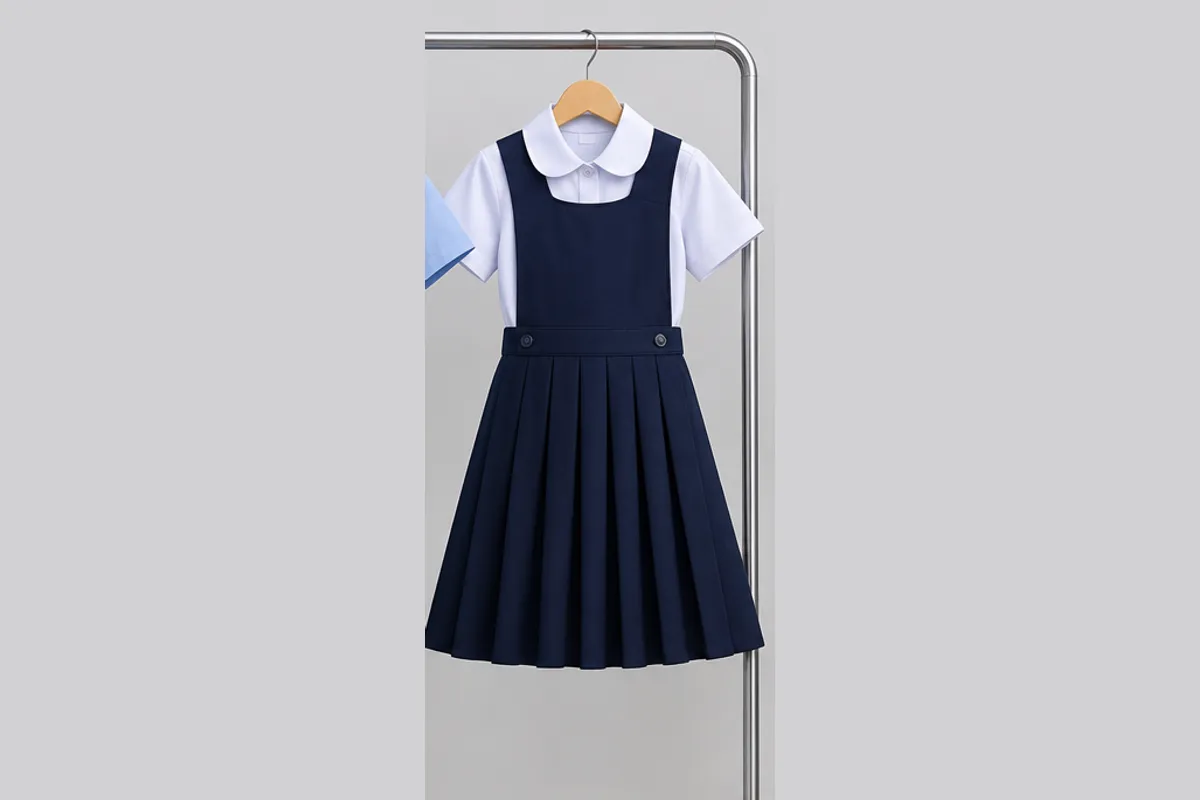
Pinafore logo embroidery usually sits in the centre of the bib on a bib pinafore, or on the left chest of a pleated pinafore dress, zip-front pinafore or tunic. The logo should be sized to fit the panel with a clear margin, stitched on a stabilised, preferably lined area so it lies flat, and checked on the sample before bulk. Many shops leave pinafores plain under their own label instead, so one style serves several schools.
Where the logo goes on each style
| Style | Usual logo position | Why |
|---|---|---|
| Bib pinafore | Centre of the bib | The bib is a flat, visible panel; the logo is the focal point |
| Pleated pinafore dress | Left chest on the bodice | Leaves the neckline clear; matches blazer and jumper placement |
| Zip-front pinafore | Left chest, beside the zip | The zip occupies the centre |
| Tunic | Left side of the yoke | The yoke is flat; pleats below would distort it |
A logo should never cross a seam, a pleat or a fastening. If the panel is too small for the logo the school wants, either reduce the logo or choose a different position.
How big should it be?
Size depends on the panel and the child. A logo that fits a blazer pocket may overwhelm a small bib on an age 3–4 pinafore. Some schools keep one logo size across all pinafore sizes for simplicity; others use a smaller logo on the smallest sizes. A practical test is to print the logo at the proposed size on paper, cut it out and hold it against the smallest pinafore you will sell; if it looks crowded there, it needs reducing. Using two sizes means two sets of embroidery work, which shows in the quotation.
Logo method, size and position are confirmed with the sample, so you see the actual result before agreeing to bulk.
Keeping embroidery flat on woven fabric
Dense embroidery pulls on woven cloth and can pucker it. Several steps prevent that:
- Stabiliser behind the embroidery supports the fabric while it is stitched.
- A lined or faced bib gives a firmer base and hides the back of the stitches.
- Sensible stitch density. A logo with large solid areas may be simplified slightly for a small panel.
- Thread colours matched to your artwork, chosen to stand out against the pinafore colour.
Check the back of the embroidered area on the sample too. Scratchy stitches against the blouse are a common complaint on unlined bibs.
Embroidery or printing?
Logo embroidery or printing is available. On pinafores, embroidery is the usual choice because it looks traditional on woven fabric and lasts through many washes. Printing suits flat, simple artwork and is more common on sportswear. If you are unsure, tell us the look you want and we advise on the sample. How to send artwork is explained on our page on logos, embroidery and labels.
Plain pinafores with your own label
For a uniform shop serving several schools, a plain pinafore is often the better buy. It sits on any school’s list that uses the colour, and you sell it under your own woven or printed label. A school-specific logo turns it into a single-school style, which ties up stock. Our page for uniform shops and retailers covers own-label ranges.
For your enquiry
- Logo or plain
- Position on each style
- Logo size, or one size for the smallest and one for the largest
- Artwork file and thread colours
- Label: yours or ours
We manufacture in India and each school’s logo makes its own style, with a minimum of 50 pieces. The styles are on the school pinafores and tunics page. We quote per style, by fabric, quantity and branding.
Questions buyers ask
Can the logo go on the pinafore skirt instead?
It can, but a skirt panel with pleats is a poor base for embroidery: the stitches distort the folds and the logo moves out of shape as the child walks. A flat bib, bodice or yoke gives a cleaner result.
Will embroidery survive frequent washing?
Embroidery stitched on a stabilised base generally lasts the life of a school garment. Washing inside out at a moderate temperature protects the threads and keeps colours bright.
Can different logos share one pinafore pattern?
Yes. The pattern stays the same and only the logo changes. Each logo counts as its own style for the minimum, because the finished garments are different.